MARINER: Unlocking Advanced AI for Unprecedented Maritime Intelligence and Safety
Explore MARINER, a groundbreaking 3E-driven benchmark for fine-grained maritime perception and complex reasoning. Learn how it pushes AI models beyond basic detection for safer, smarter open-water operations and intelligent maritime management.

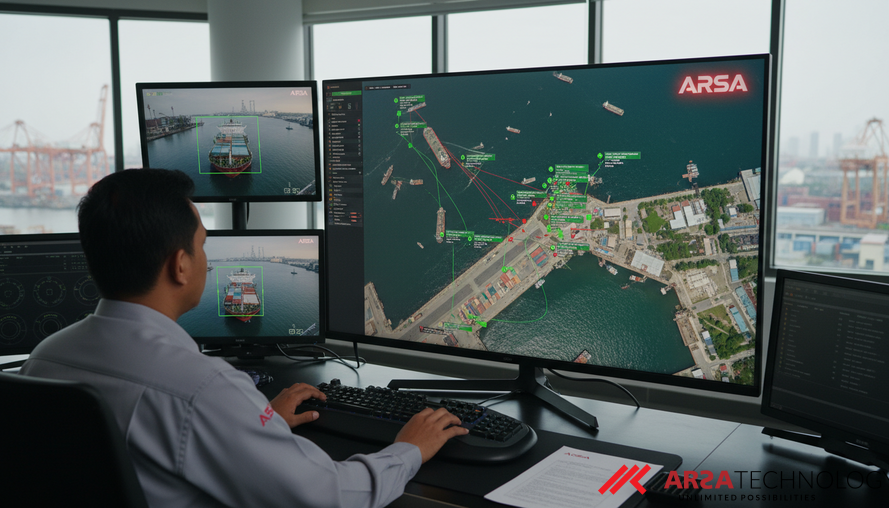
The world's oceans are vital arteries for global trade, defense, and recreation, making the maritime domain a critical area for technological advancement. As the vision of autonomous shipping and intelligent maritime management rapidly approaches, the need for sophisticated AI systems that can accurately interpret and reason about complex open-water environments becomes paramount. Unlike the controlled conditions of land-based operations, the marine world presents unique challenges: unpredictable weather, intricate vessel interactions, and dynamic, often emergent, incidents. These factors demand a new level of intelligence from AI systems, moving beyond simple object detection to comprehensive understanding and causal reasoning.
Recent breakthroughs in Multimodal Large Language Models (MLLMs) offer immense potential for transforming maritime operations. These advanced AI models combine visual understanding with linguistic reasoning, enabling them to process images, video, and text to derive deeper insights. From enhanced security and navigation to optimized logistics and rapid incident response, the applications are vast. However, effectively evaluating these models for the specific demands of the maritime domain has been a significant hurdle due to the lack of dedicated, real-world benchmarks.
Addressing the Gaps in Maritime AI Evaluation
Existing benchmarks designed for maritime environments have primarily focused on basic perception tasks like detecting ships in satellite imagery or identifying general vessel types in near-shore camera feeds. While valuable, these benchmarks fall short in several critical areas necessary for real-world, high-stakes maritime applications.
Firstly, many current datasets suffer from limited granularity. They often classify vessels into broad categories, lacking the fine-grained distinctions crucial for identifying specific types of ships, which can be vital for safety, security, and operational planning. Secondly, there is limited realism in many scenarios. Simplified maritime scenes fail to capture the complexity of open-water settings, including diverse weather conditions, varying lighting, and intricate vessel behaviors that are common in real operations. Finally, evaluation has often been fragmented, assessing individual AI tasks in isolation rather than the integrated perception, spatial understanding, and complex reasoning capabilities that true intelligent maritime systems require.
Introducing MARINER: A Comprehensive 3E-Driven Benchmark
To bridge these critical gaps, researchers have introduced MARINER, a groundbreaking and comprehensive benchmark specifically designed for fine-grained maritime understanding in real-world open-water environments. The core innovation of MARINER lies in its novel Entity-Environment-Event (3E) paradigm, which structures the dataset to reflect the true complexity of marine scenarios.
The MARINER dataset comprises an impressive 16,629 multi-source maritime images. These images capture 63 distinct, fine-grained vessel categories, allowing AI models to differentiate between subtle variations that are often overlooked. Furthermore, the dataset includes diverse adverse environments—such as fog, heavy seas, and different times of day—and five typical dynamic maritime incidents, ranging from near-collisions to distress situations. This rich data enables the evaluation of AI models across three key tasks: fine-grained classification (identifying specific vessel types), object detection (locating and categorizing objects), and visual question answering (VQA). The VQA component is particularly significant, as it tests not just what an AI "sees," but what it "understands" by asking questions that require perception, spatial reasoning, and complex causal understanding, moving beyond simple data points to cognitive-level analysis. For organizations seeking to build advanced solutions that leverage such nuanced understanding, adopting a custom AI solution tailored to these complexities is crucial. This initiative is detailed in the work by Xingming Liao et al. (2026).
Why MARINER Matters: Benchmarking Advanced AI Capabilities
The initial evaluations of mainstream Multimodal Large Language Models (MLLMs) on the MARINER benchmark have yielded significant insights. Even advanced models, which perform well in general visual understanding tasks, struggle with the fine-grained discrimination and causal reasoning required by MARINER's complex marine scenes. This finding is not a critique of MLLMs but rather a powerful testament to MARINER's ability to expose current limitations and set a new bar for AI performance in the maritime domain.
By systematically assessing how models handle intricate vessel distinctions, challenging environmental conditions, and dynamic incident scenarios, MARINER provides a clear roadmap for future AI research and development. It fills a critical void for realistic and cognitive-level evaluation, driving the development of more robust vision-language models capable of operating reliably in unpredictable open-water environments. This benchmark is poised to accelerate progress towards truly intelligent maritime systems that can perceive, understand, and react with human-like proficiency.
Practical Applications for Maritime Enterprises
For enterprises operating in maritime sectors, the implications of benchmarks like MARINER are profound. The ability to deploy AI systems that offer fine-grained perception and complex reasoning directly translates into tangible business outcomes:
- Enhanced Safety and Security: Accurate identification of various vessel types, even in adverse conditions, is critical for collision avoidance, threat detection, and restricted area monitoring. AI systems capable of understanding dynamic maritime incidents can provide real-time alerts and actionable intelligence, drastically reducing response times and preventing costly disasters. ARSA's AI BOX - Basic Safety Guard, for example, demonstrates how edge AI can provide real-time safety and compliance monitoring, a capability directly transferable to maritime industrial safety.
- Optimized Operations and Logistics: Real-time traffic monitoring, vessel classification, and behavioral analytics can optimize shipping routes, port operations, and resource allocation. By accurately predicting congestion or identifying unusual patterns, AI can streamline logistics and improve overall efficiency. ARSA’s AI BOX - Traffic Monitor is engineered to provide similar benefits for road traffic, showcasing the potential for similar intelligent analytics in maritime traffic management.
- Accelerating Autonomous Shipping: The development of fully autonomous vessels requires AI that can reliably interpret complex visual cues and make informed decisions without human intervention. MARINER provides the rigorous testing ground needed to build and validate such systems, pushing the boundaries of autonomous navigation.
- Improved Compliance and Risk Management: With detailed data and reasoning capabilities, AI can help ensure adherence to maritime regulations, track environmental impacts, and provide comprehensive audit trails for incidents, thereby mitigating risks and supporting compliance.
ARSA Technology, with its expertise since 2018 in AI and IoT solutions, specializes in deploying practical AI systems for various industries, including those with demanding operational environments. Our focus on edge AI, privacy-by-design, and reliable deployment aligns perfectly with the requirements highlighted by the MARINER benchmark. By offering modular AI platforms, including AI video analytics software and edge AI systems, ARSA empowers enterprises to transform their existing infrastructure into intelligent decision engines.
The MARINER benchmark represents a significant leap forward in validating the capabilities of AI for maritime applications. As these intelligent systems continue to evolve, they promise to usher in an era of unprecedented safety, efficiency, and sustainability across the world’s oceans.
Ready to harness the power of advanced AI for your maritime operations? Explore ARSA Technology's innovative solutions and discover how practical AI can deliver measurable impact. Contact ARSA today for a free consultation.