Navigating the Haze: Enhancing UAV Detection and Tracking in Fog with Advanced AI
Discover how cutting-edge AI, including fog-inclusive training and image restoration, empowers unmanned aerial vehicles (UAVs) to detect and track objects reliably in challenging foggy conditions, offering critical advantages for industries.

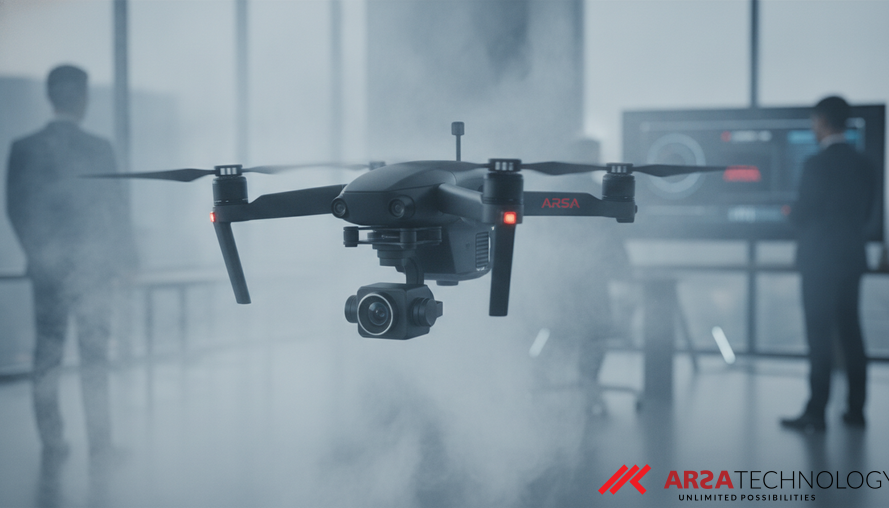
Unmanned Aerial Vehicles (UAVs), commonly known as drones, are becoming indispensable tools across a myriad of industries, from public safety and infrastructure monitoring to logistics and defense. Their ability to gather real-time visual data from expansive areas offers unprecedented operational efficiency and situational awareness. However, the reliability of these systems hinges significantly on their perception capabilities, especially when confronted with adverse environmental conditions. Fog, in particular, presents a formidable challenge, severely degrading visibility and compromising the accuracy of critical tasks like object detection and tracking. This significantly impacts real-world applications where clear sight is paramount for safety and operational success.
Understanding Fog's Impact on UAV Perception
Fog transforms clear skies into hazy canvases, fundamentally altering how light travels and how objects appear in imagery. This atmospheric phenomenon introduces two primary effects: depth-dependent attenuation and additive airlight. Attenuation refers to the scattering of light as it passes through fog, causing distant objects to appear dimmer. Airlight, conversely, is the light scattered from the atmosphere into the camera's line of sight, making the scene appear brighter and reducing the contrast between targets and their backgrounds. These combined effects obscure fine details and reduce the overall clarity of images, making small, distant objects—like other UAVs or ground targets—exceptionally difficult for traditional vision systems to discern.
The challenge is further compounded by the small size of UAVs in long-range aerial imagery. Often, a target drone may occupy only a few pixels, meaning that even a slight reduction in contrast or loss of edge detail due to fog can render it invisible to detection algorithms. For AI models, which rely heavily on distinct visual features to identify and classify objects, fog can lead to a drastic increase in "missed detections" – instances where an object is present but not recognized. This is particularly problematic for critical functions such as sense-and-avoid systems, which are designed to prevent collisions and ensure flight safety. To overcome these limitations, a deeper integration of atmospheric physics with advanced AI techniques is necessary, moving beyond mere image enhancement to a holistic approach that prioritizes operational outcomes under degraded visibility.
Advanced AI for Enhanced Fog Resilience
Addressing the complexities of fog requires sophisticated AI solutions that can robustly process degraded imagery. Researchers have developed comprehensive frameworks that link synthetic fog generation, image restoration, and advanced object detection and tracking within a unified pipeline. The practical difficulty of acquiring and annotating real-world foggy drone footage necessitates the creation of synthetic fog. This involves taking clear-weather images of UAVs and using techniques like monocular depth estimation—determining the distance of objects from a single camera—alongside an atmospheric scattering model, a mathematical representation of how light interacts with fog particles, to generate realistic foggy scenes. This synthetic data is crucial for training AI models for various fog densities.
Two primary strategies emerge for improving AI performance in fog:
- Image Restoration (Dehazing): This involves applying algorithms to foggy images to remove the haze, restoring clarity before they are fed to detection and tracking systems. Modern methods range from classical techniques to those based on deep learning, including Convolutional Neural Networks (CNNs) and transformer-based architectures. These neural networks are AI models that learn to identify and process patterns in images, much like a human brain.
- Fog-Inclusive Training: Instead of first restoring images, detectors can be specifically trained on datasets that include synthetic or real foggy imagery. This teaches the AI to recognize objects even when obscured by haze, rather than relying on a separate restoration step.
Studies show that while image restoration can improve clarity, the quality of this restoration doesn't always directly translate into better detection and tracking performance for downstream tasks. This highlights the importance of evaluating these processes jointly, rather than in isolation. Fog-inclusive training often provides the most consistent improvements in detection robustness. However, test-time restoration proves particularly beneficial when the detection system has only been trained on clear-weather images, offering a crucial layer of adaptability.
Further innovations in AI architecture, such as the proposed Fog-UAVNet discussed in recent research, integrate specialized modules to enhance resilience. These include:
- Spatial-Edge Feature Fusion Module (SEFFM): This module specifically processes visual information to emphasize both the overall context (spatial features) and the boundaries of objects (edge features). In foggy conditions, where edges often blur, intelligently combining these features helps the AI to delineate objects more clearly.
- Frequency-Adaptive Dilated Convolution (FADC): This component dynamically adjusts how the AI "looks" at different parts of an image. It adapts its "receptive field" – the area of the image it considers – based on the fog's density. This allows it to focus on fine details when the fog is light or expand its view for broader context in dense fog.
- Dynamic Task-Aligned Head (DTAH): This module ensures that the AI's two main tasks – classifying what an object is and precisely locating it – are optimally aligned. By dynamically allocating features for each task, it improves both the identification and exact positioning of objects, even under degraded visibility.
These architectural enhancements enable lightweight, real-time perception for UAVs, crucial for onboard deployment where computational resources are limited. ARSA Technology provides advanced AI Video Analytics Software that can be tailored with such robust capabilities for object detection in challenging environments.
The Power of Synthetic Data and Task-Driven Evaluation
The scarcity of annotated real-world foggy datasets for UAVs makes synthetic data generation an invaluable tool for AI development. Researchers leverage sophisticated models like the atmospheric scattering model, combined with monocular depth estimation, to create highly realistic foggy versions of clear-weather images. This process allows for precise control over fog density and severity, enabling the creation of diverse benchmark datasets. By constructing these controlled environments, AI developers can systematically evaluate how different levels of fog impact detection and tracking performance, and how various mitigation strategies perform.
The emphasis on a "task-driven evaluation framework" means that the success of image restoration or fog adaptation is not judged solely by how clear an image becomes, but by how much it improves the actual ability of the UAV to detect and track targets. This holistic approach ensures that AI solutions are developed with real-world operational impact in mind. Datasets like Foggy VisDrone, generated using artificial fog, and other real-world foggy datasets allow for comprehensive testing across various urban and industrial scenarios, validating the model’s effectiveness and generalization capabilities under practical visibility degradation. This approach to dataset creation and rigorous testing is vital for pushing the boundaries of AI in adverse conditions.
Practical Applications and Business Advantages
The ability for UAVs to perform reliably in foggy conditions unlocks significant business advantages and addresses critical operational needs across various sectors. For example:
- Public Safety and Defense: In scenarios requiring surveillance, search and rescue operations, or border security, UAVs equipped with fog-resilient AI can maintain critical situational awareness when human visibility is severely limited. This reduces response times and improves the safety of personnel. ARSA Technology offers Custom AI Solutions designed for such mission-critical applications, ensuring robust performance even under challenging environmental factors.
- Smart Cities and Traffic Management: Fog-proof UAVs can continuously monitor traffic flow, identify congestion, detect accidents, and enforce regulations, contributing to safer and more efficient urban environments. The collection of reliable data in all weather conditions supports better decision-making for urban planners and emergency services.
- Industrial Operations: In large industrial complexes, construction sites, or critical infrastructure, UAVs can conduct automated inspections and safety monitoring, detecting anomalies or ensuring compliance with Personal Protective Equipment (PPE) mandates. Maintaining these operations in fog enhances safety and reduces costly downtime. ARSA's AI Box Series provides robust edge AI systems suitable for rapid, on-site deployment in these demanding industrial environments.
- Logistics and Transportation: Autonomous drone deliveries or inspections of transportation networks can continue with greater safety and efficiency, reducing delays and improving overall operational reliability.
Deploying AI directly on edge devices, such as those within the AI Box Series, is crucial for real-time applications. This "edge AI" approach means that AI processing happens on the drone itself or on nearby local hardware, rather than sending data to a distant cloud server. This drastically reduces latency – the time delay in data transmission – which is vital for immediate decision-making in fast-moving or critical scenarios, ensuring operational reliability and data privacy, especially for organizations operating in diverse industries with strict data sovereignty requirements.
In essence, equipping UAVs with AI that can see through the fog enhances their utility, expands their operational window, and directly contributes to improved safety, efficiency, and significant return on investment for enterprises and government agencies worldwide.
Conclusion
Fog poses a profound challenge to the perception capabilities of unmanned aerial vehicles, threatening their reliability in critical applications. However, cutting-edge research demonstrates that advanced AI techniques, encompassing sophisticated fog simulation, image restoration, and fog-inclusive training, can dramatically enhance UAV detection and tracking performance. By developing AI models that intelligently fuse spatial and edge features, adapt to varying fog densities, and align classification with localization tasks, it is possible to achieve robust, real-time object perception even in severely degraded visibility. This progress is not just an academic achievement; it represents a significant leap forward for industries relying on UAVs for safety, surveillance, and operational efficiency.
To explore how these advanced AI and IoT solutions can transform your operations and enhance your resilience in challenging environments, we invite you to contact ARSA. Our expertise in practical AI deployment can help you leverage the full potential of intelligent systems.
Sources
Pouladi, A., Ahsani, V., Li, H., Najjaran, H., & Suleman, A. (2026). A Task-Driven Evaluation of UAV Detection and Tracking under Synthetic Fog. arXiv preprint arXiv:2607.05467*. Dong, Q., Han, T., Wu, G., Sun, L., & Lu, Y. (2026). Robust Object Detection for UAVs in Foggy Environments with Spatial-Edge Fusion and Dynamic Task Alignment. Remote Sensing, 18*(1), 169.