Navigating the Skies: AI and IoT for Advanced UAV Traffic Management in Complex Wind Fields
Explore how a hybrid AI and finite volume method models complex UAV traffic in 3D wind, enabling safer air mobility and optimized airspace design for enterprises.

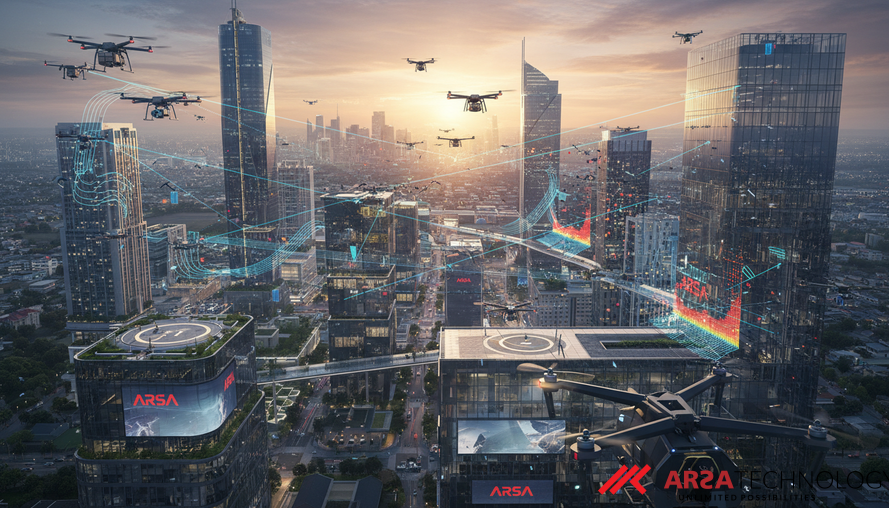
The burgeoning landscape of urban air mobility and large-scale unmanned aerial vehicle (UAV) operations presents unprecedented challenges for airspace management. Moving beyond the planning of individual drone paths, the focus is shifting towards understanding and orchestrating collective UAV behavior at a macroscopic level. This paradigm shift is crucial for designing efficient flight corridors, identifying potential bottlenecks, and ensuring safe operations amidst dynamic environmental factors like wind. A recent academic paper introduces a groundbreaking computational framework that addresses these complexities, offering a robust approach to model UAV traffic in three-dimensional, anisotropic wind fields.
The Evolving Need for Macroscopic UAV Traffic Analysis
As the sky becomes more populated with drones performing diverse tasks—from deliveries to surveillance and infrastructure inspection—the ability to manage this traffic collectively becomes paramount. Instead of tracking each drone individually, a macroscopic approach treats UAVs as a continuous flow, similar to how car traffic is managed on highways. This allows for the generation of high-level insights into minimum-time reachability, preferred travel directions, and areas of potential congestion. For enterprises, these insights are invaluable, directly informing decisions on corridor design, anticipating traffic bottlenecks, and evaluating the impact of environmental disturbances like strong winds on operational efficiency and safety. This approach helps in building scalable and reliable systems, a core offering for companies like ARSA Technology's custom AI solutions.
Traditional methods often struggle with the sheer scale and complexity of these scenarios, especially when environmental factors introduce significant variability. The goal is to move beyond mere simulation to develop predictive and actionable intelligence that transforms operational complexity into a competitive advantage.
Overcoming Dual Challenges: Wind Anisotropy and Data Integrity
Modeling UAV traffic in real-world 3D environments, particularly those with static wind fields and complex obstacles, introduces two primary interacting challenges. First, wind fields create strong anisotropy, meaning the effective travel time and optimal paths for UAVs are heavily dependent on their direction relative to the wind. This phenomenon requires sophisticated mathematical models, such as the anisotropic Eikonal and Hamilton-Jacobi-Bellman (HJB) type equations, whose solutions can exhibit sharp variations across space. Capturing this directional dependence accurately is critical for realistic traffic prediction.
The second challenge lies in maintaining transport consistency and boundary semantics. In practical scenarios, obstacles (like buildings or protected airspace) act as impenetrable barriers, while target regions (such as landing pads or delivery zones) function as absorbing areas for traffic. Ensuring that the computational model strictly adheres to these "no-flux" boundaries at obstacles and "absorbing" conditions at targets is essential for physical consistency. Standard AI-driven learning approaches, particularly end-to-end Physics-Informed Neural Networks (PINNs), often face difficulties in strictly enforcing mass conservation and boundary conditions in a quantitatively stable manner, especially in complex geometries or narrow passages where sharp gradients occur. This is where a hybrid approach becomes necessary to deliver production-ready systems, a focus of ARSA's AI Box Series designed for reliable edge deployments.
The Hybrid PINN-FVM Approach: A Constraint-Preserving Solution
To address these limitations, researchers have developed a constraint-preserving hybrid solver that combines the strengths of two distinct computational methods: a Physics-Informed Neural Network (PINN) and a conservative Finite-Volume Method (FVM). The PINN is specifically deployed to solve the anisotropic Eikonal value problem, expertly handling the complexities of 3D anisotropic settings where traditional grid-based methods might struggle. PINNs leverage the power of neural networks to approximate solutions to differential equations by embedding the physics directly into the network's loss function. This allows for flexibility in handling complex geometries and adaptively sampling data points, making it ideal for calculating minimum-time reachability under varied wind conditions.
Simultaneously, a conservative Finite-Volume Method is utilized to solve the steady density-transport equation. FVM is renowned for its ability to strictly preserve mass conservation and accurately enforce flux boundary conditions, which is crucial for modeling traffic density without artificial accumulations or depletions. This dual-component architecture ensures that the derived density fields remain physically meaningful, even in environments cluttered with intricate obstacles. The integration of these solvers, often through iterative coupling schemes like Picard iteration with under-relaxation, mitigates numerical oscillations arising from the strong interplay between traffic congestion and speed variations. This robust framework produces traceable outcomes, a hallmark of ARSA Technology, which has been experienced since 2018 in delivering reliable AI and IoT solutions.
Decoding Macroscopic Traffic Patterns
The hybrid framework generates three specific outputs that provide deep insights into UAV traffic dynamics:
- Value Field: This field encodes the minimum-time reachability to a designated target. It helps visualize how quickly a UAV can reach its destination from any point in the airspace, factoring in wind and obstacles. This is critical for efficient routing and mission planning.
- Induced Macroscopic Motion Field: Providing an interpretable preferred direction of travel, this field indicates the collective "flow" of UAVs. It highlights natural pathways and channels that emerge from the interaction of individual optimal paths under wind conditions.
- Steady Density Distribution: This output pinpoints areas of traffic concentration, revealing where "density bands" and "bottlenecks" are likely to form. Understanding these congested areas is essential for preventing accidents and optimizing airspace capacity.
These outputs collectively form a comprehensive interface between planning and evaluation, directly informing critical aspects of urban air mobility design. The framework also emphasizes reproducibility, ensuring all numerical values, hyperparameters, and experiment artifacts (like configuration snapshots, metrics logs, and plots) are documented. This transparency allows for rigorous assessment and verification by the broader research community and stakeholders.
Practical Implications for Airspace Design and Operations
The implications of this advanced modeling approach are substantial for various industries and governmental bodies. For smart city planners and urban air mobility operators, understanding these macroscopic transport patterns enables:
- Optimized Corridor Design: Identifying preferred flight paths and potential congestion points allows for the design of more efficient and safer air corridors, reducing travel times and operational costs.
- Proactive Bottleneck Identification: By predicting where traffic is likely to accumulate, operators can implement strategies to disperse flow or reroute UAVs before congestion escalates into safety hazards.
- Resilience Against Environmental Factors: The ability to accurately model wind-induced anisotropy allows for a better assessment of how environmental disturbances reshape traffic patterns, leading to more resilient and adaptive operational plans.
- Enhanced Security and Monitoring: Combined with real-time AI video analytics, these models can contribute to more effective monitoring of restricted areas and the enforcement of airspace regulations.
- Regulatory Compliance: The constraint-preserving nature of the model ensures that physical and regulatory boundaries are respected, which is crucial for obtaining operational permits and maintaining public trust.
This research, as detailed in the paper "Macroscopic transport patterns of UAV traffic in 3D anisotropic wind fields: A constraint-preserving hybrid PINN-FVM approach" by Hanbing Liang and Fujun Liu, lays the groundwork for a new generation of intelligent airspace management systems. By providing a reproducible and empirically verifiable computational framework, it fosters a traceable assessment of macroscopic traffic phenomena, moving closer to a future where large-scale UAV operations are seamlessly integrated into our daily lives.
Ready to engineer smarter, safer, and more efficient operations with AI and IoT? Explore ARSA Technology's solutions and contact ARSA for a free consultation.