Revolutionizing Energy System Design: The Power of AI-Driven Multiphysics Simulation
Discover how Residual Attention Physics-Informed Neural Networks (RA-PINNs) are enhancing the accuracy and robustness of electrothermal energy system simulations, crucial for advanced thermal management and microenergy device design. Learn how this AI breakthrough can lead to more efficient and reli

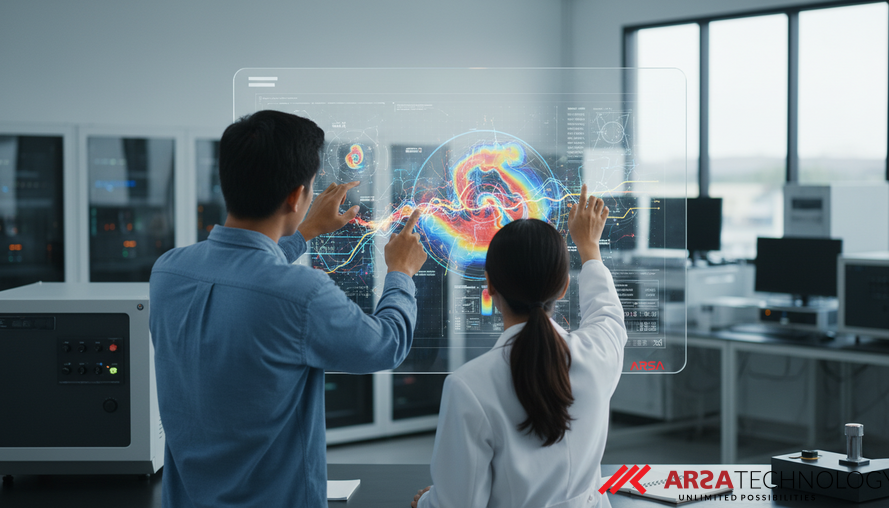
Designing and optimizing advanced energy systems, from microelectronics to electric vehicle batteries and specialized microenergy harvesters, presents a formidable challenge. These systems are governed by intricate interactions where electricity and heat are tightly coupled, influencing each other in profound ways. Ensuring efficient thermal management and precise field prediction within these complex "multiphysics" environments is paramount for device reliability, performance, and safety. Traditional simulation methods often struggle with these complexities, leading to designs that might be suboptimal or prone to failure.
The Intricacies of Electrothermal Multiphysics
Many critical engineering applications involve electrothermal energy transport, where electric currents generate heat, and temperature in turn affects electrical conductivity and other material properties. This creates a highly coupled system where multiple physical fields—like velocity, pressure, electric potential, and temperature—must be simultaneously resolved. Consider an advanced battery pack: charging and discharging generate heat, which can affect its efficiency and lifespan. Accurately predicting how heat flows and how electrical fields behave under varying conditions is vital for extending battery life, preventing overheating, and enhancing overall system performance. The inherent complexity, including strong nonlinear field coupling, temperature-dependent coefficient variability, and dynamic interfaces between different materials, makes steady-state simulation particularly difficult.
Physics-Informed Neural Networks (PINNs): A Promising Approach
For years, engineers relied on mesh-based solvers for these simulations. More recently, Artificial Intelligence (AI) has emerged as a powerful tool, with Physics-Informed Neural Networks (PINNs) offering a novel approach. PINNs are a class of neural networks that don't just learn from data; they are explicitly trained to adhere to the fundamental laws of physics, expressed as partial differential equations (PDEs), along with boundary conditions and other physical constraints. This embedding of physics directly into the AI's learning objective transforms the complex task of solving PDEs into a highly efficient function approximation problem.
While vanilla PINNs represent a significant leap, they still face hurdles when confronted with extremely complex multiphysics problems. Issues arise from physical fields exhibiting vastly different magnitudes and gradient scales, which can bias the optimization process. Furthermore, variable coefficients and indirect constraints can create difficult "loss landscapes" for the AI to navigate, and solutions dominated by interfaces (like a heat sink attached to a chip) demand the network to accurately capture both broad, smooth transport and narrow, local transitions.
Introducing Residual Attention PINNs (RA-PINN)
To overcome these persistent limitations, researchers have developed an advanced framework: the Residual Attention Physics-Informed Neural Network (RA-PINN). This innovative architecture (custom AI solutions are often built upon such advancements) significantly enhances the robustness and accuracy of multiphysics simulations. RA-PINN combines two powerful AI concepts:
- Residual Connections: These pathways allow information to bypass certain layers of the neural network, preventing "vanishing gradients" and enabling deeper, more stable training. This ensures that crucial features, even those from early layers, are propagated efficiently.
- Attention-Guided Channel Modulation: Inspired by how humans focus on specific details, attention mechanisms enable the network to "pay more attention" to areas where the physics is most challenging or where critical events (like steep temperature gradients or electrical hotspots) occur. This allows the AI to capture localized coupling structures and sharp transitions with higher fidelity.
By integrating these features with a unified five-field operator formulation (for velocity, pressure, electric-potential, and temperature), RA-PINN effectively captures localized coupling structures and steep gradients that conventional PINNs often miss. This structural innovation enriches the representation space available to the physics-informed optimizer, significantly improving the model's capacity to resolve complex multiphysics interactions.
Superior Performance and Real-World Impact
The effectiveness of RA-PINN has been rigorously evaluated across several energy-relevant benchmarks, including scenarios with constant-coefficient coupling, indirect pressure-gauge constraints, temperature-dependent transport, and oblique-interface consistency. In comparative analyses against other PINN variants (Pure-MLP, LSTM-PINN, and pLSTM-PINN), RA-PINN consistently demonstrated superior accuracy, yielding the lowest Mean Squared Error (MSE), Root Mean Squared Error (RMSE), and relative L2 errors across all tested scenarios.
Notably, RA-PINN maintained high structural fidelity even in complex interface-dominated and variable-coefficient settings, precisely where traditional PINN backbones often faltered. This enhanced robustness is critical for designing next-generation thermal management systems, optimizing microenergy harvesting devices, and improving the efficiency and safety of various electrothermal applications. This technological advancement opens doors for enterprises to design systems with greater confidence, reducing development cycles and minimizing costly physical prototyping. Companies with expertise in deploying complex AI solutions, like ARSA Technology, who has been experienced since 2018, can leverage such breakthroughs to deliver tangible operational and financial benefits to their clients.
Deployment and Future Implications
The practical implications of RA-PINN are far-reaching. By providing highly accurate and robust simulations, engineers can:
- Optimize Designs: Create more efficient and compact designs for electronic components, ensuring they operate within optimal temperature ranges, thus extending their lifespan and improving performance.
- Enhance Thermal Management: Develop superior cooling solutions for high-power devices, from data center servers to electric vehicle motors, preventing thermal runaway and increasing safety.
- Improve Energy Harvesting: Design more effective microfluidic or thermoelectric energy harvesters by precisely modeling their coupled electrothermal dynamics.
- Accelerate R&D: Drastically reduce the time and cost associated with experimental validation by relying on high-fidelity virtual prototypes.
For organizations looking to deploy such advanced AI capabilities, flexible deployment models are crucial. Solutions like the ARSA AI Box Series offer pre-configured edge AI systems that combine hardware and sophisticated video analytics software for fast, on-site deployment, ensuring that complex AI can run locally with minimal latency and maximum data control. This ensures that even the most cutting-edge AI, like RA-PINN, can be integrated into existing infrastructure, delivering real-time insights where they are needed most.
The advancements in Residual Attention Physics-Informed Neural Networks underscore a significant step forward in AI-driven engineering. By accurately simulating the complex interplay of electric and thermal forces, this technology promises to enable the development of more reliable, efficient, and innovative energy systems across various industries.
**Source:** Yuqing Zhou, Ze Tao, Fujun Liu. "Residual Attention Physics-Informed Neural Networks for Robust Multiphysics Simulation of Steady-State Electrothermal Energy Systems." arXiv:2603.23578v1 [cs.LG], March 24, 2026. https://arxiv.org/abs/2603.23578
To learn more about implementing AI-driven solutions for your specific engineering challenges and to unlock competitive advantages, we invite you to contact ARSA for a free consultation.