Smart Bird Feeders: Merging Nature Observation with Advanced AI and IoT
Explore how smart bird feeders leverage AI, IoT, and cloud technology for real-time wildlife monitoring, species identification, and digital record-keeping. Learn about their features, deployment, and the broader implications of edge AI.

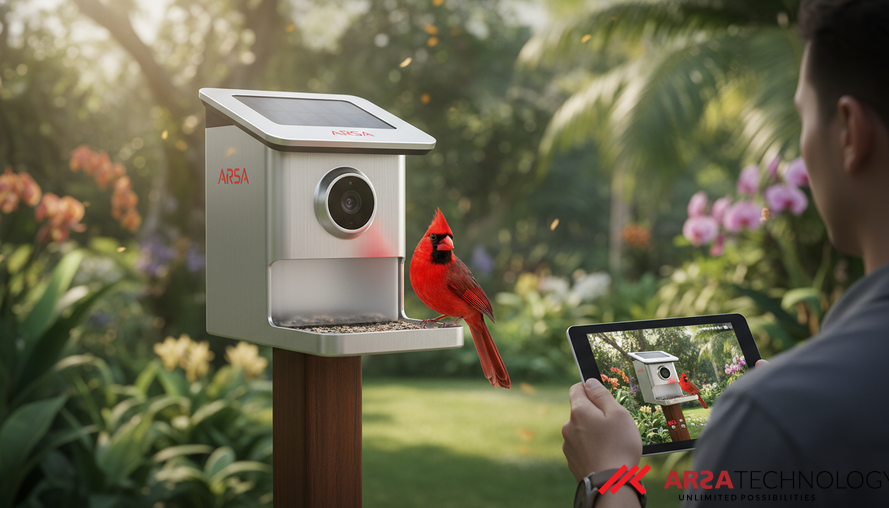
Smart bird feeders have rapidly evolved beyond simple food dispensers, transforming into sophisticated IoT devices that bring the wonders of nature directly to our screens. These intelligent gadgets blend advanced camera technology with Artificial Intelligence (AI) and cloud connectivity, offering an immersive and educational birdwatching experience. They represent a prime example of how everyday objects can be enhanced with AI and IoT to provide real-time insights and unparalleled convenience, a principle ARSA Technology applies to complex enterprise challenges across various industries.
The Evolution of Birdwatching with Smart Technology
Traditional birdwatching often requires patience, specialized equipment, and sometimes even travel. Smart bird feeders democratize this hobby, making it accessible to anyone with a smartphone. At their core, these devices feature high-definition cameras, often with wide-angle lenses and night vision capabilities, to capture clear footage of avian visitors. This captured data—be it images or video clips—is then processed and transmitted, typically to a mobile application, allowing users to observe birds even when far from home. The seamless integration of hardware and software is critical for such systems to deliver on their promise of real-time operational intelligence.
A key differentiator for these smart feeders is the resolution and field of view of their cameras. Models commonly available on the market offer 1080p cameras with a 155-degree field of view, providing detailed imagery. More advanced versions, like the Birdfy Feeder Metal 2, elevate this with sharper 4K cameras, ensuring even finer details of feathers and markings are visible. Such clarity is vital not just for aesthetic enjoyment but also for accurate species identification, which is often powered by sophisticated AI algorithms.
AI at the Edge: Intelligent Identification and Monitoring
The true "smart" aspect of these feeders comes from their integrated AI capabilities. After capturing a bird's image or video, the AI system goes to work, analyzing visual data to identify the species. This process, often happening at the edge (on the device itself or a local hub), ensures minimal latency and efficient data usage. Some systems can identify over 6,000 bird species, providing users with fascinating facts, daily highlights, and monthly summaries directly within their mobile app. This level of automated classification and analysis mirrors the sophisticated AI Video Analytics systems deployed by ARSA Technology in environments ranging from public safety to industrial monitoring.
For enthusiasts, the ability to set alerts for specific bird species is a game-changer. Imagine receiving an instant notification when that rare migratory bird visits your garden. This targeted monitoring capability transforms passive observation into an active, engaging pursuit. While many basic AI features come with a free trial period, advanced functionalities, such as detailed behavioral insights or specific species alerts, often require a premium subscription, highlighting the value of ongoing AI model development and support.
Data Management, Connectivity, and Privacy Considerations
Smart bird feeders typically rely on a combination of local storage and cloud services for data management. For instance, many offer free cloud storage for short video clips (e.g., 20-second segments for up to 30 days), allowing users to review past visits or share memorable moments. This cloud integration provides convenience and accessibility from anywhere in the world. However, for organizations with stricter data sovereignty or privacy requirements, on-premise data processing and storage are crucial. Solutions like ARSA Technology’s on-premise AI software or ARSA AI Box Series are designed for such scenarios, ensuring all video streams, inference results, and metadata remain entirely within the client’s infrastructure, without cloud dependency.
Deployment flexibility is another important aspect. These feeders are generally designed for easy setup, coming with necessary mounting attachments for poles, walls, or trees. They also need to withstand outdoor conditions, often featuring IP65 or IP66 weather-resistant ratings. Power management is crucial; devices typically run on rechargeable batteries (e.g., 5,200mAh batteries lasting up to three months) and can be augmented with optional solar panels for continuous operation. This robust design and self-sufficiency are qualities that are highly valued in critical industrial and infrastructure deployments, where reliability and minimal maintenance are paramount.
Beyond the Feeder: Broader Implications of Smart Wildlife Monitoring
The technology embedded in smart bird feeders has implications far beyond individual gardens. It showcases the potential of AI and IoT for broader environmental monitoring, citizen science, and educational initiatives. By aggregating data from numerous feeders, researchers could gain unprecedented insights into bird migration patterns, population health, and the impact of climate change. Furthermore, the principles of real-time object detection, classification, and alert generation are directly transferable to complex enterprise environments.
For instance, the same computer vision techniques that identify a summer tanager can be adapted to detect safety violations in a factory, monitor traffic flow in a smart city, or track inventory in a warehouse. The capability to transform passive infrastructure (like CCTV cameras or simple feeders) into active, intelligent sensors is a core offering of advanced AI providers. As the demand for sophisticated data analytics and automation grows, the underlying technologies proven in smart home devices are finding increasingly critical applications in commercial and industrial sectors, driving the need for custom AI solutions tailored to unique operational challenges.
This blend of high-definition cameras, edge AI, and seamless connectivity truly elevates the birdwatching experience, offering convenience, educational value, and a window into the natural world like never before. The market has seen a range of smart bird feeders, with some basic models historically available for around $99.99, and more advanced 4K metal versions, often with built-in solar charging and subscription-free AI, priced upwards of $259.99 during past promotional events. Even complementary devices, like AI-powered smart birdbaths with dual-lens cameras and two-way audio, reflect this technological advancement, often retailing around $260.
**Source:** The Verge - Birdfy’s smart bird feeder is down to its best-ever price for Mother’s Day
Transform your operations with intelligent technology. Explore ARSA Technology’s AI and IoT solutions and contact ARSA today for a free consultation.