The Future of Feedback: How Generative AI and Teacher Rubrics Transform English Writing
Explore how Generative AI, integrating teacher rubrics via Retrieval-Augmented Generation (RAG), provides immediate, structured feedback, enhancing K-12 writing and streamlining teacher workflows. Discover AI's potential and challenges in education.

AI's Evolving Role in Enhancing Human Capabilities
The integration of Artificial Intelligence (AI) across various sectors is rapidly transforming traditional processes, from industrial automation to nuanced human skill development. One area experiencing significant innovation is education, particularly in how students receive and engage with feedback on their writing. As discussions around Generative AI (GenAI) adoption intensify, its potential to provide immediate, personalized formative feedback to learners and concurrently reduce teacher workload is gaining prominence. This capability extends beyond the classroom, offering models for enhancing feedback mechanisms in corporate training, compliance document creation, and various technical writing contexts.
The research presented in the paper "Generative AI Feedback, English Writing and Teacher Rubrics: A Multiple-Case Study of CyberScholar" by Zheldibayeva et al. (Source: arxiv.org/abs/2605.17055) delves into the practical implementation of such an AI tool in K-12 settings. This study doesn't aim to quantify learning outcomes but rather to describe an implementation model, identify challenges, and offer pedagogical recommendations drawn from real classroom experiences. The foundational principle is that practical AI, thoughtfully designed, can unlock significant value.
CyberScholar: A Generative AI Approach to Formative Feedback
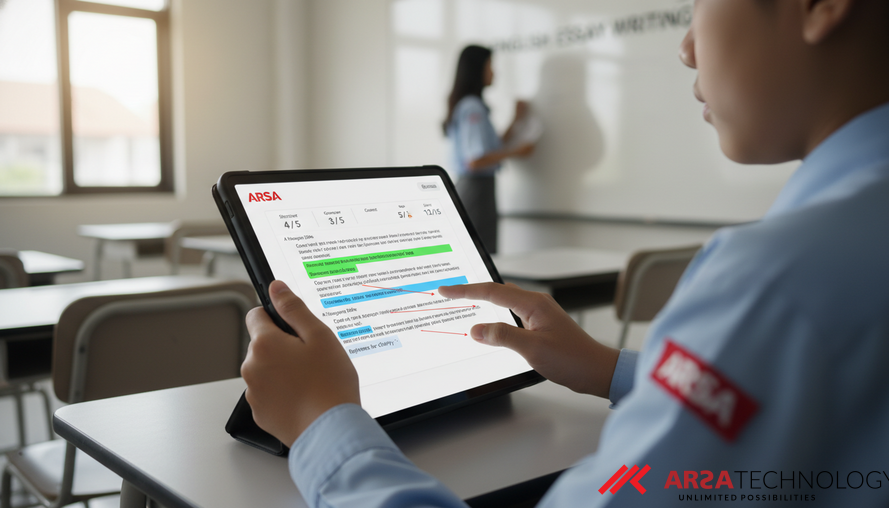
CyberScholar represents a sophisticated Generative AI tool designed to support K-12 students' writing across various disciplines. What makes CyberScholar particularly effective is its integration of Retrieval-Augmented Generation (RAG) technology. This means that instead of relying solely on its vast, pre-trained knowledge, the AI is "augmented" by specific, teacher-provided resources such as rubrics, instructional materials, and exemplary texts. By incorporating these tailored resources, CyberScholar ensures that the feedback it generates is highly relevant, criterion-specific, and directly aligned with educational standards and teacher expectations.
This integration allows the system to produce formative feedback and ratings that directly reflect the established assessment criteria. For enterprises, a similar approach with Custom AI Solutions could be revolutionary for internal training modules, ensuring that employee-generated content or reports adhere strictly to company guidelines, technical specifications, or compliance standards. The ability to fine-tune AI with proprietary knowledge bases is crucial for achieving practical, targeted results in any organizational context.
The Power of Rubric-Based, Immediate Feedback
The study, involving 143 students and five teachers across grades 7 to 11 in U.S. middle and high schools, revealed compelling insights into the student experience. Students widely valued CyberScholar's ability to provide immediate feedback based on their teachers' rubrics. This instant gratification is a significant departure from traditional methods, where feedback might take days or even weeks. As students engaged in the revision process, they reported noticing clear improvements in their writing, particularly in areas like organization, elaboration, and stylistic choices.
A key benefit highlighted by participants was the interactive and iterative nature of the tool. This fostered a cycle of continuous revision, reducing their reliance on direct teacher intervention for initial drafts and common errors. This aspect of fostering student agency, or the ability for learners to take more control over their own learning, is critical for developing essential 21st-century skills. Imagine such capabilities for employees in an enterprise setting, where AI ARSA AI API or dedicated tools could offer immediate feedback on complex reports, code, or design documents, accelerating skill development and project timelines.
Navigating Challenges: Inconsistencies and Contextual Alignment
While the benefits were evident, the study also underscored areas requiring careful consideration and human oversight. Participants noted occasional inconsistencies in the automated rating system and instances where the feedback or ratings did not perfectly align with the assignment's specific expectations. This highlights a critical lesson for any AI deployment: even advanced systems require calibration and contextual awareness.
For businesses leveraging AI, especially in sensitive areas like quality control or compliance, this translates to the necessity for robust validation frameworks. Solutions like ARSA Technology's AI Video Analytics software, while providing high accuracy in real-time detections, always benefit from human oversight and continuous learning loops to ensure alignment with evolving operational realities and specific site requirements. Ensuring that AI tools are not just accurate but also contextually intelligent remains a paramount challenge and opportunity for providers like ARSA Technology, who have been experienced since 2018 in delivering production-ready systems.
Streamlining Workflows and Elevating Instruction
From the teachers' perspective, CyberScholar offered tangible advantages, primarily saving significant time on providing formative feedback. This freed up educators to focus on more targeted, higher-order instructional practices, such as deep conceptual understanding, critical thinking, and personalized mentorship. By automating the foundational layer of feedback, AI allows human experts to dedicate their invaluable time to tasks that truly require human cognitive input and empathy.
This principle directly applies to enterprise operations. Automating routine data analysis, preliminary report generation, or initial quality checks with AI can liberate skilled professionals from repetitive tasks, allowing them to concentrate on strategic planning, complex problem-solving, and innovation. The efficiency gains translate into improved productivity, reduced operational costs, and the ability to reallocate human talent to areas where it can create the most value.
Ethical Considerations and Future Directions for AI in Skill Development
The deployment of GenAI, particularly in sensitive domains like education or enterprise operations handling proprietary data, necessitates a thorough examination of ethical considerations. Concerns include potential algorithmic bias, where the AI might unintentionally perpetuate or amplify existing societal biases embedded in its training data. The phenomenon of "hallucination," where AI generates factually incorrect or fabricated information, also demands robust mitigation strategies. Data privacy for both students and teachers (or employees and customers) is another paramount concern, requiring strict adherence to regulations like GDPR and HIPAA.
Responsible AI development, therefore, emphasizes privacy-by-design, transparent models, and mechanisms for human intervention and oversight. As AI tools become more sophisticated, maintaining a human-centered approach ensures that AI enhances human capabilities without replacing accountability or fostering overreliance on automation.
Conclusion: The Future of AI-Powered Skill Enhancement
The multiple-case study on CyberScholar powerfully demonstrates the transformative potential of rubric-grounded Generative AI in developing essential skills like English writing. By offering immediate, structured feedback, these tools empower learners, streamline workflows for educators, and pave the way for more personalized and efficient learning experiences. However, the study also reinforces the necessity for continuous calibration, human oversight, and a deep understanding of contextual factors for successful AI adoption.
For businesses and institutions seeking to harness AI for skill development, operational efficiency, or strategic insights, the lessons from CyberScholar are clear: bespoke solutions, integrated with existing frameworks and guided by human expertise, are key to unlocking measurable impact. To explore how AI and IoT solutions can transform your organization and provide similar advantages, we invite you to contact ARSA for a consultation.