Unlocking Complex Motion: How Lie Group Neural Networks Transform AI for Robotics
Explore Lie group embedded dynamical neural networks (LieEDNN), a breakthrough in AI that enables stable, geometric motion planning for robotics, camera pose, and more. Discover practical applications and ARSA's role in deployment.

Beyond Euclidean Space: Why AI Needs Geometry for Complex Dynamics
Traditional artificial intelligence models, particularly neural networks, are often built upon the assumption that data and interactions occur within simple, linear Euclidean spaces. While highly effective for many tasks, this assumption falls short when dealing with physical systems governed by intricate geometric structures. Imagine the complex, multi-jointed movements of a robotic arm, the shifting perspective of a camera in motion, or the precise mechanics of an articulated machine. These are not merely points moving in a straight line; they involve rotations, translations, and transformations that are inherently non-linear and best described by advanced geometric mathematics.
The academic paper "Planning Neural Dynamics with Lie Group Embedding through Supervised Projective Manifold Learning" introduces a pioneering solution: Lie group embedded dynamical neural networks (LieEDNNs). This innovative framework allows neural networks to intrinsically understand and operate within these complex geometric spaces. By doing so, it opens doors for AI to achieve unprecedented levels of stability, convergence, and precise trajectory generation in real-world engineering problems, particularly in fields like robotics, computer graphics, and advanced control systems (Wang et al., 2026).
The Challenge: Bridging Complex Mathematics and Neural Networks
Integrating sophisticated geometric concepts like Lie groups directly into neural network architectures presents two significant hurdles. Firstly, Lie groups, which describe continuous symmetries like rotations or rigid body motions, are fundamentally non-linear manifolds. This non-linearity means that the simple addition operations, which are the bedrock of standard neural network computations (weighted sums), are incompatible with Lie group elements themselves. You can't just "add" two rotations in the same way you add two numbers and expect a geometrically meaningful result within the group's rules.
Secondly, the dynamics of these systems evolve not in a familiar flat Euclidean space, but within the specialized, non-linear representation space of what's called a Lie algebra. This contradicts the traditional paradigm of neural ordinary differential equations (neural ODEs) that typically assume Euclidean environments. To overcome these challenges, the researchers ingeniously transfer the neural network's dynamics from the complex Lie group to its corresponding Lie algebra. A Lie algebra is a vector space, which means that the essential addition operations required by neural networks become well-defined here.
LieEDNN: A New Paradigm for Stable, Learnable Dynamics
The LieEDNN framework tackles these issues by introducing an "adjoint Lie group action" on the Lie algebra. This mathematical trick induces a linear mapping, effectively transforming complex Lie group elements into a structured, block-wise form within the neural network's weight matrices. This allows neural network operations like matrix multiplication and weighted sums to function correctly, even while operating on geometrically complex data. The Lie algebra and its adjoint action are parameterized as linear transformations, aligning the architecture seamlessly with standard neural network perceptrons.
This embedding essentially creates "manifold constraints" on the network's weights, ensuring that the learned dynamics remain consistent with the underlying geometric structure. The paper details algorithms for gradient descent and "metric projection" that learn desired equilibrium states with inherent guarantees of stability for the temporal neural network dynamics. This extends previous work on quaternion-valued neural dynamics to a much broader and more powerful class of mathematical objects—matrix Lie groups—promising more robust and versatile AI solutions for complex physical systems. For enterprises looking to implement such sophisticated AI capabilities, ARSA Technology offers custom AI solutions designed to integrate advanced models into mission-critical operations.
Understanding Lie Groups and Lie Algebras for Real-World Problems
To truly grasp the power of LieEDNNs, it's helpful to understand the core mathematical concepts they leverage. A "manifold" is a geometric object that locally resembles a flat Euclidean space but can be curved globally—think of the surface of the Earth. A "Lie group" is a special kind of manifold that also has a "group structure," meaning you can smoothly combine and invert its elements, like performing one rotation after another.
Key examples include SO(3), which represents all possible rotations in 3D space, and SE(3), the Special Euclidean group, which describes all rigid-body transformations in 3D space, encompassing both rotation and translation. These groups are vital for describing the movement of objects in our physical world. The "Lie algebra" corresponding to a Lie group is its "tangent space" at the identity element—essentially, a vector space that captures the "infinitesimal" movements or "velocities" within the group. For SE(3), its Lie algebra quantifies angular and translational momentum. The "matrix exponential" acts as a bridge, "retracting" these infinitesimal movements from the Lie algebra back to the full-scale transformations of the Lie group. This mathematical rigor allows for a precise and natural way to model complex motion.
Practical Applications: Advanced Robotics and Beyond
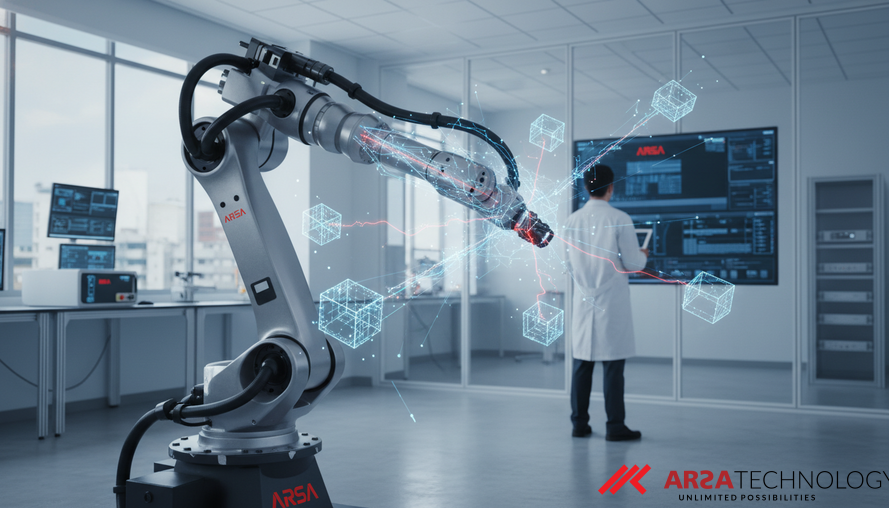
The researchers specifically instantiate their method on SE(3), demonstrating its compelling application for telescopic manipulator planning. In robotics, a telescopic manipulator—a robotic arm that can extend and retract, as well as rotate—involves highly coupled rotational and translational movements. Traditional control methods can struggle with the complexity of these interactions. LieEDNNs can directly encode these rotational and translational couplings through their neural connections, leading to more natural, stable, and accurate motion planning.
Beyond telescopic manipulators, this research has profound implications across various industries. Imagine more agile and precise industrial robots, autonomous vehicles with superior navigation and perception, or sophisticated camera systems that can track objects with unprecedented stability. For instance, in manufacturing environments, precise robotic control is crucial for quality and safety. Solutions like ARSA Technology’s AI BOX - Basic Safety Guard, while focused on safety monitoring, shares the underlying principle of using AI to understand and manage complex industrial dynamics, aiming for optimal operational outcomes. The ability of LieEDNNs to formulate computation as the temporal evolution of a continuous-time system, with desired outputs encoded as stable equilibria, is particularly suitable for tasks where stability and convergence are paramount.
The ARSA Technology Edge in Geometric AI Deployments
This groundbreaking research into Lie group embedded dynamical neural networks pushes the boundaries of AI, providing new tools for handling the geometric complexities of the physical world. At ARSA Technology, we specialize in transforming such advanced theoretical insights into practical, production-ready AI and IoT solutions for global enterprises. Our experienced team, since 2018, is adept at deploying sophisticated AI systems—from AI video analytics to custom hardware and software integrations—across various industries.
We understand that true innovation lies not just in theoretical breakthroughs, but in the meticulous engineering and real-world deployment of solutions that deliver measurable impact. ARSA focuses on bringing AI that works, at scale, and under real industrial constraints, ensuring accuracy, scalability, privacy, and operational reliability in every project. Whether it's enhancing security, optimizing operations, or creating new revenue streams, ARSA is committed to leveraging the power of advanced AI and IoT to build the future.
Ready to explore how advanced AI can transform your operations with stable, geometrically-aware solutions? We invite you to explore ARSA's enterprise AI and IoT solutions and contact ARSA for a free consultation.
Source: Wang, T., Chen, B., Zuo, Q., Xia, Q., Li, X., & Pang, W. (2026). Planning Neural Dynamics with Lie Group Embedding through Supervised Projective Manifold Learning. arXiv preprint arXiv:2605.26167v1 [cs.LG].