Lookalike3D: The Power of Repetition in Advanced 3D Scene Understanding
Discover Lookalike3D, an innovative AI approach leveraging identical and similar object pairs in indoor scenes to enhance 3D reconstruction and perception from multiview images.

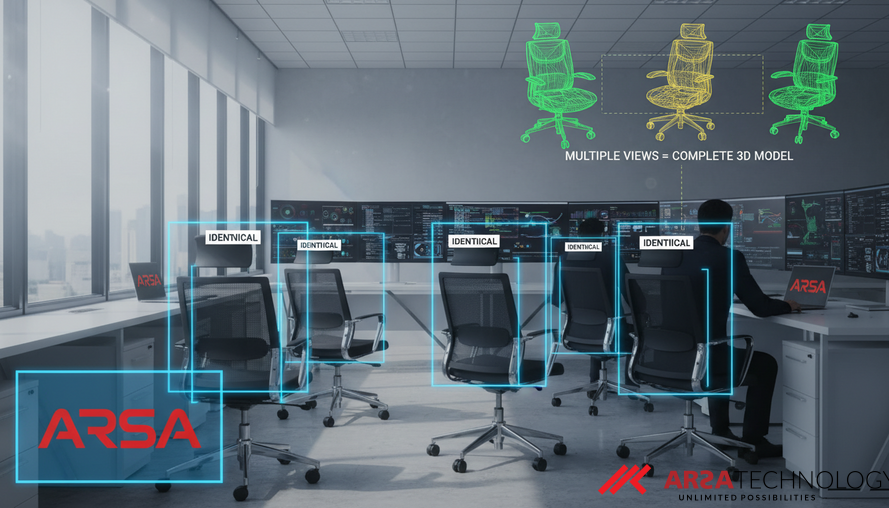
The Untapped Potential of Repeated Objects in 3D Perception
In the rapidly evolving fields of 3D scene understanding and content generation, impressive progress has been made in creating high-fidelity 3D assets and inferring object parts. These advancements are crucial for applications spanning virtual reality (VR), digital content creation, and intricate design. However, many state-of-the-art methods frequently overlook a ubiquitous source of information in real-world environments: repeated objects. Whether it's a row of identical chairs in an office, similar products on a retail shelf, or standardized equipment in a factory, identical or near-identical objects are pervasive. Recognizing and leveraging these "lookalike" objects can unlock a new dimension of efficiency and accuracy in 3D reconstruction and semantic understanding.
Current image-to-3D methodologies often perform optimally when objects are fully visible. Challenges arise when objects are partially obscured, forcing models to infer missing geometry with limited context. Yet, indoor environments naturally offer multiple perspectives of the same object if they are repeated. For instance, one chair might be viewed from the front, while an identical chair nearby is seen from the side, providing complementary visual data that can dramatically improve the understanding of occluded or partially visible instances. The academic paper "Lookalike3D: Seeing Double in 3D" explores this very concept, introducing a novel task and system to harness this rich, yet often ignored, information source (Chandan Yeshwanth, Angela Dai, Technical University of Munich).
Introducing Lookalike3D: A Smart Approach to Object Identification
The core challenge addressed by the Lookalike3D research is to classify pairs of objects within a scene as identical, similar, or entirely different. This is achieved by analyzing multiview images – essentially, multiple photographs of the same scene taken from different angles. Lookalike3D formulates this as a similarity learning problem, where the system learns to embed object representations into a feature space where proximity indicates a higher degree of similarity. This isn't just about detecting an object; it's about understanding the subtle relationships between multiple instances of objects.
To accomplish this, Lookalike3D employs a sophisticated architecture: a multiview image transformer that processes images taken from various viewpoints. This transformer is empowered by strong semantic priors derived from large image foundation models, such as DINOv2. These foundation models provide a robust understanding of general image features, giving Lookalike3D a head start in recognizing object characteristics. The system further refines its learning through an alternating attention model, which allows it to dynamically focus on relevant visual cues across different views, and a combination of multi-class triplet loss and score alignment loss, training the AI to distinguish between the three categories (identical, similar, different) with high precision. This granular approach, utilizing rich visual and geometric details from multiple 2D images, overcomes the limitations of methods relying solely on coarser 3D point cloud data.
The Foundational 3DTwins Dataset
To enable the training, benchmarking, and rigorous evaluation of lookalike object detection methods, the researchers developed the 3DTwins dataset. Built upon the comprehensive ScanNet++ dataset of 3D indoor scans, 3DTwins comprises an extensive collection of 76,000 manually annotated object pairs. These pairs are meticulously categorized as identical, similar, or different, providing a robust ground truth for the AI models. This dataset serves as a critical resource, establishing a new standard for object matching in complex 3D indoor environments and validating Lookalike3D's performance, which demonstrated an impressive 104% IoU (Intersection over Union) improvement over baseline methods. The availability of such datasets accelerates research and development in this specialized area of computer vision.
Beyond Recognition: Driving Advanced 3D Applications
The true power of Lookalike3D extends beyond mere classification; it significantly enhances downstream tasks crucial for enterprise operations. By understanding that objects are identical or similar, systems can perform joint optimization, leading to more consistent and detailed outputs.
- Joint 3D Object Reconstruction: When a system knows two objects are identical, it can pool information from multiple views of both instances to reconstruct a single, highly accurate 3D model. If one object is partially obscured, views of its identical "twin" can fill in the missing data, leading to a much more complete and consistent reconstruction than if each object were treated independently. This has immense potential in industries requiring precise digital twins or detailed asset libraries, such as manufacturing or architectural design. ARSA Technology, for instance, provides AI Video Analytics solutions that can be integrated with such advanced computer vision capabilities to build more robust 3D models from real-world video feeds.
- Part Co-segmentation: For similar objects, Lookalike3D enables part co-segmentation. This means the system can consistently identify and label corresponding parts across multiple similar objects (e.g., all chair legs, all armrests). This consistency is vital for applications like quality control, inventory management, or robotic manipulation, where understanding object components uniformly is essential. Improved part segmentation leads to more reliable automation and analysis.
The capability to deploy such advanced AI at the edge or within existing infrastructure is critical for enterprise adoption. Solutions like the ARSA AI Box Series are designed for rapid, on-site deployment, processing video streams locally to deliver instant insights without constant cloud dependency.
Why This Matters for Enterprises
The innovations presented by Lookalike3D offer significant business implications across various sectors:
- Manufacturing and Quality Control: Automating the inspection of repeated parts or products on an assembly line with higher accuracy, even with partial views. This can reduce defects and operational costs.
- Retail and Inventory Management: More precise tracking of identical or similar products on shelves, identifying missing items, or analyzing product placement efficiency.
- Architecture, Engineering, and Construction (AEC): Creating more accurate and consistent digital twins of buildings and infrastructure components, crucial for maintenance, simulation, and design.
- Security and Surveillance: Better detection and tracking of objects or even identifying specific items of interest in complex environments with high volumes of repeated elements.
- Content Creation and VR/AR: Streamlining the creation of high-fidelity 3D assets by leveraging existing repetitions, reducing manual modeling effort and ensuring visual consistency.
For enterprises seeking to transform operational complexity into a competitive advantage, the ability to leverage such fine-grained object understanding is paramount. Organizations can unlock new levels of efficiency, reduce human error, and gain deeper insights from their visual data. This kind of advanced AI capability forms the backbone of ARSA Technology's custom AI solutions, tailored to meet the unique demands of mission-critical operations.
To explore how these advanced 3D object understanding capabilities can be tailored for your enterprise's specific needs and challenges, we invite you to contact ARSA for a free consultation.
Source: Chandan Yeshwanth, Angela Dai, Technical University of Munich. "Lookalike3D: Seeing Double in 3D". https://arxiv.org/abs/2603.24713.