Revolutionizing Digital Pathology: Smarter WSI Indexing with Redundancy Reduction
Discover how ARReST's innovative approach to whole-slide image patching drastically cuts storage costs and accelerates AI-driven diagnostics in digital pathology.

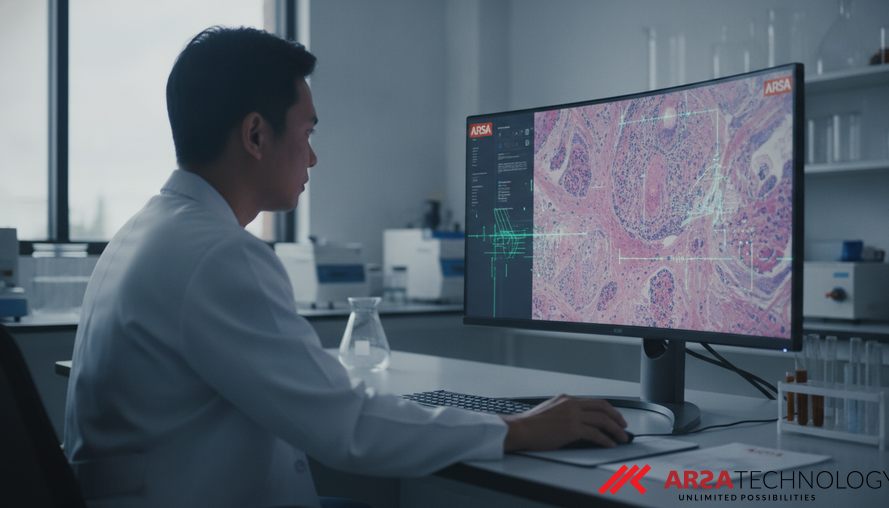
The landscape of medical diagnostics is undergoing a profound transformation with the advent of digital pathology. Central to this evolution are Whole-Slide Images (WSIs), microscopic tissue samples digitized into incredibly high-resolution, gigapixel images. While offering unprecedented opportunities for enhanced diagnosis, collaborative review, and AI-driven insights, the sheer volume of WSI data presents monumental storage and computational challenges. A groundbreaking new strategy, ARReST (Antithetical Redundancy Reduction Strategy), is emerging to tackle these issues head-on, promising more scalable and cost-efficient digital pathology systems.
The Data Deluge in Digital Pathology: A Bottleneck for Innovation
Digital pathology is rapidly generating colossal datasets. A single WSI can range from 0.5 to 4 gigabytes, comparable to a high-definition feature film (Iron Mountain Whitepaper). A typical pathology practice, processing hundreds of slides daily, can produce upwards of 3 terabytes of new data each day, leading to annual storage needs of a petabyte or more for an indexed archive (an atlas of images used for AI training and search) (Geng et al., 2026). Such massive storage requirements translate into significant financial burdens for healthcare institutions, hindering widespread adoption and the deployment of advanced AI applications.
Beyond storage costs, the computational demands for processing these images are immense. Traditional methods often involve breaking down WSIs into thousands of smaller segments, or "patches," which are then processed by AI algorithms. To enable fast retrieval, these patches are converted into numerical representations called "embeddings." When a new WSI is introduced, its embeddings must be compared against a vast library of existing embeddings in the atlas, often requiring millions of comparisons. Any reduction in the number of stored embeddings directly translates to fewer comparisons, accelerating the entire process. Without efficient data management, the scalability of these systems remains a critical concern, impacting both accessibility and the speed of clinical decision-making.
The Critical Role of AI for Diagnosis and Discovery
Artificial intelligence is poised to revolutionize pathology, moving beyond simple image analysis to complex diagnostic assistance. One of the most promising applications is Retrieval-Augmented Generation (RAG), a generative AI workflow that enhances AI models by allowing them to retrieve relevant information from external knowledge bases before generating a response. In high-stakes medical fields, RAG can significantly improve the reliability and accuracy of AI-driven insights, offering potential benefits in areas like diagnostic precision, personalized treatment plans, and even reducing diagnostic bias (Yang et al., 2025).
However, the effectiveness of RAG in digital pathology hinges on the ability to perform dependable similarity searches across massive WSI archives. If the underlying image database is bloated with redundant data or is slow to query, the AI's ability to provide timely and accurate support is compromised. Therefore, strategies to optimize WSI indexing and retrieval are not just about cost-cutting; they are fundamental to enabling the next generation of AI-driven clinical systems. Technologies such as ARSA Technology's AI Video Analytics Software are designed to manage and analyze large volumes of visual data efficiently, laying the groundwork for such advanced applications.
Addressing Redundancy with ARReST: A Smart Solution
The traditional approach to WSI patching often involves selecting a representative subset of patches, typically reducing the index size to 5-10% of the original WSI. While an improvement, this still leaves petabytes of data for large archives. The ARReST (Antithetical Redundancy Reduction Strategy) framework introduces a novel approach to further streamline this process. Instead of merely eliminating identical or near-duplicate patches (within-class redundancy), ARReST identifies and prunes "antithetical patches"—those that contribute minimally to distinguishing between different tissue classes.
This principled oppositional framework intelligently culls patches whose representations offer little value in differentiating various pathological conditions. By focusing on cross-class discrimination, ARReST ensures that crucial morphological diversity is preserved while significantly compressing the index. This means the system can identify truly unique and diagnostically meaningful information more efficiently. Experimental results from the TCGA (The Cancer Genome Atlas) repository, spanning 21 organs, demonstrated impressive storage savings ranging from 3% to 60%, with an average reduction of 14% without compromising retrieval performance (Geng et al., 2026). Such efficiencies are critical for scaling AI in sensitive environments. For organizations needing robust, locally processed solutions, the ARSA AI Box Series offers plug-and-play edge AI systems that can incorporate advanced data reduction techniques.
Practical Impact and Future of Digital Pathology AI
The implications of solutions like ARReST are far-reaching for healthcare enterprises and government bodies. Reducing the storage footprint of WSI atlases directly lowers operational costs, making advanced digital pathology more accessible. The accelerated similarity search capabilities, achieved by minimizing superfluous patch representations and reducing pairwise comparisons, mean faster retrieval times. This can significantly speed up AI inference, leading to quicker diagnoses and more agile research cycles.
For businesses looking to integrate cutting-edge AI into their operations, particularly in highly regulated sectors, the focus on data control, privacy, and performance is paramount. Deploying tailored solutions that can process and manage sensitive medical imaging data while supporting compliance requirements is essential. Companies like ARSA Technology, with over seven years of experience building AI since 2018 for demanding environments, understand these requirements deeply. Their expertise in Custom AI Solutions enables the implementation of advanced algorithms like ARReST, ensuring that these complex systems are not only efficient but also aligned with organizational needs and regulatory standards.
The future of digital pathology lies in intelligent, scalable, and cost-effective AI systems. By strategically tackling data redundancy, new methods unlock the full potential of WSIs, transforming passive image archives into active intelligence platforms that drive better health outcomes and accelerate medical discovery.
***
Sources:
Geng, J., Alabtah, G., Alfasly, S., Uegami, W., & Tizhoosh, H. R. (2026). Reducing Redundancy in Whole-Slide Image Patching for Scalable Indexing and Retrieval. arXiv preprint arXiv:2606.26157*.
- Iron Mountain. (2024). Digital Pathology Storage: Strategies and Considerations. Whitepaper.
Yang, R., Ning, Y., Keppo, E., Liu, M., Hong, C., Bitterman, D. S., Ong, J. C. L., Ting, D. S. W., & Liu, N. (2025). Retrieval-augmented generation for generative artificial intelligence in health care. npj Health Systems, 2*(1), 2.
Accelerate your digital transformation in healthcare and other mission-critical sectors with advanced AI solutions. Explore ARSA Technology's range of products and services, or contact ARSA today to discuss your specific requirements.