The Future of Empathetic AI: Dynamic Fusion for Multimodal Emotion Recognition in Conversations
Explore how Dynamic Fusion-aware GCN (DF-GCN) revolutionizes AI's ability to understand complex human emotions in conversations from text, audio, and video, offering practical applications in critical industries.

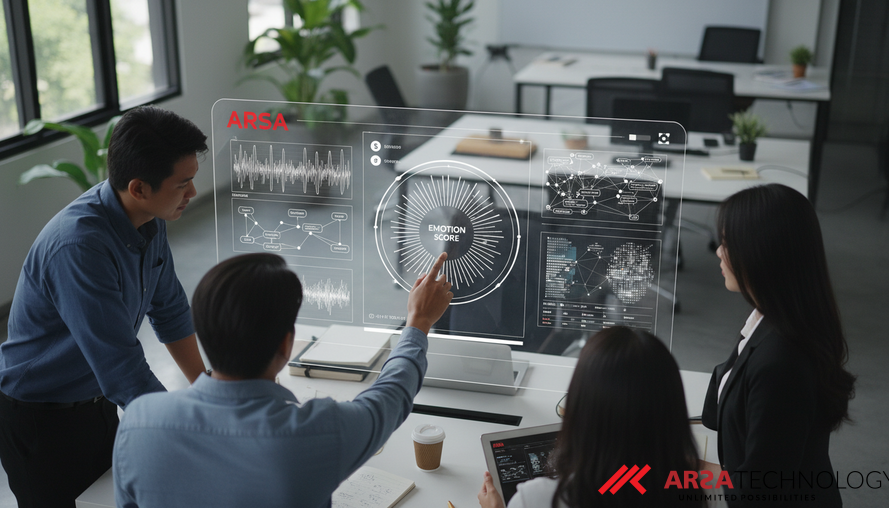
Understanding the Nuances of Conversational Emotion
In today's digital age, human interactions are increasingly mediated through conversations, be it text, voice, or video calls. Understanding the underlying emotional state of speakers in these dialogues is crucial for a multitude of applications, from enhancing customer service to improving mental health support. This field, known as Multimodal Emotion Recognition in Conversations (MERC), aims to accurately identify and interpret emotions expressed through various communication channels simultaneously. Unlike simpler emotion recognition systems that might analyze a single piece of text or a standalone image, MERC grapples with the complexity of real-time, evolving dialogues, where emotions shift and are conveyed through a combination of words, tone, and visual cues.
The ability of AI to comprehend these complex human sentiments unlocks profound potential. Imagine AI assistants that not only understand your commands but also sense your frustration, adapting their responses to be more empathetic and helpful. Or healthcare systems that can detect early signs of distress in patient conversations, prompting timely interventions. This deep understanding of user emotions in multi-round dialogues is vital for making AI systems truly intelligent and responsive, moving beyond mere functionality to genuine emotional perception and response.
The Challenge of Multimodal Emotion Recognition
While the promise of MERC is significant, achieving it presents substantial technical hurdles. Existing approaches often rely on sophisticated neural network architectures, such as Transformer models or Graph Convolutional Networks (GCNs), to model the intricate dependencies between speakers and utterances. GCNs, for instance, are particularly adept at capturing how one person's emotional state might influence another's, or how emotions evolve over a conversation. However, a major limitation of many current methods lies in their approach to integrating information from different modalities (like text, audio, and video). They typically employ a "static fusion" mechanism, using fixed parameters to combine multimodal features.
This static approach, while simplifying model design, faces significant challenges when confronted with the vast spectrum of human emotions. Different emotions might be expressed more strongly through one modality than another; for example, anger might be very evident in voice tone, while sarcasm might be conveyed primarily through textual nuance. A fixed fusion strategy struggles to adapt to these dynamic expressive patterns. It forces the model to find a single balance point for all emotion categories, often leading to suboptimal performance, especially for less common or "minority" emotions. This lack of specialized optimization means the AI might fail to capture the unique characteristics of specific emotions, limiting its accuracy and sensitivity in distinguishing complex emotional states. The research paper highlights this as a critical area for improvement, emphasizing the need for more flexible and adaptive models that can dynamically adjust how they blend different types of information.
Innovating with Dynamic Fusion-aware Graph Convolutional Networks (DF-GCN)
To overcome the limitations of static fusion, a novel approach called the Dynamic Fusion-aware Graph Convolutional Neural Network (DF-GCN) has been proposed. This groundbreaking framework introduces a dynamic element to how AI processes multimodal emotional data in conversations (Source: arXiv:2603.22345). At its core, DF-GCN integrates Ordinary Differential Equations (ODEs) directly into GCNs. In simple terms, while a traditional GCN processes information through discrete layers, adding ODEs allows the network to model continuous, fluid changes in emotional dependencies over the course of a conversation. This enables the AI to better capture the subtle, dynamic shifts in emotional interactions that unfold in real-time.
Furthermore, the DF-GCN introduces a "prompt learning" mechanism guided by a Global Information Vector (GIV). The GIV acts as a rich, condensed summary of all available information for a given utterance, encompassing both its content and context across various modalities. This GIV is then used to generate dynamic "prompts" or adaptive weights. These prompts instruct the network on how to optimally combine the different multimodal features for that specific utterance, based on its unique emotional context. This means that instead of using a one-size-fits-all approach, the DF-GCN can dynamically adjust its fusion parameters, tailoring its processing for different emotion categories during the inference stage—when the model makes predictions on new data. This adaptability allows the model to achieve more flexible and accurate emotion classification, significantly enhancing its generalization ability across diverse emotional scenarios.
How Dynamic Fusion Transforms AI's Emotional Intelligence
The key breakthrough of dynamic fusion lies in its ability to adaptively assign different "fusion weights" to various emotion categories during the inference stage. This contrasts sharply with traditional static methods that rely on fixed weights, forcing a compromise in performance across the emotional spectrum. With DF-GCN, if an AI is tasked with recognizing anger, it might prioritize audio cues and certain textual patterns more heavily, whereas for sadness, it might give more weight to subtle facial expressions and slower speech rhythms. This fine-tuned approach ensures that the model can be highly sensitive and accurate for each individual emotion, rather than balancing an average performance across all of them.
The architecture of DF-GCN facilitates this dynamic intelligence through a two-stage process. First, a Static Graph Convolution (SGCODE) block constructs an emotional interaction graph from multimodal utterance features, capturing the initial dynamic dependencies. Following this, the processed features are fed into a Transformer to derive the Global Information Vector (GIV). A prompt generation network then uses this GIV to create dynamic fusion weights. Finally, these dynamic weights, alongside the multimodal features, are integrated into a Dynamic Graph Convolution (DGCODE) block, which uses ODEs for truly dynamic fusion and accurate emotion recognition. This novel framework represents a significant leap forward in equipping AI with a more nuanced and human-like understanding of emotion.
Real-World Impact Across Industries
The implications of dynamic, multimodal emotion recognition extend far beyond academic research, offering tangible benefits across numerous industries.
- Customer Service and Experience: Businesses can deploy advanced MERC systems to monitor customer sentiment in real-time during calls or chat interactions. By identifying escalating frustration or dissatisfaction, customer service agents can be alerted to intervene proactively, transforming negative experiences into positive ones. This can lead to increased customer satisfaction, reduced churn rates, and ultimately, enhanced brand loyalty and revenue. ARSA Technology provides AI Video Analytics that can be adapted to observe behavioral cues in customer interactions within physical spaces.
- Healthcare and Psychological Support: In clinical settings, MERC can assist therapists and counselors by providing objective insights into a patient’s emotional state over multiple sessions. The system could detect subtle shifts in mood indicative of distress or progress, enabling more personalized and effective treatment plans. For remote monitoring, it could flag emotional anomalies, triggering early intervention and reducing risks associated with mental health challenges. For broader health monitoring, a product like ARSA’s Self-Check Health Kiosk could be augmented with emotional recognition to provide more holistic assessments.
- Empathetic AI and Dialogue Systems: The development of truly empathetic AI assistants that can not only understand but also respond appropriately to user emotions is a critical step towards more natural and effective human-AI interaction. From virtual companions to intelligent personal assistants, MERC allows these systems to build rapport, de-escalate tensions, and provide more meaningful support. Businesses seeking to integrate such capabilities can explore platforms like the ARSA AI API for advanced AI functionalities.
- Marketing and Retail: Understanding consumer reactions to products, services, or advertisements in conversational feedback can provide invaluable market intelligence. MERC can analyze focus group discussions or social media interactions to gauge genuine emotional responses, helping brands refine their strategies and improve engagement.
- Public Safety and Security: While not explicitly mentioned in the source, the ability to detect unusual emotional states like panic, aggression, or distress in public spaces (e.g., through monitoring public announcement systems or security footage with appropriate ethical safeguards) could enhance public safety and security operations.
ARSA Technology's Role in Deploying Advanced AI
Implementing advanced AI solutions like dynamic multimodal emotion recognition requires deep technical expertise and a practical understanding of real-world deployment challenges. ARSA Technology, a leading AI and IoT solutions provider experienced since 2018, specializes in bridging the gap between cutting-edge AI research and actionable enterprise solutions. Our team combines technical depth with performance marketing insights to deliver high-converting, SEO-optimized content that positions ARSA as a trusted AI/IoT partner for global enterprises.
ARSA offers custom AI solutions designed to address specific business needs, ensuring that complex technologies like DF-GCN can be tailored and integrated seamlessly into existing operational frameworks. Our focus on edge AI, privacy-by-design, and practical deployment realities means we build systems that are not only accurate and scalable but also compliant with stringent data protection standards and optimized for performance in demanding environments. This commitment ensures measurable impact and a clear return on investment for our clients.
The research discussed in this article is based on the paper "Dynamic Fusion-Aware Graph Convolutional Neural Network for Multimodal Emotion Recognition in Conversations" by Tao Meng et al., available at arXiv:2603.22345.
Ready to explore how dynamic AI solutions can transform your operations? Discover ARSA Technology's innovative AI and IoT offerings and see how practical AI can be deployed to deliver proven and profitable results. For a personalized discussion on your specific challenges and how our expertise can drive your competitive advantage, please contact ARSA today.