
Automated Employee Health Screening for Workplace Compliance: A Guide for Government Agencies
For occupational health directors within government agencies, ensuring robust workplace compliance and employee well-being is a complex, resource-intensive task. Traditional manual health screening methods often lead to clinic congestion, inconsistent data, and escalating costs, making it challenging to maintain an efficient and compliant health program. The need for automated employee health screening for workplace compliance has never been more critical, offering a pathway to streamline operations, reduce expenses, and proactively manage workforce health.
In this guide, we will explore the transformative potential of automated health screening solutions, comparing their advantages over conventional approaches and highlighting how ARSA Technology’s innovative Self-Check Health Kiosk can empower government agencies to achieve superior health management and regulatory adherence.
The Challenges of Traditional Health Screening in Government
Government agencies, often managing large and diverse workforces, face unique hurdles in occupational health. Manual vital sign checks consume significant staff time, creating bottlenecks and diverting medical personnel from more critical tasks. This not only impacts patient flow in clinics but also limits the capacity for billable consultations or specialized care.
Furthermore, relying on manual measurements introduces human error, leading to inconsistent data and hindering effective trend analysis for early intervention. The absence of real-time, aggregated employee health data creates blind spots, allowing absenteeism and chronic conditions to go undetected until productivity losses become substantial. Finally, the sheer cost per screening for nurse-administered vitals can make scaling preventive health programs economically unsustainable for public sector budgets.
Why Automated Health Screening is the Future of Workplace Compliance
Automated health screening systems address these challenges head-on by leveraging AI and IoT technology to deliver fast, accurate, and self-service health assessments. These systems transform routine vital checks from a burden into an efficient, data-driven process.
Key advantages include:
- Cost Efficiency: By automating routine screenings, organizations can significantly reduce the need for dedicated medical staff for basic checks, reallocating valuable human resources to more complex care. This leads to substantial operational savings and a faster return on investment.
- Enhanced Accuracy and Consistency: Medical-grade sensors and AI-powered analytics minimize human error, ensuring consistent and reliable data capture. This precision is vital for compliance reporting and informed decision-making.
- Real-Time Data and Insights: Automated systems instantly digitize health records, making data available for immediate review and aggregated analytics. This allows occupational health directors to identify population health trends, flag critical readings, and intervene proactively.
- Improved Employee Experience: Self-service kiosks offer convenience and privacy, empowering employees to take ownership of their health without scheduling conflicts or lengthy wait times.
- Scalability: A single, centralized dashboard can manage numerous kiosks across multiple sites, enabling seamless expansion of health programs without proportional increases in staffing or infrastructure.
Introducing the ARSA Self-Check Health Kiosk: Your Partner in Workplace Compliance
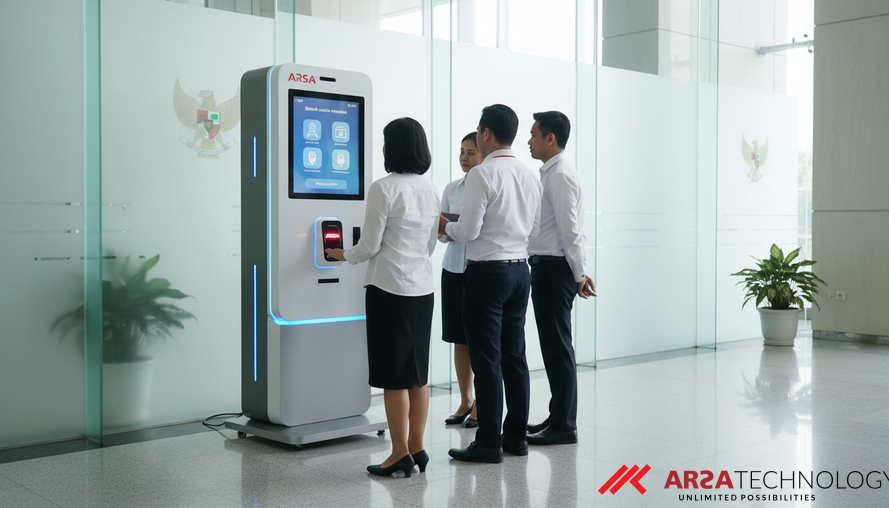
ARSA Technology’s ARSA Self-Check Health Kiosk is an AI & IoT-powered digital health kiosk designed specifically to meet the rigorous demands of government and enterprise environments. This autonomous medical-grade station provides multi-parameter vital sign measurements in approximately 90 seconds, all without requiring medical personnel.
The kiosk offers a comprehensive suite of screenings, including blood pressure monitoring, blood oxygen measurement (SpO2), heart rate monitoring, and even an innovative AI Romberg test kiosk for balance assessment. Optional modules can extend capabilities to include weight, height, BMI, glucose, and cholesterol, providing a holistic health overview.
Key Features and Business Outcomes:
- Self-Service Vitals Capture: A guided, multi-language interface with voice guidance walks users through the screening process, ensuring ease of use and accessibility compliance. This eliminates the need for staff intervention for routine checks.
- Instant Digital Records: Encrypted health profiles are immediately stored in a secure, cloud-integrated dashboard. Patients receive SMS/email reports within 60 seconds, while employers gain access to aggregated, de-identified analytics for population health management. This feature is crucial for tracking compliance and identifying emerging health trends within the workforce.
- Smart Triage Alerts: The kiosk’s AI flags critical readings (e.g., hypertension >140/90, fever >38°C, SpO2 <94%) and automatically routes alerts to on-call physicians, significantly reducing emergency response time by up to 73%. This proactive approach enhances safety and allows for early detection of employee health issues.
- Data Sovereignty and Compliance: ARSA understands the paramount importance of data privacy for government clients. The Self-Check Health Kiosk overview offers on-premise or hybrid cloud deployment options, ensuring full compliance with EU GDPR and Indonesia PDPA regulations. No sensitive biometric data leaves your infrastructure without explicit control, building trust and maintaining regulatory adherence.
- Cost Efficiency and ROI: By replacing the equivalent of 2-3 full-time equivalent (FTE) nurses per shift, the ARSA Health Kiosk delivers a typical ROI within 14-18 months. This labor reallocation allows nursing staff to focus on critical care, increasing overall patient throughput and operational efficiency.
- Scalability and Centralized Management: A single, intuitive dashboard can manage anywhere from 1 to 1,000 kiosks across various government facilities. Centralized firmware updates and predictive maintenance minimize downtime, ensuring continuous operation. This makes it an ideal solution for government entities looking to implement a widespread health kiosk with dashboard and reporting system.
Comparison: ARSA Health Kiosk vs. Other Solutions
When considering an automated employee health screening for workplace compliance solution, government agencies often weigh various options:
- Manual Screening: Highly labor-intensive, prone to human error, slow, and expensive to scale. Lacks real-time data aggregation.
- Basic Digital Devices: Offer some automation but often lack medical-grade accuracy, comprehensive parameter measurement, robust data security, or integrated dashboards.
- Cloud-Only Solutions: While convenient, these may raise concerns about data sovereignty and compliance for sensitive government data.
- ARSA Self-Check Health Kiosk: Combines medical-grade accuracy, AI-powered insights, comprehensive screening, robust data security (on-premise options), and a scalable management dashboard. It’s engineered for reliability and compliance in demanding environments.
For instance, while a digital health kiosk for hospital visitor screening might focus on basic temperature checks, ARSA’s kiosk offers a much broader range of vital signs and AI-driven assessments, making it suitable for comprehensive employee health programs. Similarly, a simple self-service blood pressure kiosk for clinics might only offer one measurement, whereas the ARSA kiosk provides a multi-parameter assessment designed for proactive health management.
ARSA’s commitment to on-premise and edge solutions extends beyond health kiosks. Our ARSA Basic Safety Guard (AI Box), for example, offers edge AI processing for safety and compliance monitoring in industrial environments, demonstrating our expertise in secure, local data processing critical for government and industrial clients.
Real-World Impact for Government Agencies
Imagine a government facility where employees can quickly and privately check their vitals before a shift, with critical alerts automatically routed to occupational health staff. This not only ensures immediate attention for potential health risks but also provides aggregated, de-identified data to inform corporate wellness programs and reduce insurance premiums through data-backed initiatives.
For border health screening posts or airports, the ARSA Health Kiosk can automate quarantine decision-making based on real-time vital thresholds, integrating with contact tracing databases for rapid response. In hospitals and clinics, it automates pre-consultation vitals, freeing up nursing staff for critical patient care. ARSA Technology has a proven track record of deploying mission-critical systems for clients like the Indonesian National Police and the Ministry of Defense, showcasing our capability to deliver reliable and compliant solutions for the public sector.
Frequently Asked Questions
What vital signs can the ARSA Self-Check Health Kiosk measure for employee screening?
The ARSA Self-Check Health Kiosk measures multiple parameters including blood pressure, heart rate, SpO2 (blood oxygen saturation), body temperature, and performs an AI-powered Romberg test for balance assessment. Optional modules can add weight, height, BMI, glucose, and cholesterol measurements.
How does the health kiosk with dashboard and reporting ensure data privacy for government employees?
Data privacy is paramount. The ARSA Health Kiosk uses AES-256 encryption and supports GDPR/HIPAA compliance. It offers on-premise or hybrid cloud deployment options, ensuring that biometric and health data remains within your infrastructure, under your control, and never leaves your network unless explicitly configured.
Can the AI Romberg test kiosk for balance assessment be integrated with existing HR systems?
Yes, the ARSA Health Kiosk is designed for seamless integration. It features API integration capabilities, allowing it to connect with existing HR, access control, or occupational health management systems to streamline data flow and automate workflows.
What is the typical ROI for implementing automated employee health screening for workplace compliance with ARSA’s kiosk?
The ARSA Self-Check Health Kiosk typically achieves ROI within 14-18 months. This is primarily driven by significant cost efficiencies from labor reallocation (replacing 2-3 FTE nurses per shift) and increased patient throughput, alongside the benefits of early detection and improved compliance.
Conclusion
The shift towards automated employee health screening for workplace compliance is not merely an upgrade; it’s a strategic imperative for government agencies aiming for operational excellence, cost efficiency, and superior employee well-being. The ARSA Self-Check Health Kiosk provides a robust, compliant, and scalable solution that transforms occupational health management from a reactive burden into a proactive, data-driven advantage. By embracing ARSA’s AI and IoT innovations, government entities can ensure their workforce remains healthy, productive, and compliant with the highest standards.
To explore how ARSA Technology can tailor a solution for your agency’s specific needs and begin your digital transformation journey, we invite you to contact ARSA solutions team today. You can also learn more about all ARSA products designed for enterprise and government applications.
Stop Guessing, Start Optimizing.
Discover how ARSA Technology drives profit through intelligent systems.
