
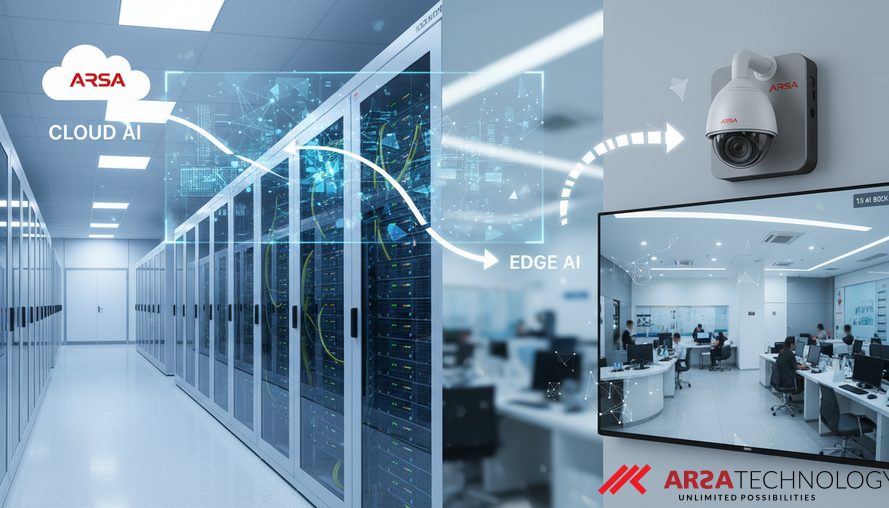

Edge AI vs Cloud AI for Enterprise Video Analytics Comparison: A CTO’s Guide
For Chief Technology Officers and IT Directors, the decision between edge AI and cloud AI for enterprise video analytics is a critical architectural choice. It impacts everything from operational efficiency and data security to long-term costs and scalability. As organizations increasingly leverage AI to derive insights from vast amounts of video data, understanding the nuances of an edge AI vs cloud AI for enterprise video analytics comparison becomes paramount. This guide will dissect the core differences, advantages, and considerations for each approach, helping you determine the optimal strategy for your enterprise, especially within sensitive sectors like banking.
The landscape of AI-powered video analytics offers powerful capabilities, from enhancing security and optimizing operations to automating identity verification. However, the underlying infrastructure—whether processing occurs at the “edge” (close to the data source) or in the “cloud” (remote data centers)—dictates performance, cost, and compliance. Making an informed decision requires a deep dive into technical specifications, financial implications, and regulatory demands.
Understanding Edge AI for Enterprise Video Analytics
Edge AI refers to artificial intelligence processing that occurs directly on the device where data is collected, or on a local server nearby, rather than sending all data to a centralized cloud server. In the context of enterprise video analytics, this means AI algorithms run on devices like smart cameras, dedicated edge AI boxes, or local servers within your facility.
Key Characteristics of Edge AI:
- Decentralized Processing: Analytics happen closer to the source, reducing reliance on network connectivity.
- Lower Latency: Real-time processing enables immediate alerts and actions, crucial for time-sensitive applications like security monitoring or fraud detection.
- Reduced Bandwidth: Only processed metadata or critical alerts are sent over the network, significantly cutting bandwidth requirements and associated costs.
- Enhanced Data Privacy: Raw video footage often remains on-site, minimizing exposure to external networks and bolstering data privacy edge computing vs cloud CCTV concerns. This is particularly vital for regulated industries.
ARSA Technology offers solutions like the ARSA AI Box Series, which embodies edge AI principles. These pre-configured edge AI systems combine hardware with ARSA’s video analytics software for rapid, on-site deployment, processing video streams at the edge without cloud dependency.
Understanding Cloud AI for Enterprise Video Analytics
Cloud AI, conversely, involves sending video streams or images to remote data centers for processing. These powerful, scalable cloud platforms host sophisticated AI models and return insights or actions back to the user.
Key Characteristics of Cloud AI:
- Centralized Processing Power: Access to virtually unlimited compute resources allows for complex AI models and large-scale data analysis.
- Scalability: Easily scale processing capacity up or down based on demand without investing in physical hardware.
- Accessibility: Data and insights are accessible from anywhere with an internet connection, facilitating remote monitoring and management.
- Reduced On-Premise IT Overhead: Cloud providers handle infrastructure maintenance, updates, and security, reducing your internal IT burden.
ARSA’s Face Recognition & Liveness API is a prime example of a cloud AI solution, offering enterprise-grade biometric capabilities as a service.
Edge AI vs Cloud AI for Enterprise Video Analytics Comparison: Key Factors
When evaluating these two architectures, several critical factors come into play.
1. Performance and Latency
- Edge AI: Excels in scenarios demanding ultra-low latency. For instance, in a banking environment, instant face verification at an ATM or access point requires processing within milliseconds. An edge AI box ensures that decisions are made almost instantaneously, preventing delays that could impact security or customer experience.
- Cloud AI: While highly performant, cloud AI introduces network latency. Data must travel to the cloud, be processed, and then results returned. For applications where a few seconds of delay are acceptable (e.g., long-term trend analysis, non-critical alerts), cloud AI is perfectly suitable. However, for real-time fraud prevention or critical security responses, edge often has the advantage.
2. Cost Implications: On-Premise Video Analytics vs Cloud Processing Costs
- Edge AI: Involves an upfront capital expenditure (CapEx) for hardware (e.g., ARSA AI Box, local servers). However, it often leads to lower operational expenditure (OpEx) related to bandwidth and cloud processing fees. For large-scale deployments with many cameras, the cumulative edge AI box vs cloud video analytics total cost can be significantly lower due to reduced data transfer and no recurring cloud compute charges per inference.
- Cloud AI: Typically operates on an OpEx model, with costs based on usage (API calls, data storage, compute time). While this offers flexibility and avoids large upfront investments, costs can escalate rapidly with high video volumes or frequent processing. Understanding your anticipated usage is crucial to accurately project on-premise video analytics vs cloud processing costs.
3. Data Privacy and Security
- Edge AI: Offers superior data privacy by keeping raw video data on-site. This is a significant advantage for organizations operating under strict data sovereignty laws or regulations like GDPR, HIPAA, or Indonesia’s PDPA. For sensitive applications like biometric access control in government facilities or banking, edge computing minimizes the risk of data breaches during transmission or storage in third-party cloud environments.
- Cloud AI: While cloud providers offer robust security measures, the act of transmitting sensitive video data to external servers inherently introduces a privacy consideration. Enterprises must carefully vet cloud providers and ensure compliance with all relevant data protection regulations. For applications like e-KYC where personal biometric data is handled, the choice between edge and cloud often comes down to a risk assessment and compliance strategy.
4. Scalability and Flexibility
- Edge AI: Scaling edge deployments involves adding more edge devices or upgrading local hardware. While this provides granular control, it can be more complex to manage across numerous distributed sites.
- Cloud AI: Offers unparalleled scalability. Adding more processing power or storage is often a matter of adjusting a few settings, making it ideal for fluctuating workloads or rapidly expanding operations. This flexibility is a strong argument for many enterprises.
5. Connectivity Requirements
- Edge AI: Can operate effectively in environments with limited or intermittent internet connectivity. This makes it suitable for remote sites, industrial facilities, or areas with unreliable network infrastructure.
- Cloud AI: Requires a stable, high-bandwidth internet connection to transmit video data efficiently. Network outages can severely impact operations.
Why Choose Edge AI Over Cloud for CCTV?
For many enterprises, particularly those with extensive existing CCTV infrastructure, the question of why choose edge AI over cloud for CCTV often boils down to a few key benefits:
- Cost Efficiency for Large Deployments: As mentioned, reducing bandwidth and cloud processing fees can lead to substantial savings over time, especially when dealing with hundreds or thousands of camera feeds.
- Real-time Responsiveness: For immediate threat detection, safety compliance (e.g., PPE monitoring with ARSA Basic Safety Guard), or instant access control, edge AI’s low latency is critical.
- Data Sovereignty and Compliance: Keeping sensitive video data within your network simplifies compliance with stringent data protection regulations and addresses concerns about data residency.
- Operational Continuity: Edge systems can continue to function and provide analytics even if internet connectivity is lost, ensuring uninterrupted security and operational monitoring.
When Cloud AI Shines: The Case for ARSA’s Face Recognition & Liveness API
While edge AI offers compelling advantages for certain video analytics tasks, cloud AI remains the superior choice for specific applications, especially those requiring broad accessibility, rapid integration, and specialized, high-accuracy models. This is precisely where ARSA Technology’s ARSA Face Recognition & Liveness API excels, particularly for the banking industry.
For banks, preventing identity fraud and streamlining customer onboarding (e-KYC) are paramount. The ARSA Face Recognition & Liveness API, a cloud-based solution, offers:
- Instant API Integration: Developers can quickly integrate 1:1 face verification and 1:N face identification into existing applications via a simple REST API. This allows banks to rapidly deploy secure identity management solutions without significant infrastructure overhaul.
- Superior Accuracy and Anti-Spoofing: With 99.67% accuracy (LFW) and robust active/passive liveness detection, the API effectively prevents spoofing attacks using photos, videos, or masks. This is crucial for secure e-KYC and authentication processes.
- Scalability for High-Volume Transactions: Cloud-hosted infrastructure means the API can scale seamlessly to handle hundreds of thousands of API calls per month, accommodating peak transaction periods and rapid customer growth.
- Reduced Manual Verification Costs: By automating identity verification, banks can reduce manual verification costs by up to 80%, leading to significant operational savings and improved efficiency.
- Sub-Second Verification Response: Despite being cloud-based, the API is optimized for speed, delivering sub-second verification responses essential for a smooth customer experience during onboarding or transaction authentication.
- Comprehensive Face Database Management: The API includes robust features for managing face collections, enabling banks to maintain secure and efficient identity databases.
For use cases like e-KYC, where data is often collected from diverse sources (mobile apps, web portals) and needs to be verified against centralized databases, the cloud model offers the flexibility and reach that edge solutions might struggle to match without significant distributed infrastructure. While the raw biometric data is sensitive, ARSA’s API is designed with security in mind, offering GDPR/HIPAA encryption for identity verification and ensuring data integrity.
Hybrid Approaches: The Best of Both Worlds
It’s important to note that the choice isn’t always strictly one or the other. Many enterprises adopt a hybrid approach, leveraging edge AI for real-time, low-latency processing and data privacy, while utilizing cloud AI for long-term storage, complex analytics, model training, and broad accessibility. For example, an ARSA AI Box could handle immediate security alerts at a branch, while aggregated, anonymized data is sent to a cloud platform for overarching trend analysis or to power a centralized dashboard demo.
ARSA Technology provides both edge AI systems and on-premise AI video analytics software, alongside its cloud-based Face Recognition & Liveness API. This comprehensive portfolio allows enterprises to choose the deployment model that best fits their specific operational realities, compliance needs, and budget constraints.
Conclusion
The edge AI vs cloud AI for enterprise video analytics comparison is not about declaring a single winner, but rather identifying the optimal architecture for specific use cases and organizational priorities. For real-time, privacy-sensitive applications with high data volumes and existing CCTV infrastructure, edge AI often presents a compelling case due to lower latency, reduced bandwidth costs, and enhanced data sovereignty. However, for applications requiring broad accessibility, rapid integration, and scalable specialized AI models like high-accuracy face recognition and liveness detection for e-KYC in banking, cloud AI solutions like the ARSA Face Recognition & Liveness API offer unmatched benefits.
Ultimately, CTOs and IT Directors must weigh the trade-offs between performance, cost, data privacy, and scalability. ARSA Technology stands ready to help you navigate this complex decision, offering a full spectrum of AI solutions from edge to cloud.
—
FAQ
Q1: What are the primary cost differences between on-premise video analytics vs cloud processing costs?
A1: On-premise (edge) video analytics typically involves higher upfront capital expenditure for hardware but lower ongoing operational costs due to reduced bandwidth and no recurring cloud compute fees. Cloud processing has lower upfront costs but can incur significant, usage-based operational expenses for data transfer and AI inference, which can escalate with high video volumes.
Q2: How does data privacy edge computing vs cloud CCTV impact regulatory compliance?
A2: Edge computing generally offers stronger data privacy as raw video data remains within your local network, simplifying compliance with regulations like GDPR, HIPAA, and PDPA. Cloud CCTV involves transmitting data to external servers, requiring careful vetting of cloud providers and robust data governance to ensure compliance.
Q3: What factors should I consider when evaluating the edge AI box vs cloud video analytics total cost?
A3: When assessing the total cost, consider hardware acquisition for edge AI boxes, installation, maintenance, and electricity. For cloud video analytics, factor in subscription fees, data ingestion and egress charges, API call costs, storage, and potential network upgrade needs. Don’t forget the cost of internal IT staff time for managing each solution.
Q4: For what specific scenarios would an enterprise choose edge AI over cloud for CCTV?
A4: Enterprises often choose edge AI over cloud for CCTV when real-time, low-latency processing is critical (e.g., immediate security alerts), data privacy and sovereignty are paramount, internet connectivity is unreliable, or when managing large-scale deployments where bandwidth and cloud processing costs would be prohibitive.
—
Stop Guessing, Start Optimizing.
Discover how ARSA Technology drives profit through intelligent systems.
