
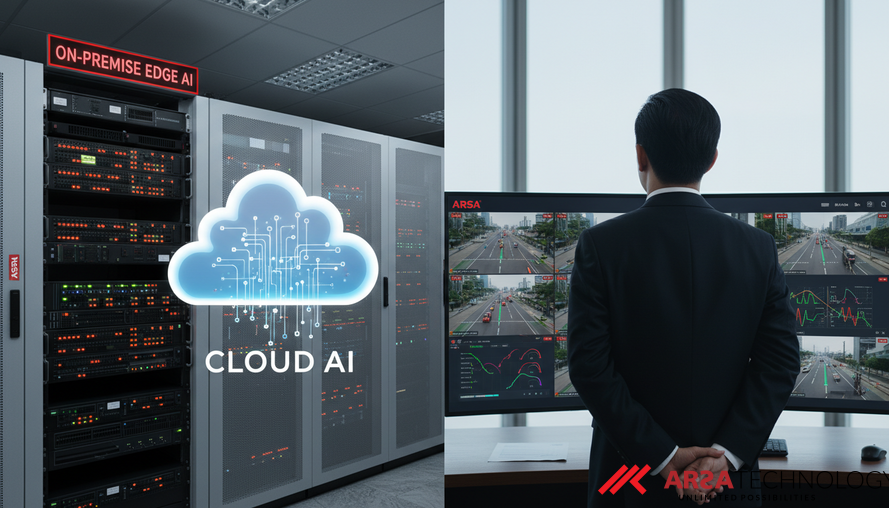

Edge AI vs Cloud AI for Enterprise Video Analytics Comparison: A Practical Guide for Government Businesses
For government agencies and public sector enterprises, the strategic decision between edge AI and cloud AI for enterprise video analytics is paramount. This choice impacts not only operational efficiency and budget but also critical factors like data sovereignty, security, and real-time responsiveness. As CTOs and IT Directors evaluate architectures, a comprehensive edge AI vs cloud AI for enterprise video analytics comparison becomes essential to ensure solutions align with public service mandates and regulatory requirements.
Traditional video surveillance systems, while providing visual records, often fall short in delivering proactive intelligence. Modern AI video analytics transforms passive CCTV feeds into active, actionable insights. The fundamental question then becomes: where should this intelligence be processed – at the edge, close to the data source, or in a centralized cloud environment? For government entities managing sensitive public data and critical infrastructure, the implications of this architectural choice are profound.
Understanding Edge AI for Video Analytics in Government
Edge AI refers to artificial intelligence processing that occurs directly on the device or local network where data is collected, rather than sending it to a remote cloud server. For video analytics, this means that AI models run on local hardware – such as an ARSA AI Box or existing on-premise servers – analyzing video streams in real-time at the source.
The primary benefits of edge AI for government applications are:
- Enhanced Data Privacy and Security: For sensitive government data, keeping video feeds and analytical results within a controlled, local network is crucial. Edge computing minimizes the risk of data breaches during transmission and ensures compliance with strict data sovereignty laws and privacy regulations (e.g., GDPR, local PDPA). This is a key differentiator in the data privacy edge computing vs cloud CCTV debate.
- Reduced Latency: Processing data at the edge means faster insights. For applications like real-time traffic monitoring, incident detection, or perimeter security, milliseconds matter. Edge AI enables immediate alerts and automated responses, critical for public safety and emergency services.
- Lower Bandwidth Requirements: Instead of continuously streaming high-definition video to the cloud, edge devices process the video locally and only send metadata or specific alerts. This significantly reduces network bandwidth consumption, leading to cost savings and more efficient use of existing infrastructure.
- Offline Operation Capability: Many government facilities, especially those related to defense or critical infrastructure, operate in restricted or air-gapped environments. Edge AI solutions can function entirely offline, providing uninterrupted service without reliance on external internet connectivity.
Exploring Cloud AI for Video Analytics
Cloud AI, conversely, relies on powerful, centralized data centers to perform AI processing. Video streams are uploaded to the cloud, analyzed, and then insights are delivered back to the user.
While cloud AI offers certain advantages, particularly for commercial applications with less stringent data requirements, it presents unique challenges for government:
- Scalability and Flexibility: Cloud platforms can theoretically scale almost infinitely, allowing for rapid expansion of processing power as needed. However, this often comes with unpredictable on-premise video analytics vs cloud processing costs.
- Ease of Deployment (Initial): For organizations without existing robust IT infrastructure, cloud solutions can appear simpler to deploy initially, as the vendor manages the underlying hardware.
- Cost Implications: While initial setup costs might be lower, recurring subscription fees, data egress charges, and the sheer volume of data transfer can lead to significant and often unpredictable long-term expenses. This directly impacts the edge AI box vs cloud video analytics total cost over time.
- Data Sovereignty Concerns: Storing and processing sensitive government video data in third-party cloud environments, especially those hosted internationally, raises serious questions about data ownership, jurisdiction, and compliance.
Edge AI vs Cloud AI for Enterprise Video Analytics Comparison: Key Considerations for Government
When making this critical architectural decision, government IT leaders must weigh several factors:
1. Data Security and Privacy
- Edge AI: Offers superior control. All video streams and inference results remain within the government’s physical or virtual infrastructure. This is paramount for classified information, citizen data, and national security applications. ARSA Technology’s AI Video Analytics Software, for instance, is designed for self-hosted, on-premise deployment, ensuring full data ownership and compliance readiness.
- Cloud AI: Data is transmitted to and stored on third-party servers. While cloud providers offer robust security measures, the inherent act of transferring sensitive data outside a controlled environment introduces potential vulnerabilities and compliance hurdles.
2. Performance and Latency
- Edge AI: Ideal for real-time applications. Processing occurs instantly where the video is captured, making it perfect for immediate incident response, traffic flow optimization, or critical infrastructure monitoring. Our ARSA Traffic Monitor (Software) exemplifies this, providing real-time dashboards for city operators.
- Cloud AI: Introduces network latency. The time taken to transmit video to the cloud, process it, and send back results can be a critical delay for time-sensitive government operations.
3. Cost of Ownership (TCO)
- Edge AI: Involves an upfront investment in hardware (if not using existing servers) and software licenses. However, it eliminates recurring cloud data transfer and processing fees, leading to predictable and often lower on-premise video analytics vs cloud processing costs in the long run. The ARSA Traffic Monitor (Software), deployed on existing infrastructure, helps reduce overall infrastructure costs.
- Cloud AI: Offers a pay-as-you-go model, which can seem attractive initially. However, scaling video analytics can quickly incur substantial and escalating operational expenses due to data storage, processing, and egress fees, making the edge AI box vs cloud video analytics total cost comparison lean towards edge for long-term, high-volume use.
4. Scalability and Management
- Edge AI: Scalability is achieved by adding more edge devices or allocating more compute resources to existing on-premise servers. Management can be centralized through a unified dashboard, as offered by ARSA’s solutions, providing a clear overview of distributed systems.
- Cloud AI: Scales by provisioning more cloud resources. While flexible, managing cloud resources and ensuring cost optimization requires specialized expertise and continuous monitoring to avoid bill shock.
5. Regulatory Compliance
- Edge AI: Facilitates compliance with stringent government regulations regarding data residency, privacy, and security. By keeping data local, agencies can more easily demonstrate adherence to national and international standards.
- Cloud AI: Requires careful vetting of cloud providers to ensure their practices and data center locations meet all applicable government and industry-specific compliance standards, which can be complex and time-consuming.
Why Choose Edge AI Over Cloud for CCTV in Government?
For government entities, the strategic advantages of edge AI often outweigh those of cloud AI, particularly when considering the core mandates of public service: security, privacy, and efficient resource management. The ability to maintain full control over sensitive data, ensure real-time responsiveness for critical operations, and manage costs predictably makes a compelling case for on-premise and edge-based solutions.
ARSA Technology understands these unique requirements. Our AI Video Analytics Software, including the specialized ARSA Traffic Monitor (Software), is engineered for government and enterprise clients who demand robust, secure, and compliant solutions. Deployable on existing servers, it offers centralized processing for multiple camera streams, enabling comprehensive city-wide traffic intelligence without cloud dependency. This empowers agencies with data-driven transport planning and real-time incident response capabilities, all while preserving privacy and minimizing latency.
With ARSA’s on-premise solutions, government departments can leverage advanced AI for vehicle counting, vehicle classification, and congestion analysis, transforming urban infrastructure into a smart, responsive network. The REST API integration allows seamless connection with existing dashboards and alerting systems, ensuring a smooth transition to intelligent operations.
Conclusion
The choice between edge AI and cloud AI for enterprise video analytics is a strategic one, especially for government businesses where data privacy, security, and real-time performance are non-negotiable. While cloud offers certain conveniences, the inherent benefits of edge AI – including superior data control, reduced latency, and predictable costs – make it the preferred architecture for mission-critical government applications.
By opting for solutions like ARSA Technology’s on-premise AI Video Analytics Software, government IT directors can deploy powerful, scalable, and compliant video intelligence systems that deliver measurable impact. To explore how ARSA Technology can help your agency implement a secure and efficient edge AI video analytics solution, please contact our solutions team today. You can also explore all ARSA products to find the right fit for your specific needs.
—
FAQ
What are the primary reasons government agencies should consider edge AI for video analytics?
Government agencies should consider edge AI for video analytics primarily due to enhanced data privacy and security, reduced latency for real-time operations, lower bandwidth requirements, and the ability to operate in offline or air-gapped environments, which are critical for sensitive public sector data and infrastructure.
How do on-premise video analytics vs cloud processing costs compare for long-term government projects?
For long-term government projects, on-premise video analytics often results in lower and more predictable total costs compared to cloud processing. While on-premise requires an initial hardware and software investment, it eliminates recurring cloud data transfer, storage, and processing fees, which can escalate unpredictably with cloud solutions.
What specific data privacy edge computing vs cloud CCTV advantages does edge AI offer?
Edge AI offers significant data privacy advantages by processing all video streams and analytical data locally, within the government’s controlled network. This prevents sensitive CCTV footage and inference results from being transmitted to or stored on external cloud servers, ensuring compliance with data sovereignty laws and minimizing exposure to third-party risks.
Can ARSA Technology’s solutions help with city-wide traffic intelligence using edge AI?
Yes, ARSA Technology’s ARSA Traffic Monitor (Software), deployed on-premise, is specifically designed to provide city-wide traffic intelligence. It enables real-time vehicle counting, vehicle classification, and congestion analysis, empowering government agencies with data-driven transport planning and rapid incident response capabilities without cloud dependency.
—
Stop Guessing, Start Optimizing.
Discover how ARSA Technology drives profit through intelligent systems.
