
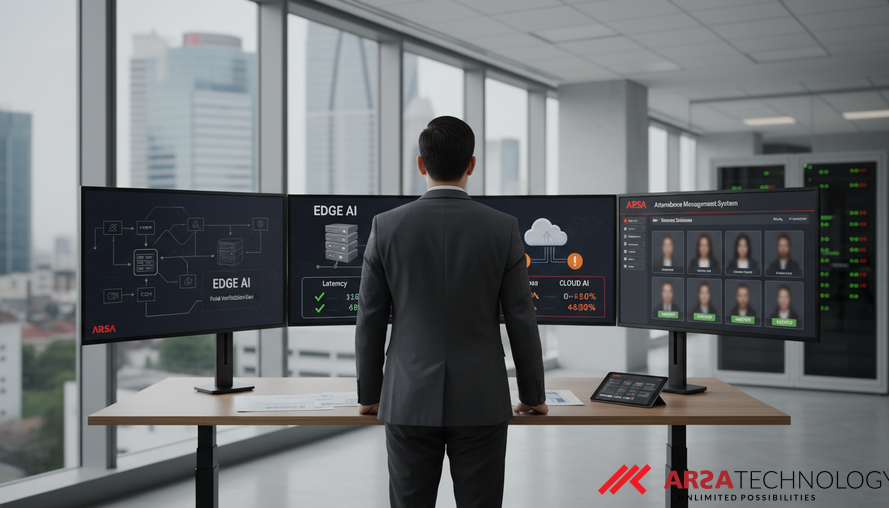

Edge AI vs. Cloud: Which 1:1 Face Verification Solution Fits Your Business for Attendance Management Systems?
In today’s rapidly evolving digital landscape, organizations, particularly within the government sector, are seeking robust and efficient solutions for identity management. The choice between Edge AI and Cloud AI for implementing a face recognition API for attendance management system is a critical decision for system integrators. This guide will dissect both approaches, highlighting their strengths and weaknesses, and demonstrate how ARSA Technology’s solutions empower businesses to achieve secure, scalable, and cost-effective operations.
The demand for accurate and reliable biometric systems is driven by the need to enhance security, streamline operations, and ensure compliance. Whether it’s verifying employee presence, managing access to restricted areas, or onboarding new personnel, the underlying technology must deliver precision and performance.
Understanding Edge AI for Face Recognition
Edge AI refers to artificial intelligence processing that occurs directly on the device or at the local network edge, rather than sending data to a centralized cloud server. For face recognition, this means that the cameras or dedicated edge devices (like ARSA’s AI Box Series or Face Recognition & Liveness SDK) perform the facial analysis and verification locally.
Advantages of Edge AI:
- Low Latency: Processing happens instantly, reducing delays crucial for real-time applications like rapid access control.
- Enhanced Data Privacy & Security: Biometric data remains within the local network, never leaving the premises. This is paramount for government agencies and highly regulated industries concerned with data sovereignty and compliance. ARSA’s Face Recognition & Liveness SDK is specifically designed for air-gapped, on-premise deployments, ensuring zero data exposure.
- Offline Operation: Systems can function without an internet connection, ideal for remote locations or environments with unreliable connectivity.
- Reduced Bandwidth Usage: Only metadata or alerts are sent over the network, significantly cutting down on bandwidth costs.
Disadvantages of Edge AI:
- Higher Upfront Hardware Costs: Requires investment in specialized edge devices or powerful local servers.
- Complex Management: Distributed deployments can be challenging to manage, update, and maintain across multiple sites.
- Limited Scalability for Large Databases: While individual edge devices are powerful, scaling a massive, centralized face database across many distributed units can be more complex than a cloud-native approach.
Understanding Cloud AI for Face Recognition
Cloud AI, conversely, leverages remote servers and infrastructure hosted by a third-party provider (e.g., AWS, Azure, Google Cloud) to perform AI processing. For face recognition, this means video streams or images are sent to the cloud, processed, and the results are returned to the local application. ARSA’s Face Recognition & Liveness API is a prime example of a robust cloud-based solution.
Advantages of Cloud AI:
- Scalability and Flexibility: Easily scales to accommodate millions of users and high volumes of requests without significant local infrastructure changes.
- Lower Upfront Costs: Typically operates on a subscription or pay-as-you-go model, reducing initial capital expenditure.
- Simplified Management: The cloud provider handles infrastructure maintenance, updates, and security, freeing up internal IT resources.
- Global Accessibility: APIs can be accessed from anywhere with an internet connection, facilitating distributed operations.
Disadvantages of Cloud AI:
- Internet Dependency: Requires a stable and continuous internet connection.
- Potential Latency: Data transfer to and from the cloud can introduce delays, though modern cloud infrastructure minimizes this.
- Data Privacy Concerns: While reputable cloud providers offer strong security, some organizations, especially in the government sector, may have strict policies against storing biometric data off-premise. This is where ARSA offers both cloud and on-premise options to suit diverse needs.
Choosing the Right Face Recognition API for Attendance Management System: A System Integrator’s Perspective
For system integrators building solutions for government clients, the decision hinges on specific project requirements, budget, and compliance mandates.
Consider these factors:
1. Data Sovereignty and Compliance: If your client has stringent regulations requiring all biometric data to remain on-premise (e.g., for national security or highly sensitive government data), an Edge AI solution like ARSA’s SDK is often the non-negotiable choice. However, for less sensitive applications where data can be anonymized or encrypted in transit, a cloud-based face recognition API for attendance management system can offer significant operational advantages.
2. Deployment Speed and Ease of Integration: Cloud APIs excel here. With a well-documented REST API, integration into existing applications or new systems can be remarkably fast. ARSA’s Face Recognition & Liveness API is available on RapidAPI, offering instant access and a free tier for testing, making rapid prototyping and deployment feasible.
3. Scalability Needs: For large-scale deployments across numerous government offices or public facilities, a cloud API provides unparalleled scalability. It can handle a massive number of users and transactions, dynamically adjusting resources as demand fluctuates.
4. Cost Model: Cloud solutions typically offer an OpEx (operational expenditure) model, allowing for predictable monthly costs based on usage. Edge solutions require CapEx (capital expenditure) for hardware, followed by ongoing maintenance.
5. Real-time Performance: While Edge AI traditionally boasts lower latency, modern cloud APIs are highly optimized for sub-second response times, often making the difference negligible for most attendance management and access control scenarios.
ARSA Face Recognition & Liveness API: The Cloud Advantage for System Integrators
For system integrators seeking a powerful, flexible, and rapidly deployable solution, the ARSA Face Recognition & Liveness API stands out. It’s engineered to meet the commercial intent of businesses looking for effective identity management.
Key Features and Business Outcomes:
- 1:1 Face Verification & 1:N Face Identification: Whether confirming an individual’s identity against a single reference (1:1) or searching a large database (1:N), the API delivers 99.67% accuracy, ensuring reliable authentication for employee check-in systems and access control.
- Active & Passive Liveness Detection: Crucial for preventing identity fraud, ARSA’s API incorporates both active (challenge-response) and passive liveness detection to thwart spoofing attempts using photos, videos, or masks. This is vital for secure digital onboarding and e-KYC processes in government services.
- Face Database Management: Easily enroll, update, and manage secure face collections, organizing data by application or tenant. This simplifies the creation of a robust biometric API for visitor management platform or a comprehensive face ID API for building access control.
- REST API & Cloud-Hosted: Its REST API architecture ensures seamless integration into virtually any application or platform. Being cloud-hosted, it offers the scalability and managed infrastructure benefits discussed earlier.
- Cost Efficiency: By automating verification processes, organizations can significantly reduce manual verification costs, potentially by up to 80%. This leads to a rapid return on investment (ROI) within typical project timelines.
- Rapid Deployment: Available on RapidAPI, system integrators can begin testing and integrating the API almost immediately, accelerating project timelines and time-to-market for their solutions.
Real-World Applications for Government and Enterprise
Imagine a government office implementing a new face verification for employee check-in system. Instead of traditional punch cards or fingerprint scanners, employees simply present their face to a camera. The ARSA API instantly verifies their identity, logs their attendance, and grants access. This not only improves efficiency but also enhances security by preventing “buddy punching” and unauthorized entry.
For a public facility, a facial authentication API for access control app can manage visitor entry, ensuring only authorized personnel or pre-registered visitors gain access. This can be integrated with existing security infrastructure, much like how ARSA’s AI Video Analytics Software can transform existing CCTV networks into intelligent monitoring systems for various applications, including traffic management, as seen with the ARSA Traffic Monitor (Software).
ARSA Technology has a proven track record, with over 7 years of experience delivering mission-critical AI and IoT solutions for government and enterprise clients, including the Indonesian National Police and the Ministry of Defense. Our commitment to accuracy, privacy, and operational reliability ensures that our solutions are not just experimental, but production-ready.
Frequently Asked Questions
What is the typical accuracy of a face recognition API for attendance management system?
The ARSA Face Recognition & Liveness API achieves an accuracy of 99.67% on standard benchmarks, ensuring highly reliable verification for attendance and access control systems.
Can ARSA’s facial authentication API for access control app prevent spoofing?
Yes, ARSA’s API incorporates both active (challenge-response) and passive liveness detection to effectively prevent spoofing attacks using photos, videos, or 3D masks, ensuring robust security.
How does a biometric API for visitor management platform integrate with existing systems?
ARSA’s Face Recognition & Liveness API uses a standard REST API, making it highly flexible for integration with existing visitor management platforms, CRM systems, or custom applications. Our solutions are designed to be modular and hardware-agnostic.
Is the ARSA face ID API for building access control suitable for large-scale government deployments?
Absolutely. The ARSA Face Recognition & Liveness API is cloud-hosted and built for scalability, capable of handling up to 500,000 API calls per month and managing large face databases, making it ideal for extensive government and enterprise deployments.
Conclusion
The decision between Edge AI and Cloud AI for a face recognition API for attendance management system is nuanced. While Edge AI offers unparalleled data sovereignty and offline capabilities, Cloud AI provides superior scalability, ease of management, and rapid deployment for many modern applications. For system integrators building solutions for the government sector, the ARSA Face Recognition & Liveness API offers a compelling cloud-based solution that balances high accuracy, robust anti-spoofing, and flexible integration, all backed by ARSA Technology’s proven expertise in mission-critical AI.
Ready to integrate a powerful face recognition solution into your next project? Explore all ARSA products or contact ARSA solutions team today to discuss your specific requirements and see how our technology can transform your operations.
Stop Guessing, Start Optimizing.
Discover how ARSA Technology drives profit through intelligent systems.
