
ROI of ARSA Self-Check Health Kiosk: What Hospital Decision-Makers Need to Know
In today’s demanding healthcare landscape, hospitals face immense pressure to optimize operations while ensuring the well-being of their most valuable asset: their staff. Rising occupational health costs, coupled with the need for efficient pre-shift screenings and proactive wellness programs, present a significant challenge. Forward-thinking hospital decision-makers are now exploring innovative solutions to reduce occupational health costs with AI health kiosk technology, and the ARSA Self-Check Health Kiosk stands out as a powerful tool for achieving this.
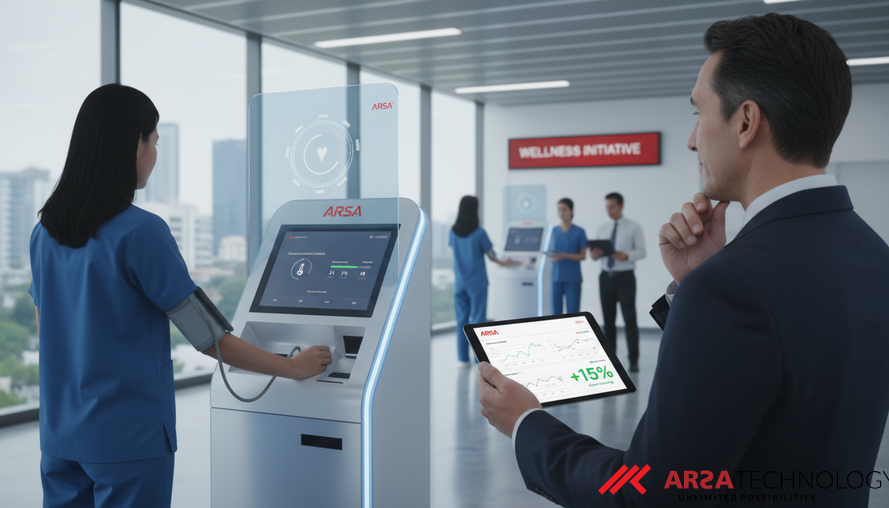
The ARSA Self-Check Health Kiosk is an AI and IoT-powered digital health station designed for autonomous health screening, allowing staff to measure vital signs quickly and accurately without direct medical personnel intervention. This article delves into the tangible Return on Investment (ROI) and strategic advantages that ARSA’s solution offers to hospitals and large enterprises.
The Growing Burden of Occupational Health Costs
Traditional occupational health programs often involve manual vital sign checks, which are time-consuming and resource-intensive. For hospitals, this translates into nursing staff being diverted from critical care duties to routine screenings, leading to:
- Clinic Congestion: Routine vital checks can consume a significant portion of healthcare staff time, creating bottlenecks at intake desks and delaying patient flow.
- Workplace Health Blind Spots: Without consistent, real-time data, corporations often lack visibility into employee health trends, leading to undetected chronic conditions and compounding productivity losses from absenteeism.
- Inconsistent Screening: Manual measurements are prone to human error, and fragmented paper records hinder effective trend analysis and early intervention strategies.
- High Cost Per Screening: Traditional nurse-administered vital checks can be expensive, making it economically unsustainable to scale preventive health programs across a large workforce.
These challenges highlight a clear need for a more efficient, accurate, and scalable approach to employee health screening.
Introducing the ARSA Self-Check Health Kiosk: An Intelligent Solution
The ARSA Self-Check Health Kiosk is an autonomous, medical-grade vitals station that addresses these pain points directly. It integrates AI and IoT to provide a comprehensive health screening experience in approximately 90 seconds.
Core functions include:
- Blood Pressure Monitoring: Accurate, medical-grade BP tunnel-type sensors.
- Blood Oxygen Measurement (SpO2): Real-time oxygen saturation readings.
- Heart Rate Monitoring: Precise heart rate detection.
- AI-Powered Romberg Test: An innovative AI-based procedure to assess balance, crucial for roles requiring physical stability.
- Non-Contact Temperature Measurement: Embedded thermal camera for quick, hygienic temperature checks.
- Identity Verification: Secure face recognition or QR-based identification with GDPR/HIPAA encryption.
The kiosk is designed for self-service, featuring a multi-language UI with voice guidance, making it accessible and user-friendly for diverse workforces. All vital user data is recorded and displayed on a web-based dashboard, offering instant digital records and aggregated analytics for population health management.
How ARSA AI Health Kiosks Reduce Occupational Health Costs with AI Health Kiosk
Implementing the ARSA Self-Check Health Kiosk directly impacts a hospital’s bottom line by significantly reducing operational expenditures associated with occupational health.
Firstly, the kiosk’s self-service nature allows for the automation of routine vital checks. This critical shift can replace the need for 2-3 full-time equivalent (FTE) nurses per shift dedicated solely to screenings. By reallocating nursing staff to critical care or higher-value patient interactions, hospitals can dramatically increase billable consultation capacity and improve overall patient throughput. The ROI from labor reallocation alone can be achieved in as little as 14-18 months.
Secondly, the system’s ability to provide a self-service health check reduces clinic visits for routine measurements. Employees can complete their screenings quickly at convenient on-site locations, minimizing time away from their duties and reducing the administrative burden on clinic staff. This streamlined process directly contributes to lower operational costs per screening.
Furthermore, the kiosk’s intelligent features, such as automatic anomaly flagging against user thresholds and smart triage alerts, play a crucial role. AI flags critical readings (e.g., hypertension >140/90, fever >38°C, SpO2 <94%) and can auto-route alerts to on-call physicians. This proactive approach reduces emergency response time by up to 73%, preventing minor health issues from escalating into costly medical emergencies or prolonged absenteeism.
The Tangible ROI of Employee Health Screening Kiosks
Beyond direct labor savings, the ROI of employee health screening kiosk solutions extends to several key areas:
- Increased Productivity: Healthy employees are productive employees. By making health screening convenient and regular, the kiosk encourages staff to monitor their well-being, leading to fewer sick days and improved on-the-job performance.
- Compliance and Risk Mitigation: For industries with strict safety regulations, such as manufacturing, regular health screenings are often mandatory. The kiosk provides an auditable, consistent record of compliance, reducing the risk of penalties and legal liabilities.
- Enhanced Corporate Wellness Programs: The aggregated, de-identified data from the kiosks provides valuable insights into population health trends. This data empowers HR and occupational health departments to design targeted wellness programs, potentially leveraging data-backed wellness initiatives for insurance premium reductions.
- Scalability Without Compromise: A single ARSA dashboard can manage 1 to 1000 kiosks across multiple facilities. Centralized firmware updates and predictive maintenance features minimize downtime, ensuring the system remains operational and cost-effective as your organization scales.
Beyond Cost Savings: Enhancing Workforce Health and Productivity
While cost reduction is a primary driver, the ARSA Self-Check Health Kiosk also significantly improves overall workforce health. The early detection employee health issues technology embedded in the kiosk allows for proactive intervention. By identifying potential health concerns like elevated blood pressure or low oxygen saturation early, employees can seek medical attention before conditions worsen, leading to better health outcomes and reduced long-term healthcare costs.
This is particularly vital for sectors like manufacturing, where physical demands are high. Preventive health monitoring for manufacturing workers helps identify risks related to fatigue, cardiovascular health, or balance (via the Romberg test), ensuring workers are fit for duty and reducing the likelihood of workplace accidents. The continuous monitoring capability fosters a culture of health and safety.
ARSA Technology’s commitment to data sovereignty, offering on-premise or hybrid cloud deployment options, ensures full compliance with regulations like EU GDPR and Indonesia PDPA. This provides hospital decision-makers with peace of mind regarding sensitive employee health data. For robust identity management, the kiosk can also integrate with systems utilizing the ARSA Face Recognition & Liveness API, ensuring secure and accurate user identification.
Seamless Integration and Future-Proofing
The ARSA Self-Check Health Kiosk is designed for seamless integration into existing IT infrastructures. With WiFi and Ethernet connectivity, along with REST API integration, it can easily connect to your current health record systems, HR platforms, or custom dashboards. This flexibility ensures that the data collected is actionable and contributes to a holistic view of employee health.
As part of all ARSA products, the Health Kiosk is built on a foundation of proven AI and IoT expertise, ensuring a production-grade solution, not an experimental one. ARSA Technology, with over seven years of experience serving government and enterprise clients, understands the need for reliable, scalable, and secure systems.
Conclusion
For hospital decision-makers looking to significantly reduce occupational health costs with AI health kiosk technology, the ARSA Self-Check Health Kiosk offers a compelling solution. It delivers substantial ROI through labor reallocation, increased efficiency, and proactive health management, while simultaneously fostering a healthier, more productive workforce. By automating routine screenings, enabling early detection of health issues, and providing robust data for wellness programs, ARSA empowers hospitals to optimize their occupational health strategies.
Ready to transform your hospital’s occupational health program and realize significant cost savings? Contact ARSA solutions team today to request a quotation and explore how the Self-Check Health Kiosk overview can benefit your organization.
—
FAQ
What is the typical ROI timeframe for implementing an employee health screening kiosk?
Based on labor reallocation and increased patient throughput, hospitals can typically achieve a Return on Investment (ROI) from the ARSA Self-Check Health Kiosk in 14-18 months. This is primarily driven by reducing the need for medical personnel for routine vital checks.
How does early detection employee health issues technology benefit a hospital’s workforce?
Early detection technology, like that in the ARSA Health Kiosk, allows for the proactive identification of potential health concerns (e.g., hypertension, low SpO2) before they escalate. This leads to timely medical intervention, better health outcomes for employees, reduced absenteeism, and lower long-term healthcare costs for the organization.
Can a self-service health check reduce clinic visits and improve efficiency?
Absolutely. By providing an accessible, on-site self-service health check, employees can quickly complete routine screenings without needing to schedule or attend traditional clinic appointments. This significantly reduces clinic congestion, frees up medical staff for critical care, and minimizes employee time away from their duties, thereby improving overall operational efficiency.
Is the ARSA Self-Check Health Kiosk suitable for preventive health monitoring for manufacturing workers?
Yes, the ARSA Self-Check Health Kiosk is highly suitable for preventive health monitoring for manufacturing workers. It offers vital sign measurements (BP, SpO2, heart rate) and an AI-powered Romberg test to assess balance, which are crucial for physically demanding roles. This helps ensure workers are fit for duty, supports safety compliance, and reduces the risk of workplace accidents.
—
Stop Guessing, Start Optimizing.
Discover how ARSA Technology drives profit through intelligent systems.
