
How to Reduce Occupational Health Costs with AI Health Kiosk Technology
For CFOs and plant managers, the rising tide of occupational health costs presents a significant challenge. From managing worker absenteeism and chronic conditions to ensuring compliance and preventing workplace accidents, traditional health monitoring methods often fall short, leading to inefficiencies and escalating expenses. The good news is that advanced technology offers a powerful solution: the AI health kiosk. Deploying an intelligent, self-service health station can fundamentally transform how businesses approach employee wellness, leading to substantial savings and a healthier workforce.
This guide explores how AI health kiosks, particularly those leveraging edge computing, can help you reduce occupational health costs with AI health kiosk technology, enhance operational efficiency, and foster a proactive health culture. We’ll compare deployment models and highlight the tangible benefits for your bottom line.
The Escalating Burden of Traditional Occupational Health Management
Many organizations still rely on manual processes or infrequent health checks, which are inherently inefficient and costly. Consider the typical challenges:
- Time-consuming manual checks: Nurses or medical personnel spend significant time on routine vital sign measurements, diverting resources from critical care. This contributes to clinic congestion and delays.
- Inconsistent data and human error: Manual data entry is prone to mistakes, leading to fragmented records and hindering effective trend analysis for population health management.
- Delayed detection of health issues: Infrequent check-ups mean that early detection of employee health issues technology is often missed, allowing conditions to worsen before intervention. This results in more severe health outcomes and higher treatment costs.
- High cost per screening: Each nurse-administered vital check incurs a direct labor cost, making large-scale preventive health programs economically unsustainable for many enterprises.
These factors collectively contribute to a reactive approach to employee health, where costs are incurred after problems arise, rather than prevented.
Understanding AI Health Kiosks: A Paradigm Shift in Workplace Wellness
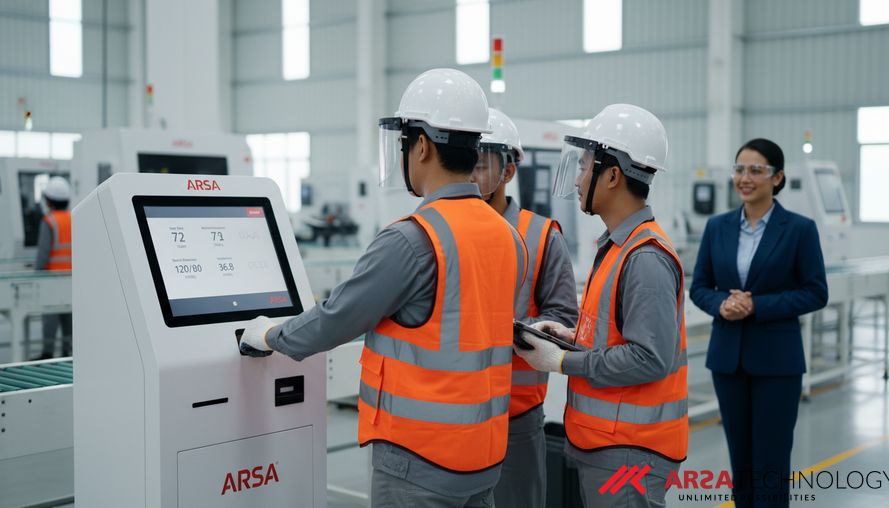
An AI health kiosk is an autonomous, self-service station equipped with medical-grade sensors and artificial intelligence to measure vital signs and conduct basic health screenings. These kiosks empower employees to perform quick, accurate health checks on their own, integrating the data into a digital health record system.
Key functions typically include:
- Blood pressure monitoring
- Blood oxygen measurement (SpO2)
- Heart rate monitoring
- Body temperature measurement
- AI-powered Romberg test for balance assessment
- Optional measurements like weight, height, BMI, glucose, and cholesterol.
By automating these routine tasks, AI health kiosks offer a scalable and consistent solution for preventive health monitoring for manufacturing workers and employees across all sectors.
Edge AI vs. Cloud: Optimizing Your Health Monitoring Deployment
When considering an AI health kiosk, a critical decision revolves around its underlying architecture: edge AI or cloud-based processing. While both have merits, the choice significantly impacts data privacy, latency, and operational costs.
Edge AI Health Kiosks: The On-Premise Advantage
Edge AI kiosks, like the ARSA Self-Check Health Kiosk, process data directly on the device or within your local network. This deployment model offers distinct advantages for businesses prioritizing data sovereignty and real-time insights:
- Enhanced Data Privacy and Security: With edge processing, sensitive biometric and health data remains within your infrastructure. This is crucial for compliance with regulations like GDPR and HIPAA, ensuring that no personal health information leaves your premises unless explicitly configured for secure, aggregated reporting. For a CFO, this means mitigating significant legal and reputational risks associated with data breaches.
- Minimal Latency for Real-Time Alerts: Processing at the edge ensures immediate analysis of vital signs. This low latency is essential for smart triage alerts, where critical readings (e.g., high blood pressure, low SpO2) can trigger instant notifications to on-call physicians or safety personnel. Reducing emergency response time by up to 73%, as seen with ARSA’s solution, directly translates to better health outcomes and potentially lower emergency medical costs.
- Offline Operation Capability: Edge AI kiosks can function independently of a constant internet connection. This is invaluable for facilities in remote locations or environments with unreliable network access, ensuring continuous health monitoring without interruption.
- Reduced Cloud Costs: By minimizing data transfer to the cloud, edge solutions eliminate recurring cloud storage and processing fees, contributing directly to the ROI of employee health screening kiosk investments.
- Full Data Ownership: Organizations retain complete control over their health data, defining retention policies and access protocols in alignment with internal security and compliance reviews.
Cloud-Based Health Monitoring: Pros and Cons
Cloud-based solutions centralize data processing and storage on remote servers.
- Pros: High scalability, easy remote management, and access to advanced analytics tools without significant on-premise IT infrastructure.
- Cons:
- Data Privacy Concerns: Sending sensitive health data to external cloud servers raises significant privacy and compliance questions, especially for regulated industries.
- Internet Dependency: A stable and robust internet connection is mandatory for continuous operation, making it vulnerable to network outages.
- Latency Issues: Data must travel to and from the cloud for processing, which can introduce delays, potentially impacting the speed of critical alerts.
- Ongoing Cloud Costs: While initial setup might be lower, recurring subscription and data transfer fees can accumulate, impacting long-term operational budgets.
For organizations like manufacturing plants, where data privacy, operational reliability, and cost control are paramount, the advantages of edge AI for health screening are compelling.
How ARSA’s Self-Check Health Kiosk Helps Reduce Occupational Health Costs with AI Health Kiosk
ARSA Technology’s Self-Check Health Kiosk is specifically engineered to address the challenges of occupational health, offering a robust solution to reduce occupational health costs with AI health kiosk technology. This AI & IoT-powered digital health station provides autonomous health screening, delivering fast, accurate measurements without requiring medical personnel for routine checks.
- Automated, Medical-Grade Screening: The kiosk integrates FDA/CE-certified sensors for precise blood pressure, SpO2, and heart rate monitoring, alongside an AI-based Romberg test for balance. This self-service health check reduces clinic visits and frees up valuable healthcare staff time, potentially replacing 2-3 full-time equivalent (FTE) nurses per shift. This labor reallocation alone can achieve ROI in 14-18 months.
- Early Detection and Smart Triage: The kiosk acts as an early detection employee health issues technology. Its AI automatically flags critical readings against user-defined thresholds (e.g., hypertension >140/90, fever >38°C, SpO2 <94%) and can auto-route alerts to on-call physicians. This proactive approach significantly reduces emergency response times and allows for timely intervention, preventing minor issues from becoming major health crises.
- Comprehensive Data & Reporting: All vital user data is recorded and displayed on a secure, web-based dashboard. Employers gain access to aggregated, de-identified analytics for population health management, enabling data-backed corporate wellness programs and even leveraging data for insurance premium reductions. Employees receive instant digital reports via SMS/email.
- Seamless Integration and Scalability: Designed for on-site installation, the ARSA Health Kiosk offers flexible deployment options (on-premise or hybrid cloud) to ensure full compliance with data sovereignty regulations like EU GDPR and Indonesia PDPA. With a single dashboard managing 1-1000 kiosks, it’s a scalable solution for enterprises of any size. The system also supports API integration for connecting with existing HR or access control systems, including identity verification via face recognition or QR code, leveraging technologies like the ARSA Face Recognition & Liveness API for secure access.
Implementing Preventive Health Monitoring for Manufacturing Workers
For manufacturing environments, the benefits are particularly pronounced. Pre-shift health screening can identify workers who might be at risk due to elevated blood pressure, fatigue (Romberg test), or other vital sign anomalies. This not only safeguards the individual worker but also enhances overall workplace safety by preventing incidents caused by impaired health.
By integrating the ARSA Self-Check Health Kiosk into your daily operations, you can:
- Automate Pre-Shift Screening: Ensure workers are fit for duty before entering hazardous zones, reducing accident rates.
- Track Workforce Health Trends: Identify patterns in health data to implement targeted wellness initiatives.
- Improve Compliance: Maintain detailed, digital health records for regulatory audits.
- Boost Employee Morale: Demonstrate a commitment to employee well-being, fostering a healthier, more productive workforce.
This proactive preventive health monitoring for manufacturing workers directly contributes to a safer, more efficient, and ultimately more profitable operation.
The Tangible ROI of Employee Health Screening Kiosk
Investing in an AI health kiosk isn’t just about employee well-being; it’s a strategic financial decision. The ROI of employee health screening kiosk solutions like ARSA’s is realized through:
- Reduced Healthcare Costs: Lower claims from fewer chronic conditions and emergency interventions.
- Decreased Absenteeism: Healthier employees mean fewer sick days and higher productivity.
- Improved Productivity: A healthy workforce is a more engaged and efficient workforce.
- Enhanced Safety: Proactive screening reduces workplace accidents and associated costs.
- Compliance Savings: Avoid penalties and legal costs associated with non-compliance in health and safety regulations.
The ability for a self-service health check reduces clinic visits and the associated administrative burden, further amplifying these savings.
Ready to Transform Your Occupational Health Strategy?
The choice between edge AI and cloud for health monitoring is clear for organizations seeking control, privacy, and immediate insights. By adopting an advanced AI health kiosk, businesses can significantly reduce occupational health costs with AI health kiosk technology, moving from reactive spending to proactive health investment. ARSA Technology is committed to delivering practical, proven, and profitable AI and IoT solutions that meet the demands of mission-critical enterprises.
Explore the full range of all ARSA products, including our Self-Check Health Kiosk overview, and discover how our solutions can be tailored to your specific operational realities. To learn more about how ARSA Technology can help your organization implement a cutting-edge health screening solution, contact ARSA solutions team today for a consultation.
FAQ
What is the primary benefit of using an AI health kiosk to reduce occupational health costs?
The primary benefit is automating routine health screenings, which significantly reduces the need for medical personnel, lowers the cost per screening, and enables early detection of employee health issues, ultimately leading to fewer severe health incidents and lower overall healthcare expenditures.
How does an ARSA Self-Check Health Kiosk provide early detection of employee health issues technology?
The ARSA Self-Check Health Kiosk uses medical-grade sensors and AI to measure vital signs like blood pressure, heart rate, and SpO2. Its “Smart Triage Alerts” automatically flag critical readings and can notify medical staff, providing an early detection employee health issues technology that allows for timely intervention before conditions escalate.
What is the typical ROI of employee health screening kiosk investments?
The ROI of employee health screening kiosk solutions can be achieved within 14-18 months through labor reallocation (reducing the need for 2-3 FTE nurses per shift), decreased absenteeism, improved productivity, enhanced workplace safety, and compliance savings.
How does a self-service health check reduces clinic visits and staff burden?
A self-service health check reduces clinic visits by empowering employees to perform their own vital sign measurements quickly and accurately. This automation frees up healthcare staff from routine tasks, allowing them to focus on more critical patient care and reducing congestion at intake desks.
Stop Guessing, Start Optimizing.
Discover how ARSA Technology drives profit through intelligent systems.
