

Understanding How to Automate PPE Compliance Monitoring with AI: A Business Leader’s Guide
In today’s industrial landscape, ensuring the safety of personnel is paramount, especially in dynamic environments like warehouses. Traditional methods of Personal Protective Equipment (PPE) compliance monitoring often rely on manual inspections, which are prone to human error, inconsistent, and resource-intensive. This is where artificial intelligence (AI) steps in, offering a transformative solution. For HSE managers and business leaders, understanding how to automate PPE compliance monitoring with AI is no longer a luxury but a strategic imperative to enhance safety, reduce incidents, and ensure regulatory adherence.
The integration of AI into existing CCTV infrastructure allows for continuous, objective, and scalable monitoring, fundamentally changing how organizations approach workplace safety. By leveraging advanced computer vision, businesses can move from reactive incident management to proactive prevention, safeguarding their most valuable asset: their people.
The Challenges of Manual PPE Compliance in Warehouses
Warehouses are bustling hubs of activity, characterized by heavy machinery, moving goods, and a constant flow of personnel. In such environments, the consistent use of PPE—like hard hats, safety vests, and eye protection—is critical. However, manual monitoring presents significant challenges:
- Human Error and Inconsistency: Human observers can miss violations, especially in large or complex areas, or during long shifts. Fatigue and distraction can lead to oversight.
- High Labor Costs: Deploying dedicated personnel solely for PPE monitoring is expensive and diverts resources from other critical safety functions.
- Limited Coverage: It’s impractical to have human monitors cover every corner of a vast warehouse 24/7, leaving blind spots where violations can occur undetected.
- Lack of Real-time Alerts: Manual systems often identify violations retrospectively, after an incident has already occurred, rather than preventing it in real-time.
- Inefficient Reporting: Compiling compliance reports from manual observations is time-consuming and often lacks the granular data needed for effective analysis and improvement.
These challenges underscore the need for a more robust, efficient, and reliable approach to PPE compliance.
How to Automate PPE Compliance Monitoring with AI
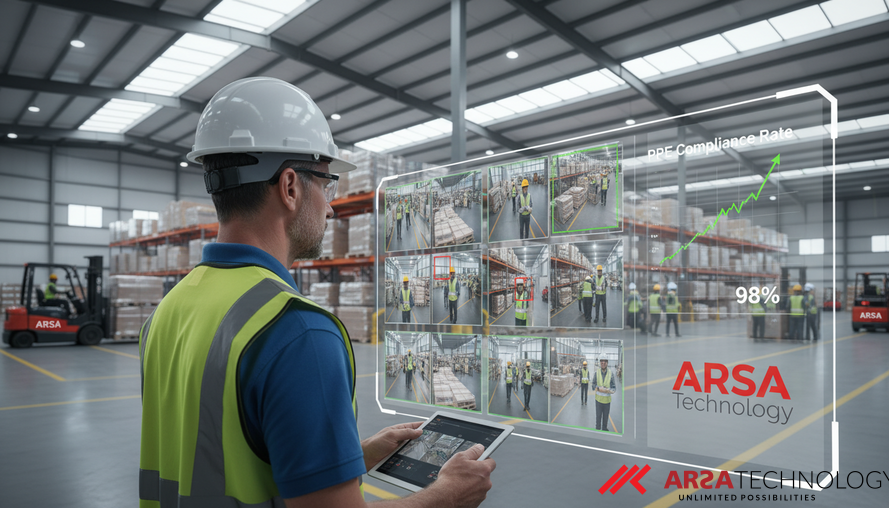
Automating PPE compliance monitoring with AI involves deploying intelligent video analytics software that can process live or recorded CCTV feeds to detect whether individuals are wearing the required safety gear. This process typically follows several key steps:
1. Data Acquisition: Existing CCTV cameras capture video footage of the workplace. ARSA’s AI Video Analytics Software overview is hardware-agnostic, meaning it can integrate seamlessly with your current camera systems without requiring costly hardware upgrades.
2. AI Model Training: Advanced computer vision models are trained on vast datasets of images and videos to recognize various types of PPE (e.g., hard hats, safety vests, gloves, masks) and identify their presence or absence on individuals. These models are continuously refined for high accuracy.
3. Real-time Analysis: The AI software processes video streams in real-time, frame by frame, to detect individuals and analyze their attire against predefined PPE requirements. This allows for immediate identification of non-compliance.
4. Alert Generation: Upon detecting a violation, the system automatically generates real-time safety violation alerts with edge AI. These alerts can be sent to HSE managers, supervisors, or even directly to the individual via integrated communication systems, enabling immediate intervention.
5. Data Logging and Reporting: All detections, violations, and compliance events are logged, providing a comprehensive audit trail. This data is then used to generate detailed compliance reports, identify trends, and inform safety training programs.
ARSA Technology’s ARSA Basic Safety Guard (Software) is specifically designed for this purpose. It offers a powerful, self-hosted solution that transforms your existing video infrastructure into an intelligent safety monitoring system.
Key Capabilities of an AI PPE Detection System for Construction Sites and Warehouses
While the primary focus here is warehouses, the capabilities of an AI PPE detection system are highly transferable to other high-risk environments like construction sites.
- Automated Hard Hat Detection Using CCTV: This is a core function. The AI can reliably identify if workers are wearing hard hats in designated areas, even in challenging lighting conditions or with varying angles.
- Safety Vest and Other PPE Detection: Beyond hard hats, the system can detect safety vests, eye protection, gloves, and even specialized gear required for specific tasks.
- Restricted Area Monitoring: The AI can define virtual boundaries for restricted zones and alert if unauthorized personnel enter without proper clearance or PPE. This is crucial for preventing accidents in hazardous areas.
- Behavioral Anomaly Detection: Advanced systems can also identify unusual behaviors that might indicate a safety risk, such as loitering in dangerous zones or operating machinery without proper safety protocols.
- Centralized Dashboard and Analytics: All data and alerts are aggregated into a user-friendly dashboard, providing HSE managers with a single pane of glass for monitoring safety across multiple sites or large facilities. This allows for quick insights into compliance rates, common violations, and areas needing improvement. You can try our live dashboard demo to see how such insights are presented.
ARSA Basic Safety Guard: On-Premise AI for Uncompromised Workplace Safety
ARSA Technology understands that for many enterprises and government entities, data privacy, security, and control are non-negotiable. That’s why our ARSA Basic Safety Guard is offered as a fully self-hosted, on-premise software platform.
- No Cloud Dependency, Full Data Ownership: With ARSA Basic Safety Guard, all video streams, inference results, and metadata remain entirely within your infrastructure. There’s no external data transfer, ensuring complete data sovereignty and compliance with strict privacy regulations like GDPR and Indonesia PDPA. This is particularly vital for privacy-sensitive environments.
- Hardware-Agnostic Deployment: You can deploy the software on your existing servers, private data centers, or edge compute infrastructure. This eliminates the need for purchasing dedicated AI appliances, making it a cost-effective solution that integrates seamlessly with your current IT strategy.
- Scalable by Design: As your operational needs grow, you can scale the analytics capacity by simply allocating more compute resources, rather than installing new physical devices at each location.
- Integration Ready with REST API: The software is designed for easy integration using its REST API with existing dashboards, alerting systems, and data pipelines. This means you can enhance your current safety management systems without a complete overhaul.
- Compliance-Ready Reporting: The system provides detailed event logs and historical analytics, which are invaluable for compliance audits, incident investigations, and demonstrating due diligence to regulatory bodies.
By choosing an on-premise solution like ARSA Basic Safety Guard, organizations gain unparalleled control over their safety infrastructure, ensuring that sensitive operational data never leaves their secure network.
Transforming Workplace Safety with CCTV AI Analytics for Workplace Safety
The impact of integrating CCTV AI analytics for workplace safety extends far beyond simple detection. It creates a culture of continuous improvement and proactive risk management.
- Reduced Accidents and Injuries: Real-time alerts and consistent monitoring significantly reduce the likelihood of accidents caused by PPE non-compliance.
- Enhanced Operational Efficiency: By automating monitoring, safety personnel can focus on higher-value tasks like training, risk assessments, and emergency response, rather than tedious surveillance.
- Cost Savings: Lower incident rates lead to reduced insurance premiums, fewer worker’s compensation claims, and minimized downtime from accidents. The efficiency gained from automated monitoring also reduces labor costs associated with manual checks.
- Improved Compliance Posture: Automated, data-driven reporting provides irrefutable evidence of compliance efforts, simplifying audits and demonstrating a commitment to safety regulations.
- Data-Driven Safety Insights: The collected data allows HSE managers to identify patterns, pinpoint high-risk areas or times, and tailor safety training programs for maximum effectiveness. For instance, if the system frequently detects missing hard hats in a specific zone, it highlights a need for targeted intervention or signage.
ARSA Technology’s seven years of experience in deploying AI solutions for government and enterprise clients across various demanding industries, including manufacturing and industrial, positions us as a trusted partner in this transformation. Our commitment to “Technology with Impact” means we engineer systems that deliver measurable outcomes in the real world.
Frequently Asked Questions
What is an AI PPE detection system for construction sites and warehouses?
An AI PPE detection system uses computer vision technology to automatically monitor video feeds from existing CCTV cameras, identifying whether workers are wearing required Personal Protective Equipment (PPE) such as hard hats, safety vests, and eye protection in real-time. This system generates alerts for non-compliance and provides data for safety reporting.
How does automated hard hat detection using CCTV work?
Automated hard hat detection leverages AI models trained to recognize hard hats in various orientations and lighting conditions within CCTV footage. When a person is detected in a designated area without a hard hat, the system flags it as a violation and triggers an alert.
Can ARSA’s AI Video Analytics Software integrate with my existing security infrastructure?
Yes, ARSA AI Video Analytics Software is hardware-agnostic and designed to integrate with your existing CCTV cameras and IT infrastructure. It provides a REST API for seamless connection with your current dashboards, alerting systems, and data pipelines, ensuring a smooth deployment without vendor lock-in.
What are the benefits of using CCTV AI analytics for workplace safety?
Using CCTV AI analytics for workplace safety leads to reduced accidents, improved compliance, significant cost savings by automating monitoring, enhanced operational efficiency as safety personnel are freed from manual tasks, and data-driven insights for continuous safety improvements. It enables proactive rather than reactive safety management.
Conclusion
The question of how to automate PPE compliance monitoring with AI has a clear and compelling answer: through robust, on-premise AI video analytics solutions like ARSA Basic Safety Guard. For HSE managers in warehouses and other industrial settings, this technology represents a significant leap forward in ensuring worker safety, streamlining operations, and maintaining stringent compliance standards. By transforming passive CCTV footage into actionable, real-time intelligence, ARSA Technology empowers organizations to create safer, more efficient workplaces with full control over their data.
Ready to explore how ARSA Technology can enhance your workplace safety? Contact our solutions team today for a consultation or to request a quotation for our full range of AI products.
Stop Guessing, Start Optimizing.
Discover how ARSA Technology drives profit through intelligent systems.
