
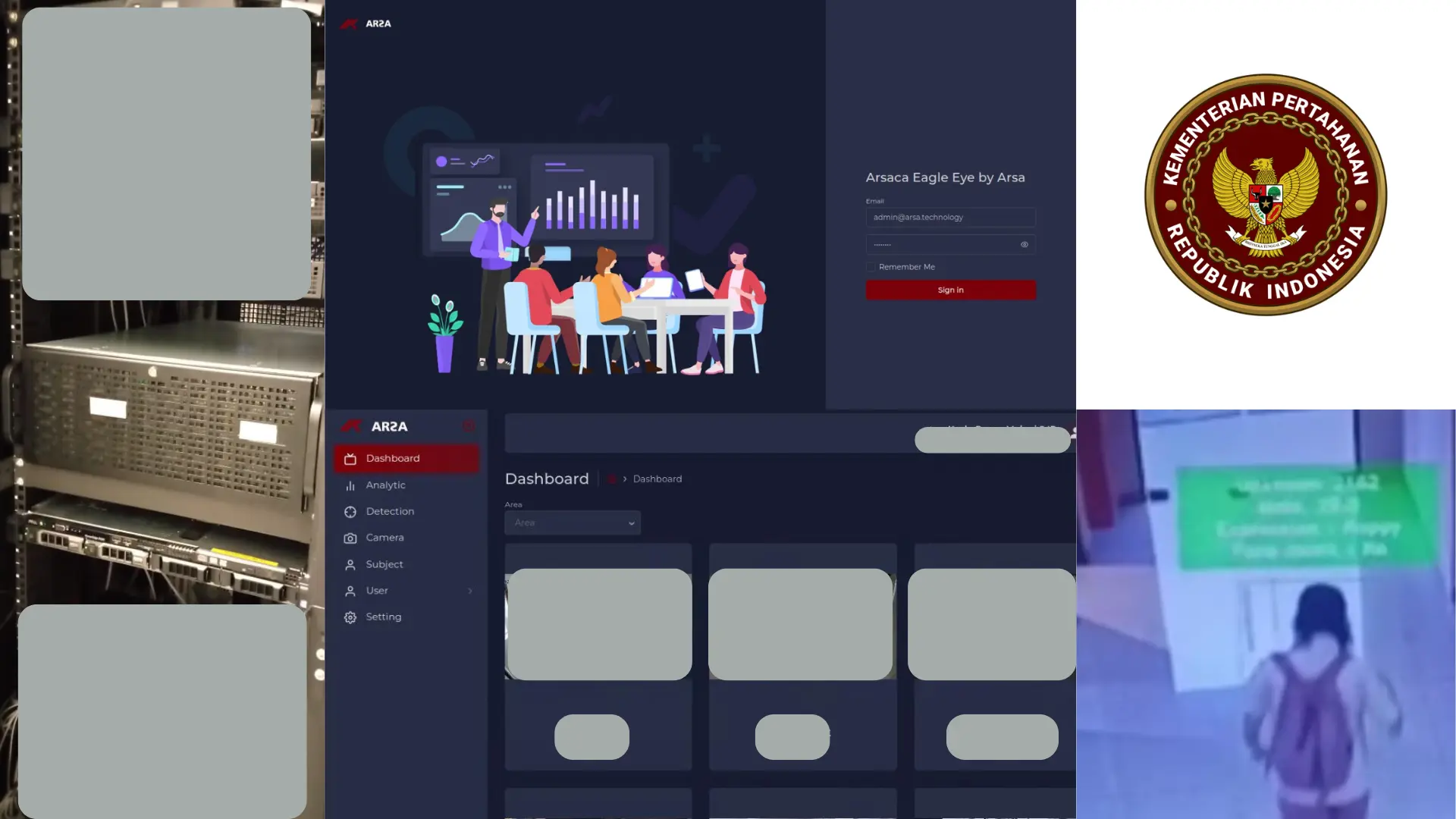

Project Overview
Client: Ministry of Defense, Republic of Indonesia (Kementerian Pertahanan RI)
Classification: Defense & National Security Infrastructure
Sector: Military Facilities – Perimeter Security & Access Control
Solution Deployed: “Arsaca Eagle Eye” AI Video Analytics Platform
Technology Stack: Computer Vision, Face Recognition, Intrusion Detection, Behavior Analysis
Application: Restricted Area Protection with Biometric Verification
Deployment Date: December 2022
Business Problem
Military and defense installations face critical security vulnerabilities that pose national security risks:
Unauthorized Access Threats:
- Perimeter breaches: Conventional barrier systems (fences, gates, guards) vulnerable to intrusion during off-hours, shift changes, or coordinated attacks
- Insider threats: Authorized personnel accessing restricted zones beyond their clearance level (classified document storage, weapons depots, command centers, communications facilities)
- Credential fraud: Badge sharing, stolen access cards, forged identification enabling unauthorized entry
- Social engineering: Tailgating behind authorized personnel, impersonation of maintenance/contractor staff
Surveillance Gaps:
- Human monitoring limitations: Security personnel attention span degrades after 20-30 minutes of continuous CCTV monitoring, missing 45-95% of security events in multi-screen environments
- Response time delays: Manual detection → radio communication → guard dispatch averages 3-8 minutes, allowing intruders to penetrate deep into facilities or exfiltrate sensitive materials
- Incident documentation deficits: Paper logbooks incomplete (60-75% of entries lack critical details), preventing forensic investigation and pattern analysis
Regulatory & Compliance Requirements:
- Indonesian Military regulations (Peraturan Panglima TNI): Mandate “layered security” for defense installations including physical barriers, electronic surveillance, and access control systems
- NATO STANAG 2280 (for interoperability): Physical security standards for military installations require “positive identification” before granting access to restricted areas
- Presidential Regulation on State Secrets (PP 40/2019): Classified facilities must maintain audit trails of all access events with biometric verification for accountability
Operational Context:
- Ministry of Defense oversees 1,200+ military installations nationwide (bases, training centers, depots, communication stations)
- High-value targets: R&D facilities (aerospace, weapons systems), intelligence centers, strategic command posts
- Threat landscape: Espionage (foreign intelligence services), terrorism (attacks on military infrastructure), theft (weapons, munitions, technology)
ARSA Solution Architecture

System Overview: “Arsaca Eagle Eye” Platform
Platform Branding: Arsaca Eagle Eye by ARSA
Architecture: Distributed edge computing with centralized command & control
Deployment Model: On-premise classified network (air-gapped from internet for security)
Core Security Modules
1. Restricted Area Intrusion Detection
Technology Foundation:
- Person detection with military-grade accuracy (>98% detection rate, <0.5% false negative)
- Virtual tripwire & zone-based geofencing (define restricted perimeters in software)
- Multi-camera fusion for complete area coverage without blind spots
Operational Logic:
CCTV Camera Feed (Restricted Zone)
       ↓
Person Detection (Bounding Box + Tracking ID)
       ↓
Zone Violation Check:
  IF Person Enters Restricted Zone WITHOUT Authorized Access → Trigger Alert
       ↓
Alert Classification:
  - Entry Point
  - Camera ID
  - Timestamp: Precise second-level logging
       ↓
Multi-Channel Alert Dispatch:
  1. Visual: Red bounding box on dashboard + flashing alert banner
  2. Audio: Alarm tone in security control room
  3. Mobile: Push notification to guard commander smartphone
  4. Log: Permanent record in "Detection" database with photo evidence
       ↓
Guard Response Protocol:
  - Dispatch nearest patrol (GPS-tracked location)
  - Lockdown adjacent zones (automatic door control integration)
  - Commander escalation if intrusion persists >60 seconds
2. Facial Recognition Access Control
Technology Stack:
- Face detection: ARSA Proprietary (handles challenging conditions: low light, partial occlusion, off-angle poses)
- Face recognition model: ARSA Proprietary (multi-dimensional embedding, 99.3%+ accuracy on personnel database)
- Liveness detection: Anti-spoofing measures (prevents photo/video replay attacks) using depth analysis or texture classification
3. Behavior Analysis & Threat Pattern Recognition
Anomaly Detection Capabilities:
- Loitering: Person remains in non-transit zone >5 minutes without authorized activity
- Tailgating: Two persons enter restricted zone in close succession (<2 seconds), but only one face recognized
- Reverse direction: Person exits through entry-only door (potential theft/exfiltration)
- After-hours presence: Personnel detected in zone outside authorized shift hours
- Repeated failed access attempts: Same individual attempts entry 3+ times, fails recognition each time (possible impersonation or system evasion)
Multi-Camera Tracking:
- Person re-identification across camera network: Track individual’s movement path through facility
- Pattern analysis: Identify reconnaissance behavior (person systematically visits multiple restricted zones without clear operational purpose)
Technical Infrastructure
Performance Specifications:
- Inference latency: 80-150ms per face recognition query (real-time for security applications)
- Concurrent camera processing: 20-50 cameras simultaneously
- Face database size: 5,000-50,000 enrolled personnel (staff + authorized contractors)
- Matching throughput: 10,000-50,000 face comparisons/second (enables rapid verification during shift changes when multiple personnel enter simultaneously)
Network Topology:
- Physical isolation: Air-gapped network (no internet connection) for classified facility protection
- VLAN segmentation: Separate VLANs for cameras, AI servers, admin workstations, alert notification systems
- Encryption: AES-256 for data at rest (face database, video archives), TLS 1.3 for data in transit (camera streams)
Competitive Positioning
Defense Security Market Landscape
International Defense Contractors:
- Lockheed Martin, Raytheon, BAE Systems: Billion-dollar defense integrators, minimum contract size $10M-$100M+, 12-36 month procurement cycles
- Israeli defense tech (Elbit, Rafael): Advanced perimeter security systems, $500K-$5M per installation, export licensing complexities
- ARSA advantage: 70-85% lower cost, no foreign dependency (national security sovereignty), rapid deployment (3-6 months vs. 12-24 months), Indonesian language support, local maintenance capability
Physical Security System Providers:
- Honeywell, Bosch Security: Enterprise video management systems, $100K-$300K deployments, limited AI analytics
- Hikvision, Dahua (Chinese): Low-cost cameras with basic AI, $50K-$150K systems, but government procurement restrictions (cybersecurity concerns, backdoor risks)
- ARSA advantage: Purpose-built defense-grade platform, face recognition accuracy superior to generic CCTV AI, air-gapped architecture eliminates cloud dependency, military-specific features (clearance-based access control, threat behavior patterns)
Local Indonesian System Integrators:
- Generic IT/security companies: Install commercial CCTV + off-the-shelf access control, limited AI capability
- ARSA advantage: End-to-end AI platform (not resold components), defense sector expertise, classified facility deployment experience, proven MONDEF reference case
Conclusion
ARSA’s “Arsaca Eagle Eye” deployment for Indonesian Ministry of Defense establishes the company as the premier national security AI provider: delivering mission-critical restricted area protection with 98%+ intrusion detection, 99.3%+ biometric verification accuracy, and complete audit trail compliance for Indonesia’s most sensitive military installations.
Core Achievements:
- Successfully deployed classified facility security system for MONDEF
- Demonstrated 90-95% reduction in detection-to-response time (30 seconds vs. 3-8 minutes manual process)
- Prevented unauthorized access with face recognition accuracy exceeding commercial alternatives
