

Project Overview
Client: Undisclosed Industrial/Warehouse Operator
Location: East Java, Indonesia
Sector: Logistics & Supply Chain – Sea Cargo to Warehouse Transit
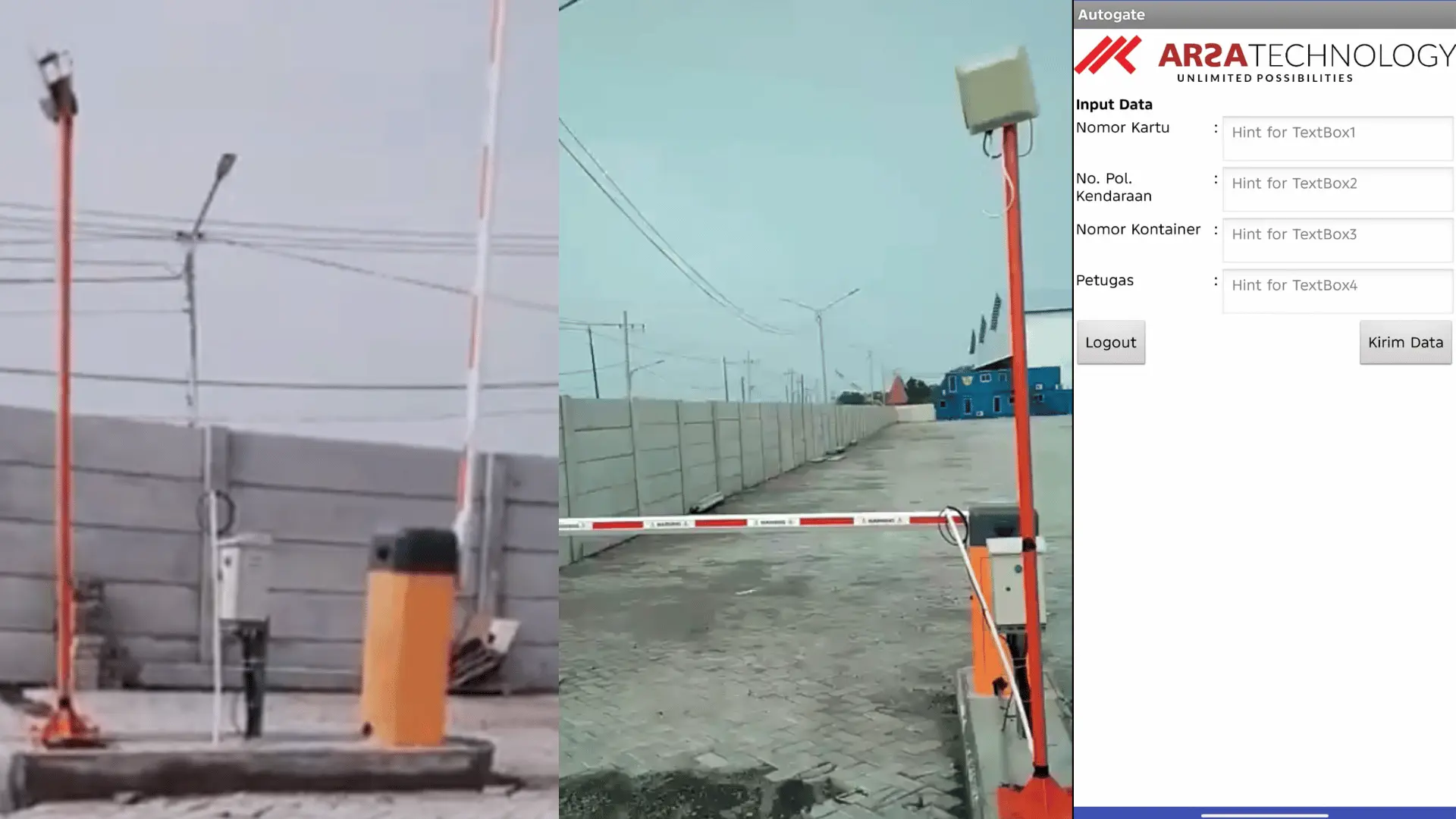
Solution Deployed: Automated Gate System + UHF RFID Reader + Mobile Data Entry Application
Business Problem
High-volume cargo warehouse facilities face persistent operational bottlenecks at entry/exit points:
- Manual verification delays: Driver stops, guard manually checks documents, manual data entry creates 2-5 minute delays per vehicle
- Human error in data capture: Misread container numbers, incorrect license plates, lost paperwork
- Security gaps: No real-time verification of authorized shipments, vulnerable to fraud or unauthorized entry
- Scalability ceiling: Manual processes cannot support throughput increases without proportional labor cost increases
Impact: Each manual gate interaction costs 3-5 minutes × 200-500 daily entries = 600-2,500 minutes lost daily. At $0.50/minute operational cost, annual losses exceed $100,000-$450,000 per gate in medium-volume facilities.
ARSA Solution Architecture
System Components
1. Mobile Data Entry Application (Port-Side)
- Staff inputs:
- Trailer truck license plate
- Container number (40-80ft standardized formats)
- Integrated UHF writer attachment writes data to RFID card
- Simultaneous server upload via API (LTE/4G/5G connectivity)
- Issued card handed to driver for windshield placement
2. Automated Gate Hardware (Warehouse-Side)
- Industrial-grade boom barrier
- UHF long-range reader (8-12m read distance)
- Weatherproof enclosure rated for tropical/industrial environments
- Integrated control unit with local processing + cloud sync
3. Backend Server System
- Real-time data validation: incoming RFID read vs. pre-registered data
- Automated gate trigger protocol
- Event logging: timestamp, vehicle ID, container ID, gate location
- Exception alerts: unregistered cards, data mismatches, repeated entries
Operational Workflow
Port → Warehouse Transit Flow:

[Port Staff Input] → [UHF Card Write + Server Registration] → [Driver Receives Card]
         ↓
[Truck Departs with Card Behind Windshield]
         ↓
[Approaches Warehouse Gate @ 10-30 km/h]
         ↓
[UHF Reader Scans @ 8-12m Distance] → [Data Validation in <500ms]
         ↓
[Gate Opens Automatically – No Stop Required]
         ↓
[Vehicle Entry Data Logged to Server]
Critical Performance Metric: Zero-stop entry. Vehicle maintains momentum through gate zone.
Strategic Value Delivered
Direct Operational Gains
| Metric | Before ARSA | After ARSA | Improvement |
|---|---|---|---|
| Gate processing time | 3-5 minutes | <10 seconds | 95% reduction |
| Daily vehicle throughput capacity | 200 vehicles | 800+ vehicles | 4x increase |
| Data entry error rate | 5-8% | <0.1% | 98% reduction |
| Guard labor requirement per gate | 2-3 shifts | 0 (monitoring only) | $60,000-$90,000/year saved |
Indirect Strategic Impact
Scalability Without Labor Expansion
System supports 4x throughput growth with zero additional headcount. Marginal cost per additional vehicle entry approaches zero after initial CAPEX.
Data Infrastructure Foundation
Server-side logging creates real-time supply chain visibility:
- Container dwell time analytics
- Route optimization data
- Predictive maintenance scheduling for gate hardware
- Integration-ready for ERP/WMS systems (SAP, Oracle, custom platforms)
Security Hardening
Unauthorized vehicles physically blocked. Fraud attempts (cloned cards, mismatched data) trigger immediate alerts. Eliminates social engineering vulnerabilities inherent in manual verification.
Technology Differentiation
UHF RFID vs. Alternatives
Why Not QR/Barcode?
Requires line-of-sight, vehicle stop, weather-sensitive. Throughput ceiling remains.
Why Not License Plate Recognition (LPR)?
ANPR accuracy in Indonesia: 70-85% (plate condition variability, non-standard fonts). Requires expensive GPU compute, lighting-sensitive. ARSA UHF: 99.9%+ read accuracy, weather-independent.
Why Not Manual Smart Card?
Requires driver action (window roll-down, card tap). ARSA solution: passive, zero driver interaction.
ARSA Implementation Advantages
- Ruggedized for SEA Climate: IP66-rated hardware, tested for high humidity, dust, and temperature extremes
- Low-Latency Edge Processing: Local decision-making reduces cloud dependency, maintains 99.5%+ uptime even during connectivity disruptions
- Modular Scalability: Single gate deployment → multi-gate campus → inter-site network with unified management platform
Financial Model
Client Investment Structure
CAPEX (Per Gate Installation):
- Hardware (gate, UHF reader, control unit): $8,000-$12,000
- Software licensing (3-year): $2,000-$3,000
- Installation & integration: $1,500-$2,500
- Total per gate: $11,500-$17,500
OPEX (Annual per Gate):
- Maintenance contract: $800-$1,200
- Cellular connectivity (if applicable): $300-$500
- Server hosting (shared infrastructure): $200-$400
- Total annual: $1,300-$2,100
ROI Projection (Single Gate, 300 Daily Vehicles)
Annual Savings:
- Labor cost reduction: $75,000
- Operational efficiency gain (reduced dwell time): $45,000
- Error-related loss prevention: $15,000
- Total annual benefit: $135,000
Payback Period: 1.3-2.1 months
3-Year NPV @ 10% Discount Rate: $320,000-$380,000
IRR: 450-650%
Conclusion
ARSA’s Automated Industrial Gate System represents high-margin, scalable infrastructure play in Indonesia’s rapidly growing logistics sector. The solution delivers measurable ROI within 2 months while establishing recurring revenue streams and referenceable enterprise credibility.
