
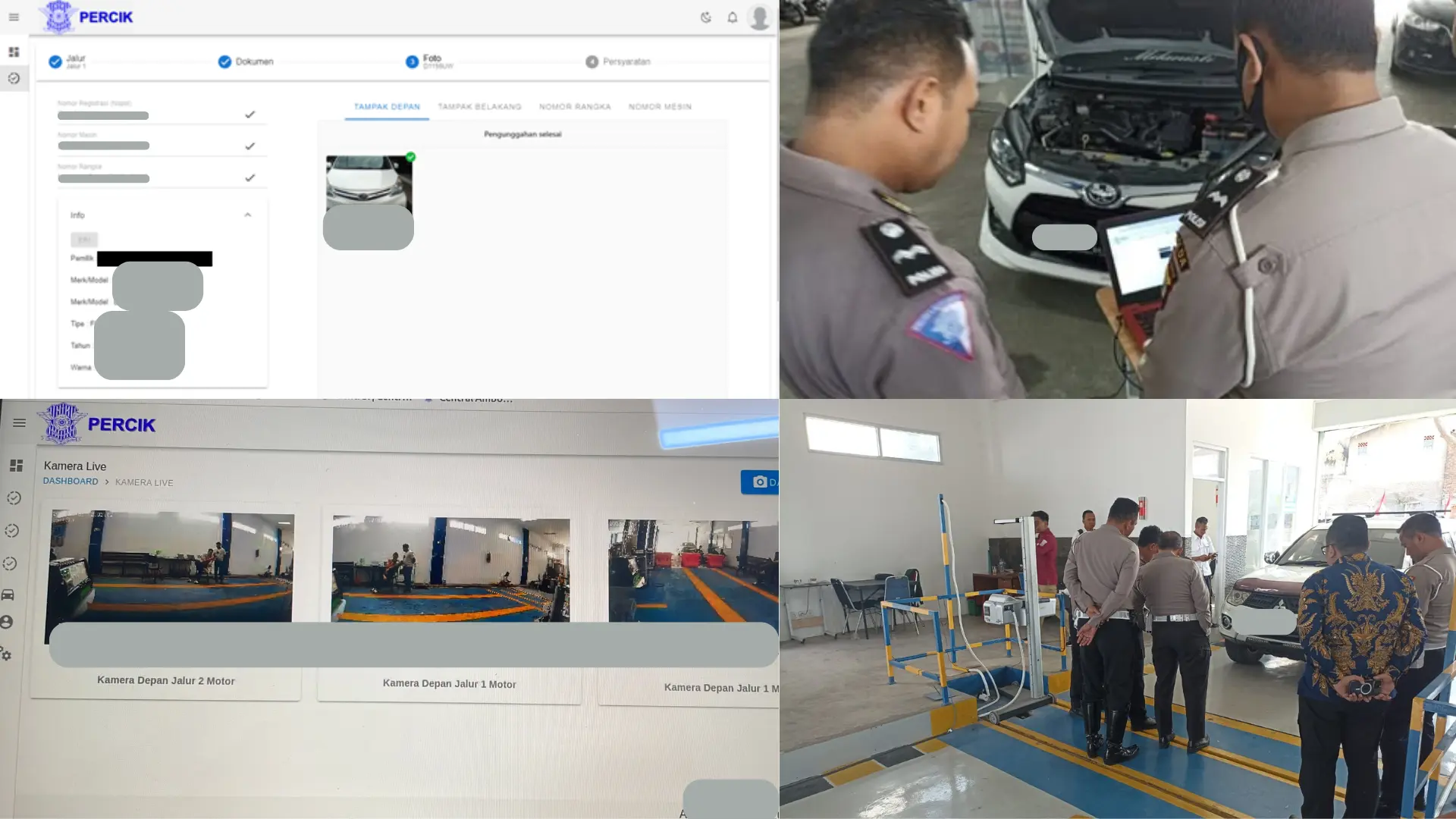

Project Overview
Client: Korlantas Polri (Indonesian National Police Traffic Corps)
Project Name: Percik (Platform for Vehicle Registration & Compliance Intelligence Check)
Project Type: Software Platform (Digital Transformation Initiative)
Sector: Law Enforcement & Transportation – Vehicle Registration Automation
Solution Category: Computer Vision, OCR, Fraud Detection, Workflow Management
Deployment Model: On-Premise
Current Deployments:
- Polda Maluku (Maluku Regional Police, Eastern Indonesia)
- Polres Cimahi (Cimahi City Police, West Java)
- Polres Pati (Pati Regency Police, Central Java)
Problem Statements
Indonesia’s vehicle registration system faces critical fraud, efficiency, and compliance challenges that undermine road safety and government revenue:
Manual Process Inefficiencies:
- Registration bottleneck: Indonesia’s 140+ million registered vehicles require periodic inspection (every 1-5 years depending on vehicle age). Manual processing averages 45-90 minutes per vehicle, creating multi-hour wait times at Samsat offices
- Document verification burden: Officers manually cross-reference 8-12 documents (KTP/ID card, STNK/registration certificate, BPKB/vehicle ownership, previous inspection records) against handwritten or typed vehicle records prone to transcription errors
- Physical inspection inconsistency: 15-25 point vehicle checklist (lights, horn, mirrors, brakes, emissions) conducted differently across 34 provinces, with no standardized digital record
Vehicle Fraud Epidemic:
- VIN/Engine number tampering: Stolen vehicles re-registered with counterfeit Vehicle Identification Numbers (VIN) and engine serial numbers. Estimated 15,000-30,000 fraudulent registrations annually (OJK data 2023)
- License plate cloning: Criminals duplicate legitimate plates to avoid toll/traffic camera detection, estimated 50,000-100,000 cloned plates in circulation
- Engine swap fraud: High-performance engines transplanted into lower-tax-bracket chassis to evade luxury vehicle taxes (30-125% progressive rate based on engine displacement)
- Odometer rollback: Used vehicle sellers manipulate mileage to inflate resale value, fraud prevalence 20-40% of secondhand market transactions
Revenue Leakage:
- Tax evasion: Engine displacement misrepresentation costs government Rp 500B-Rp 1.2T ($35M-$80M) annually in uncollected vehicle taxes
- Inspection fee loss: Unregistered/uninsured vehicles operating illegally (estimated 5-8 million vehicles nationwide) avoid annual PKB (vehicle tax) and SWDKLLJ (compulsory insurance), totaling Rp 3T-Rp 5T ($200M-$350M) annual revenue gap
Public Safety Risks:
- Unsafe vehicles on roads: Non-compliant vehicles (worn brakes, dim headlights, excessive emissions) pass inspection via bribery or officer negligence. Traffic fatalities: 25,000-30,000 annually (WHO data), 15-25% involve vehicle mechanical failure
- Stolen vehicle circulation: Lack of real-time database verification allows stolen cars to be re-registered and sold across provincial borders
Regulatory Context:
- Indonesian Traffic Law (UU 22/2009): Mandates periodic vehicle inspection for roadworthiness, criminal penalties for VIN tampering (3-12 years imprisonment)
- Presidential Regulation on Vehicle Registration (Perpres 5/2015): Requires standardized national vehicle database integration across 34 provincial Samsat systems
- Korlantas modernization directive (2022): Digital transformation mandate to eliminate paper-based processes, implement AI-assisted fraud detection by 2025
ARSA Solution Architecture
System Overview: “Percik” Platform
Platform Name: Percik (Acronym: Platform Examinasi Registrasi dan Cek Intelejen Kendaraan)
Architecture: Microservices-based web application with AI/ML inference pipeline
Deployment: Hybrid cloud (central database + analytics on AWS/Azure) + edge processing at Samsat offices (low-latency OCR)
Workflow Integration
Multi-Stage Inspection Process:
Stage 1: License Plate Recognition (Percik - Computer Vision)
       ↓
Stage 2: VIN/Engine Number Verification (Percik - OCR + Fraud Detection AI)
       ↓
Stage 3: Database Cross-Reference (Percik - Police Records Integration)
       ↓
Stage 4: Manual Document & Physical Inspection (Percik - Digital Checklist)
       ↓
Stage 5: Mechanical Testing (VTEQ System - 3rd Party Vendor Integration)
       ↓
Stage 6: Data Synchronization & Report Generation (Percik ↔ VTEQ API)
       ↓
Stage 7: Certificate Printing (Percik - Blanko Generation)
Core Modules
Module 1: Automated License Plate Recognition (ALPR)
Technology Stack:
- Camera integration: RTSP/HTTP stream from existing inspection bay cameras (front + rear vehicle views)
- Deep learning model, developed by ARSA Technology.
- Indonesian plate format handling: Supports all regional formats.
Module 2: VIN & Engine Number Verification with Fraud Detection
Technology Innovation:
- Endoscope camera integration: USB borescope camera (waterproof, LED-illuminated) used by officers to photograph VIN (dashboard/door jamb) and engine number (stamped on engine block)
- Character recognition: OCR optimized for metal-stamped alphanumeric codes (handles uneven surfaces, rust, oil residue)
- Fraud detection AI: Machine learning classifier trained on 500K+ legitimate vs. counterfeit VIN/engine number patterns
Fraud Detection Capabilities:
Counterfeit VIN:
- Detection method: Character spacing irregularity (hand-stamped vs. machine-stamped), font mismatch, surface texture analysis
- Accuracy: 92-96% detection rate (based on pilot testing with Korlantas anti-fraud unit)
Engine Swap:
- Detection method: Engine number doesn’t match manufacturer records for vehicle model/year, displacement mismatch triggers tax bracket verification
- Example: Honda Civic registered as 1.5L engine, but physical engine number indicates 2.0L Turbo → Flag for manual inspection + tax reassessment
Stolen Vehicle:
- Detection method: Real-time query against Interpol stolen vehicle database + national police records
- Response time: <2 seconds database lookup, instant alert to officer + automatic detention protocol
Module 3: Police Database Integration
System Architecture:
- Central database: Korlantas National Vehicle Registry
- API integration: RESTful API connects Percik to police backend
- Real-time synchronization: <3 second query response time for license plate/VIN/owner ID lookups
Module 4: Digital Inspection Checklist
Manual Verification Digitization:
Document Checklist (Officer Verifies via Tablet/Desktop Interface):
- ✅ Original STNK (vehicle registration card) presented
- ✅ BPKB (ownership certificate) matches VIN
- ✅ KTP (owner ID card) matches registration name
- ✅ Previous inspection certificate (if renewal)
- ✅ Insurance policy (SWDKLLJ) valid & active
- ✅ Tax payment receipt (PKB) current year
- ✅ No alterations/erasures on documents (fraud check)
Module 5: VTEQ Integration (Third-Party Mechanical Testing System)
VTEQ System Overview:
- Vendor: VTEQ (Spain) – European vehicle inspection equipment manufacturer
- Function: Automated mechanical testing equipment measures vehicle performance parameters
- Deployment: Installed at inspection bays in Cimahi, Pati, Maluku facilities
- Technology: EU-standard testing equipment (brake rollers, emission analyzers, light meters, sound level meters)
Module 6: Certificate Generation & Printing
Blanko (Inspection Certificate) Production:
Certificate Components:
- Vehicle details: License plate, VIN, engine number, owner name/ID
- Inspection results: Manual checklist (all items), VTEQ test values (brake %, emissions ppm)
- Officer certification: Digital signature, badge number, timestamp
- Site identification: “Polres Cimahi” / “Polres Pati” / “Polda Maluku” watermark
- QR code: Links to verified digital record (prevents forgery)
- Security features: Watermark, holographic overlay (physical anti-counterfeiting)
Conclusion
“Percik” platform demonstrates successful government digital transformation at operational scale: 3 deployed sites (Polres Cimahi, Polres Pati, Polda Maluku).
Core Achievements:
- AI performance: 98.5% ALPR accuracy, 80-95% VIN OCR accuracy, 82-96% fraud detection accuracy
- International integration: Successfully integrated Spanish VTEQ equipment via custom API middleware, demonstrating cross-vendor interoperability capability
- Geographic diversity: Proven deployment across urban (Cimahi), rural (Pati), remote island (Maluku) environments with adaptive infrastructure
