
Automated Employee Health Screening for Workplace Compliance: A Buyer’s Guide
In today’s dynamic corporate landscape, ensuring employee well-being and adhering to stringent workplace regulations are paramount. Occupational health directors face the dual challenge of managing employee health proactively while optimizing operational efficiency and maintaining compliance. This is where automated employee health screening for workplace compliance emerges as a transformative solution, moving beyond traditional, labor-intensive methods to deliver precision, privacy, and scalability.
Manual health checks consume significant staff time, introduce inconsistencies, and often fail to provide real-time, actionable data. The need for a robust, efficient system is clear. This guide will help you navigate the considerations for selecting an automated health screening solution, highlighting how ARSA Technology’s Self-Check Health Kiosk addresses these critical enterprise requirements.
The Strategic Imperative for Automated Employee Health Screening
The shift towards automated health screening isn’t merely about convenience; it’s a strategic move that impacts an organization’s bottom line, regulatory standing, and overall workforce productivity. From pre-shift screenings in industrial settings to routine wellness checks in corporate offices, the benefits are far-reaching.
- Cost Efficiency: Traditional nurse-administered vital checks can cost $15-30 per session. Automating these processes can significantly reduce labor costs, potentially replacing 2-3 full-time equivalent (FTE) nurses per shift, leading to an ROI typically achieved within 14-18 months.
- Enhanced Compliance: Meeting health and safety regulations, such as those for specific industries or pre-shift fitness-for-duty assessments, becomes streamlined and auditable.
- Early Detection & Intervention: Consistent, frequent screening facilitates the early detection of health anomalies, enabling timely intervention and potentially reducing severe health incidents and associated costs.
- Data-Driven Wellness Programs: Aggregated, de-identified data provides valuable insights for developing targeted corporate wellness programs, improving population health management, and even leveraging data for insurance premium reductions.
- Reduced Clinic Congestion: In larger organizations or facilities with on-site clinics, automated kiosks free up medical staff for critical care, improving patient flow and consultation capacity.
What to Look for in an Automated Health Screening Solution
When evaluating solutions for automated employee health screening for workplace compliance, occupational health directors must consider several key factors to ensure the chosen system aligns with their operational needs, security protocols, and long-term strategic goals.
1. Accuracy and Medical-Grade Sensors
The reliability of health data is non-negotiable. Any automated system must utilize medical-grade sensors that meet international accuracy standards. ARSA Technology’s ARSA Self-Check Health Kiosk, for instance, is equipped with FDA/CE-certified sensors, ensuring ±3mmHg BP accuracy and ±0.2°C temperature precision. This level of accuracy is crucial for credible health assessments and compliance reporting.
2. Comprehensive Health Parameters
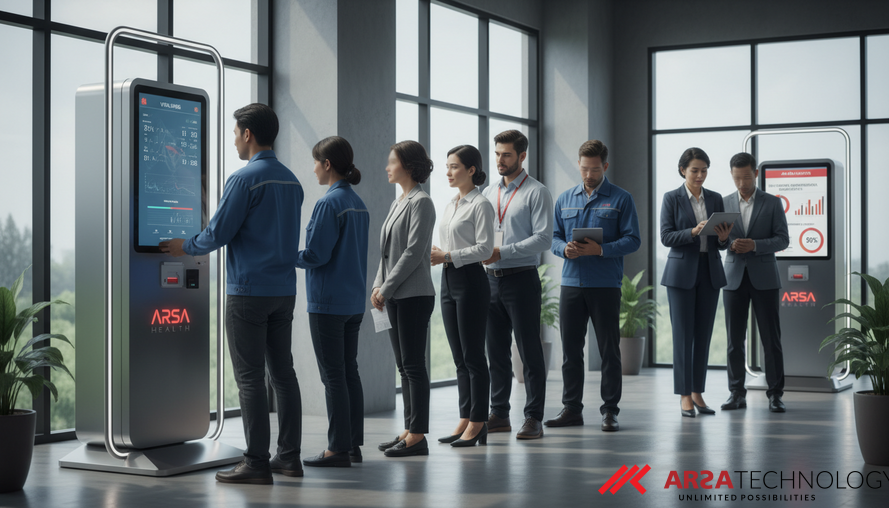
A versatile health kiosk should offer a broad range of measurements. Beyond basic vital signs, consider systems that provide a holistic health overview. The ARSA Health Kiosk measures blood pressure, heart rate, SpO2 (blood oxygen saturation), body temperature, weight, height, BMI, and even an AI-powered Romberg test for balance assessment. Optional modules for glucose and cholesterol further enhance its utility, providing a multi-parameter screening in approximately 90 seconds.
3. Data Privacy, Security, and Sovereignty
For enterprises and government entities, data privacy is paramount. Solutions must offer robust encryption and flexible deployment options to ensure sensitive health data remains secure and compliant with regulations like GDPR and Indonesia PDPA. ARSA’s Self-Check Health Kiosk supports on-premise or hybrid cloud deployment, featuring AES-256 encryption, role-based access control, and audit logs with tamper detection. Identity verification via face recognition or QR code is also GDPR/HIPAA compliant, ensuring no biometric data leaves your infrastructure without explicit control.
4. Integration and Reporting Capabilities
An effective automated screening system should seamlessly integrate with existing IT infrastructure and provide actionable insights. Look for solutions with a web-based health kiosk with dashboard and reporting features that allow for real-time data visualization, historical trend analysis, and automated reporting. ARSA’s kiosk offers API integration for connecting with other systems, enabling employers to access aggregated, de-identified analytics for population health management, while individuals receive instant digital reports via SMS/email.
5. User Experience and Accessibility
For widespread adoption, the kiosk must be intuitive and accessible to all employees. Features like multi-language UI, voice guidance, and a user-friendly touchscreen interface are essential. The self-service nature of ARSA’s kiosk guides users through the screening process without staff intervention, making it efficient and reducing potential human error.
6. Scalability and Centralized Management
Enterprises often operate across multiple sites, requiring a solution that can scale effortlessly. A single dashboard capable of managing hundreds or thousands of kiosks, coupled with centralized firmware updates and predictive maintenance, minimizes downtime and IT overhead. ARSA’s solution is designed for this scalability, offering a 99.2% uptime SLA.
Beyond Basic Vitals: Advanced AI in Health Screening
The integration of AI elevates health screening beyond simple data collection. For instance, an AI Romberg test kiosk for balance assessment provides an objective, standardized method to evaluate neurological function and fall risk, crucial for roles requiring physical stability or for monitoring aging workforces. This AI-powered assessment adds a layer of sophisticated analysis that manual checks often miss, contributing significantly to safety compliance.
ARSA’s expertise extends beyond health kiosks; our broader AI video analytics capabilities, such as the ARSA Smart Retail Counter (Software), demonstrate our commitment to transforming raw data into actionable intelligence across various domains. This foundational AI and IoT expertise underpins the advanced capabilities of our health solutions.
Real-World Applications: From Clinics to Corporations
While the primary focus here is automated employee health screening for workplace compliance, the versatility of digital health kiosks extends to various sectors. A digital health kiosk for hospital visitor screening can efficiently manage entry protocols, ensuring a safer environment for patients and staff. Similarly, a self-service blood pressure kiosk for clinics can automate routine vital checks, freeing up nursing staff and improving patient throughput. In corporate settings, these kiosks are invaluable for pre-shift screening, particularly in manufacturing or logistics, where immediate health status can impact safety and productivity.
ARSA Technology’s Commitment to Health and Compliance
ARSA Technology is dedicated to engineering practical AI and IoT solutions that deliver measurable impact. Our Self-Check Health Kiosk overview illustrates our full-stack approach, combining medical-grade hardware with intelligent software. We understand the complexities of enterprise deployments and offer solutions that are proven in demanding environments, ensuring data sovereignty, operational reliability, and full compliance readiness.
The kiosk’s “Smart Triage Alerts” feature is a prime example of its impact, automatically flagging critical readings (e.g., hypertension >140/90, fever >38°C, SpO2 <94%) and routing alerts to on-call physicians. This capability can reduce emergency response time by up to 73%, a critical factor in occupational health management.
Measuring Success: The ROI of Health Kiosk Deployment
Implementing an automated health screening system is an investment, but one with clear and measurable returns. Beyond the 14-18 month payback period mentioned earlier, organizations can expect:
- A massive reduction in manual monitoring workload.
- Significant improvements in compliance audit readiness.
- Enhanced employee morale through demonstrated commitment to well-being.
- Data-backed insights for optimizing health and safety policies.
These tangible benefits underscore the value of a well-chosen automated health screening solution.
In conclusion, for occupational health directors seeking to modernize their health and safety protocols, investing in automated employee health screening for workplace compliance is a strategic imperative. By carefully evaluating solutions based on accuracy, comprehensive features, data security, integration capabilities, and scalability, organizations can select a system that not only meets regulatory demands but also fosters a healthier, more productive workforce. ARSA Technology stands ready to partner with enterprises in this transformation, offering robust, privacy-centric, and highly accurate solutions designed for real-world operational challenges.
FAQ
What are the primary benefits of implementing a digital health kiosk for hospital visitor screening?
A digital health kiosk significantly reduces clinic congestion by automating vital checks, improves patient flow, and ensures a consistent, contact-minimal screening process for visitors, enhancing overall facility safety and operational efficiency.
How does a self-service blood pressure kiosk for clinics improve patient care?
A self-service blood pressure kiosk allows patients to quickly and accurately measure their blood pressure, freeing up nursing staff to focus on more critical patient needs, reducing wait times, and providing immediate digital records for physician review.
What makes the AI Romberg test kiosk for balance assessment a valuable tool for workplace safety?
The AI Romberg test kiosk provides an objective and consistent assessment of an individual’s balance, which is crucial for identifying employees at risk of falls or those in roles requiring high physical stability. This helps in proactive safety management and compliance with occupational health standards.
What kind of data does a health kiosk with dashboard and reporting provide to employers?
A health kiosk with dashboard and reporting provides employers with aggregated, de-identified analytics on population health trends, operational metrics, and compliance status. This data supports the development of targeted corporate wellness programs, helps identify potential health risks early, and can be used to demonstrate commitment to employee well-being for insurance benefits.
Stop Guessing, Start Optimizing.
Discover how ARSA Technology drives profit through intelligent systems.
