
Automated Employee Health Screening for Workplace Compliance: Edge AI vs. Cloud Solutions
In today’s dynamic work environment, ensuring the health and safety of employees is paramount, especially for occupational health directors navigating complex regulations and striving for peak operational efficiency. The demand for automated employee health screening for workplace compliance has surged, driven by the need for accurate, consistent, and cost-effective health monitoring. But when it comes to implementing such a system, businesses face a critical choice: should they opt for an Edge AI solution, processing data locally, or a cloud-based platform? This guide delves into the nuances of each approach, helping you determine which best fits your organization’s needs for privacy, performance, and long-term value.
The traditional methods of health screening often involve significant staff time, leading to bottlenecks and inconsistent data. For hospitals, clinics, and large corporations, these inefficiencies can translate into substantial operational costs and delays in patient or employee flow. Modern AI and IoT technologies offer a transformative alternative, but understanding the underlying architecture is key to a successful deployment.
The Evolving Landscape of Workplace Health Screening
Workplace health screening has moved beyond basic temperature checks. Today, it encompasses a range of vital signs and assessments designed to proactively identify potential health risks, manage chronic conditions, and ensure employees are fit for duty. For hospitals, this extends to ensuring staff and even visitors meet certain health criteria, especially in sensitive areas. The goal is to create a healthier, safer environment while adhering to industry-specific regulations and privacy standards like HIPAA or Indonesia PDPA.
The challenges are clear:
- Clinic Congestion: Routine vital checks can consume up to 60% of healthcare staff time, diverting resources from critical care.
- Workplace Health Blind Spots: Lack of real-time data means absenteeism and chronic conditions often go undetected until productivity is significantly impacted.
- Inconsistent Screening: Manual measurements are prone to human error, leading to fragmented data and hindering trend analysis.
- High Cost Per Screening: Traditional nurse-administered screenings are expensive, making large-scale preventive programs economically unsustainable.
Why Automated Employee Health Screening for Workplace Compliance Matters
Implementing an automated employee health screening for workplace compliance system offers a multitude of benefits that directly impact an organization’s bottom line and operational integrity. Beyond simply meeting regulatory requirements, these systems foster a proactive health culture, leading to:
- Reduced Operational Costs: By automating routine screenings, organizations can reallocate nursing staff to higher-value tasks, significantly reducing labor costs. The ARSA Self-Check Health Kiosk, for instance, can replace the equivalent of 2-3 FTE nurses per shift, achieving ROI in just 14-18 months.
- Enhanced Data Accuracy and Consistency: AI-powered systems eliminate human error, providing precise, standardized measurements every time. This consistent data is crucial for trend analysis and early intervention.
- Real-time Insights and Alerts: Instant digital records and smart triage alerts mean critical readings (e.g., hypertension, fever, low SpO2) are flagged immediately and routed to appropriate personnel, drastically reducing emergency response times.
- Improved Employee Wellness and Productivity: Early detection of health issues allows for timely interventions, reducing absenteeism and presenteeism, ultimately boosting overall workforce productivity.
- Streamlined Compliance: Automated systems generate comprehensive audit logs and reports, simplifying compliance tracking for occupational health and safety regulations.
Edge AI Health Kiosks: The On-Premise Advantage
Edge AI solutions, like the ARSA Self-Check Health Kiosk, process data directly on the device, at the “edge” of your network. This approach offers distinct advantages, particularly for organizations prioritizing data sovereignty, low latency, and operational independence.
With an Edge AI health kiosk, all health screening data, including blood pressure monitoring, blood oxygen measurement, and heart rate monitoring, is processed and often stored locally within your infrastructure. This means:
- Uncompromised Data Privacy: Sensitive employee health data never leaves your premises or private network unless explicitly configured. This is crucial for adhering to strict data protection regulations such as GDPR and Indonesia PDPA, and especially vital for hospitals handling patient information under HIPAA.
- Minimal Latency: Processing at the edge ensures near-instantaneous results and alerts, which is critical for time-sensitive health screenings and access control decisions.
- Reduced Cloud Costs: Eliminating continuous data transfer to the cloud significantly reduces bandwidth and recurring cloud storage fees.
- Offline Operation: Edge AI kiosks can operate fully offline, making them ideal for environments with unreliable internet connectivity or air-gapped security requirements.
- Scalability with Control: While each unit processes locally, a centralized dashboard can still provide aggregated, de-identified analytics for population health management, allowing for scalable deployment across multiple sites with unified oversight.
For an occupational health director, the on-premise nature of an Edge AI solution provides peace of mind regarding data control and compliance, a non-negotiable factor in healthcare and industrial sectors.
Cloud-Based Health Monitoring: Convenience with Caveats
Cloud-based health monitoring solutions offer convenience and often a lower initial setup cost, as they leverage remote servers for data processing and storage. These platforms can be attractive for smaller businesses or those with less stringent data sovereignty requirements.
However, cloud solutions come with their own set of considerations:
- Data Sovereignty Concerns: Sending sensitive health data to third-party cloud servers raises questions about where the data resides, who has access, and how it’s protected, potentially complicating compliance with local and international regulations.
- Latency Issues: Real-time processing can be affected by internet speed and network congestion, leading to delays in data analysis and alert generation.
- Recurring Costs: Cloud subscriptions often involve ongoing fees that can escalate with increased usage and data storage, potentially outweighing initial cost savings over time.
- Internet Dependency: A stable internet connection is mandatory for continuous operation, making these solutions vulnerable to outages.
While cloud solutions offer accessibility, the trade-offs in data control and potential long-term costs make them less suitable for mission-critical applications or highly regulated industries like healthcare, where a digital health kiosk for hospital visitor screening or staff pre-shift checks demands absolute data integrity.
ARSA Self-Check Health Kiosk: Your Comprehensive Edge AI Solution
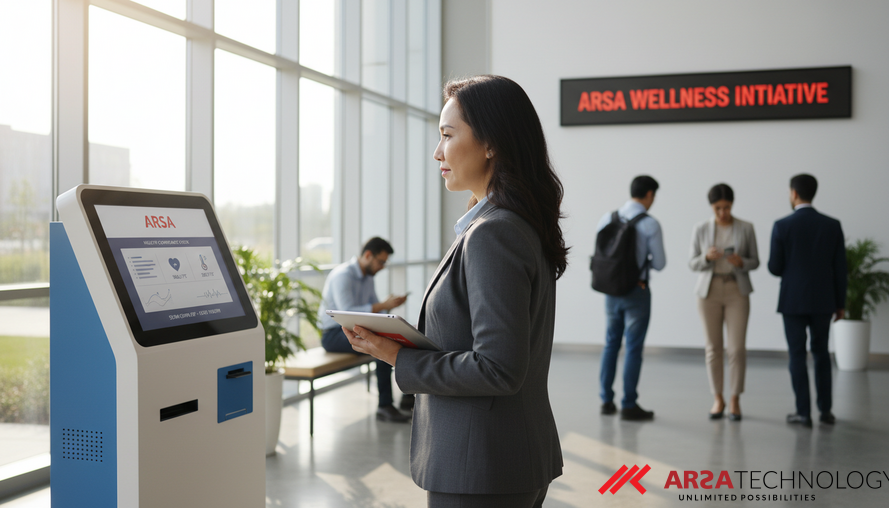
The ARSA Self-Check Health Kiosk stands out as a robust Edge AI solution, purpose-built for organizations that demand precision, privacy, and efficiency in health screening. This IoT kiosk combines advanced AI with medical-grade sensors to deliver autonomous health screening, requiring no medical personnel for routine checks.
Key features and capabilities include:
- Multi-Parameter Screening: Users are guided through an 8-parameter screening process, including accurate blood pressure monitoring, heart rate, SpO2 (blood oxygen measurement), body temperature, BMI, and optional glucose and cholesterol modules.
- AI-Powered Romberg Test for Balance Assessment: Beyond vital signs, the kiosk incorporates an AI Romberg test kiosk for balance assessment, providing an objective measure of neurological function and fall risk, particularly relevant for roles requiring physical stability.
- Instant Digital Records & Smart Triage: All vital user data is recorded and displayed on a web-based dashboard. Critical readings trigger smart triage alerts, automatically notifying on-call physicians and reducing emergency response time by 73%.
- Data Sovereignty and Compliance: With on-premise or hybrid cloud deployment options, the ARSA Health Kiosk ensures full compliance with EU GDPR and Indonesia PDPA, and is designed with HIPAA considerations in mind for healthcare environments. Your data remains under your control.
- Seamless Integration: The kiosk supports Face Recognition or QR-based identity verification with GDPR/HIPAA encryption and offers API integration for connection with existing HR, ERP, or access control systems.
- Scalability and Management: A single dashboard can manage 1 to 1,000 kiosks, with centralized firmware updates and predictive maintenance minimizing downtime.
Whether you need a self-service blood pressure kiosk for clinics to streamline patient intake or a comprehensive solution for corporate wellness programs, the ARSA Health Kiosk delivers. It transforms the way organizations approach health screening, moving from reactive to proactive, and from labor-intensive to automated.
Implementing Your Health Kiosk: From Setup to Scalability
Deploying an ARSA Self-Check Health Kiosk is designed for simplicity and rapid integration. The plug-and-play installation allows organizations to quickly set up autonomous health stations. Once connected, the kiosk begins capturing vital signs, feeding data into a secure system.
The true power lies in the health kiosk with dashboard and reporting capabilities. Occupational health directors gain access to a comprehensive web-based dashboard that provides aggregated, de-identified analytics for population health management. This allows for:
- Trend Analysis: Identify emerging health patterns within the workforce.
- Compliance Tracking: Monitor screening completion rates and flag non-compliance.
- Program Evaluation: Measure the impact of wellness initiatives with data-backed insights.
- Resource Optimization: Understand where health interventions are most needed.
ARSA Technology’s commitment to practical AI extends beyond health kiosks. Our broader range of products, including all ARSA products like the ARSA AI Box Series, which can be deployed for various edge AI applications such as the ARSA DOOH Audience Meter (AI Box), demonstrates our expertise in delivering robust, on-premise solutions that empower businesses with actionable intelligence without compromising data integrity.
Conclusion
Choosing between Edge AI and cloud solutions for automated employee health screening for workplace compliance is a strategic decision that impacts data privacy, operational efficiency, and long-term costs. For occupational health directors and organizations in regulated industries, the ARSA Self-Check Health Kiosk, with its Edge AI capabilities, offers a compelling advantage. It provides medical-grade accuracy, robust data sovereignty, and a comprehensive health kiosk with dashboard and reporting, ensuring your workplace compliance needs are met with precision and peace of mind.
Transform your occupational health strategy from a cost center into a proactive, data-driven asset. To learn more about how ARSA Technology can tailor a solution for your specific requirements, contact ARSA solutions team today.
—
FAQ
What vital signs can the ARSA Self-Check Health Kiosk measure for employee screening?
The ARSA Self-Check Health Kiosk measures multiple parameters including blood pressure, heart rate, SpO2 (blood oxygen saturation), body temperature, and BMI. It also features an AI Romberg test for balance assessment. Optional modules can be added for glucose and cholesterol measurements.
How does the digital health kiosk for hospital visitor screening ensure data privacy?
The ARSA Health Kiosk prioritizes data privacy through Edge AI processing, meaning data is processed locally on the device. It offers on-premise or hybrid cloud deployment options, uses AES-256 encryption, and supports GDPR/HIPAA compliance for identity verification and health record management, ensuring data sovereignty.
Can the self-service blood pressure kiosk for clinics integrate with existing hospital systems?
Yes, the ARSA Self-Check Health Kiosk is designed for seamless integration. It features API integration capabilities, allowing it to connect with existing hospital information systems, ERPs, or access control platforms to streamline patient intake and staff health monitoring workflows.
What are the benefits of the AI Romberg test kiosk for balance assessment in a workplace setting?
The AI Romberg test kiosk provides an objective, automated assessment of an individual’s balance and proprioception. In a workplace setting, especially for roles requiring physical stability or operating heavy machinery, this assessment can help identify potential fall risks or neurological impairments, contributing to enhanced safety and compliance.
Stop Guessing, Start Optimizing.
Discover how ARSA Technology drives profit through intelligent systems.
