

Unlocking Restaurant Potential: How Customer Heatmap Analytics Optimizes Store Layout
In the competitive landscape of modern shopping malls, understanding customer behavior is no longer a luxury—it’s a necessity. For mall property managers overseeing a diverse portfolio of tenants, especially restaurants, optimizing every square foot is paramount to driving revenue and enhancing visitor experience. This is where customer heatmap analytics for store layout optimization emerges as a game-changer, transforming passive observation into actionable intelligence. By visualizing where customers go, stop, and linger, businesses can make data-driven decisions to refine their physical spaces, ultimately boosting efficiency and profitability.
Traditional methods of observing customer flow are often subjective and labor-intensive, providing limited insights into the complex dynamics of human movement within a retail or dining environment. ARSA Technology offers advanced AI-powered solutions that bring precision and clarity to this challenge, enabling mall managers and their restaurant tenants to unlock previously hidden opportunities for growth. Our edge AI systems provide real-time data, ensuring that every decision, from menu placement to seating arrangements, is backed by concrete evidence.
The Hidden Language of Foot Traffic: Understanding Customer Movement Patterns
Every step a customer takes within a restaurant or its surrounding mall area tells a story. From the moment they enter, their path, their pauses, and their interactions reveal preferences, pain points, and missed opportunities. Understanding these customer movement pattern analysis CCTV insights is crucial for any business aiming to enhance its operational efficiency and customer satisfaction.
For restaurants, this translates into critical intelligence:
- Entrance and Exit Flow: Are customers entering smoothly, or are bottlenecks forming? Is the entry point inviting?
- Seating Area Appeal: Which tables or sections are most popular? Are less frequented areas underutilized due to poor visibility or accessibility?
- Service Counter Efficiency: How long do customers wait at the cashier or order pickup? Are there ways to streamline the queue?
- Promotional Hotspots: Are special offers or new menu items placed in high-visibility, high-dwell-time areas?
By analyzing these patterns, mall property managers can advise their restaurant tenants on optimal layout adjustments. For instance, if a heatmap reveals customers consistently bypass a new dessert display, it signals a need for repositioning or enhanced promotion. Conversely, areas with high foot traffic but low engagement might indicate a need for more compelling visual merchandising or interactive elements. This detailed understanding helps tenants not just survive, but thrive, by actively responding to how their customers interact with their space.
Beyond Basic Counting: AI Dwell Time Analysis for Shopping Malls and Restaurants
While knowing where customers go is valuable, understanding *how long* they stay in specific areas is equally, if not more, important. This is the essence of AI dwell time analysis for shopping malls and individual restaurant units. Dwell time indicates engagement, interest, and potential for conversion.
For a restaurant, high dwell time in a waiting area might signal slow service or insufficient seating. Conversely, high dwell time near a menu board or a promotional display suggests strong interest. ARSA’s AI solutions provide precise dwell time metrics, allowing businesses to:
- Assess Menu Effectiveness: If customers spend significant time looking at a digital menu board, it might be clear but if they spend too long, it might be confusing or overwhelming.
- Optimize Seating Comfort: Longer dwell times at tables indicate comfortable seating and a pleasant dining experience, while short dwell times could signal discomfort or a desire for faster service.
- Evaluate Promotional Impact: Measure how long customers engage with new product displays or special offers, providing direct feedback on their effectiveness.
- Improve Queue Management: Identify average waiting times and peak congestion periods, enabling proactive staffing adjustments or queue re-design to reduce queue abandonment.
These insights allow mall managers to provide data-backed recommendations to their restaurant tenants, helping them fine-tune their operations. For example, if AI dwell time analysis for shopping malls reveals that patrons spend an average of 15 minutes in a restaurant’s waiting area during lunch rush, this data can inform decisions about adding more host staff, implementing a digital waitlist system, or even expanding the waiting area if feasible.
Transforming Restaurant Floor Plans with Heatmap Data
The ultimate goal of gathering detailed customer behavior data is to optimize retail floor plan with heatmap data. For a restaurant, this means strategically arranging tables, service counters, kitchen access points, and promotional displays to maximize customer flow, comfort, and ultimately, sales.
Consider a restaurant struggling with slow service during peak hours. Heatmap data might reveal:
- Congested Pathways: Customers and staff constantly bumping into each other, slowing down service.
- Underutilized Zones: Empty tables in one section while another is overcrowded.
- Inefficient Workflow: Staff taking long routes from the kitchen to certain tables.
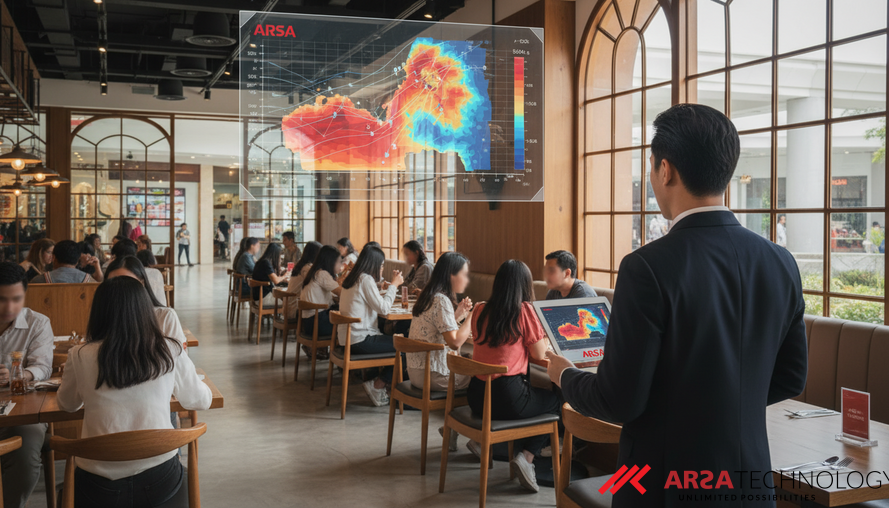
With ARSA’s ARSA Smart Retail Counter (AI Box), these issues become visible. The system generates intuitive heatmap visualizations that highlight hot (high activity) and cold (low activity) zones. This visual data empowers restaurant managers to:
- Redesign Layouts: Reconfigure seating to create clearer pathways, improve table turnover, and distribute customers more evenly.
- Strategic Placement: Position high-margin items or popular dishes near high-traffic areas, or create inviting “cold zones” with comfortable seating to encourage longer stays.
- Staffing Optimization: Understand peak activity areas to deploy staff more effectively, reducing wait times and improving service quality.
- Enhance Ambiance: Identify noisy or uncomfortable areas that deter customers and implement solutions like sound dampening or better lighting.
The ability to optimize retail floor plan with heatmap data allows for continuous improvement cycles. Restaurants can implement changes, then monitor subsequent heatmaps to validate the impact and make further refinements, ensuring their space is always performing at its best.
ARSA Smart Retail Counter: Your Edge AI Solution for Restaurant Optimization
ARSA Technology’s Smart Retail Counter (AI Box) is specifically engineered to deliver these powerful analytics with unparalleled ease and efficiency. As part of our AI Box Series, it represents a plug-and-play edge AI system designed for rapid deployment and immediate impact.
Key features and benefits for mall property managers and restaurant tenants include:
- 5-Minute Setup: The AI Box is designed for quick installation, integrating seamlessly with existing CCTV cameras. This minimal disruption means restaurants can start gathering insights almost instantly.
- Edge Computing Security: All AI processing occurs locally on the device, ensuring video streams are analyzed on-device and do not leave the network unless explicitly configured. This privacy-first approach is crucial for sensitive environments and compliance.
- Real-Time Data: Get instant insights into people counting, visitor footfall tracking, queue management, heatmap visualization, and dwell time analysis. This real-time intelligence allows for immediate operational adjustments.
- Conversion Rate Measurement: Beyond just traffic, the Smart Retail Counter can help measure conversion rates by tracking how many visitors to a specific area (e.g., a promotional display) then proceed to a point of sale or service.
- Scalability: Each AI Box can process up to 3 camera streams, making it ideal for individual restaurant units or specific zones within larger dining areas. Multiple units can be deployed for broader coverage within a mall.
This powerful combination of hardware and software empowers businesses to make informed decisions without the complexities of cloud-dependent systems or extensive IT overhead.
Achieving Tangible ROI: Business Outcomes of Heatmap Analytics
Implementing customer heatmap analytics for store layout optimization with ARSA’s Smart Retail Counter translates directly into measurable business outcomes. For mall property managers, this means providing tangible value to their tenants, leading to higher tenant satisfaction and retention. For restaurant owners, it means a healthier bottom line.
Consider these potential impacts:
- Increase Sales Conversion by 25%: By optimizing product placement, improving customer flow, and enhancing engagement in key areas, restaurants can convert more visitors into paying customers.
- Optimize Staffing Costs: Real-time queue management and dwell time analysis allow for precise staffing adjustments during peak and off-peak hours, reducing unnecessary labor costs while maintaining service quality.
- Improve Store Layout: Data-driven layout changes lead to a more intuitive and pleasant customer journey, reducing frustration and encouraging repeat visits. This can also help identify optimal locations for new features like self-ordering kiosks or expanded seating.
- Reduce Queue Abandonment: By identifying and addressing bottlenecks, restaurants can significantly cut down on the number of customers who leave due to long waits, directly impacting revenue.
Beyond these direct financial benefits, the insights gained contribute to a superior customer experience. When a restaurant’s layout is optimized for comfort and efficiency, customers are more likely to enjoy their visit, leading to positive reviews and increased loyalty. This also extends to the broader mall environment, where improved tenant performance contributes to the overall vibrancy and attractiveness of the property, positively impacting foot traffic analytics for tenant performance across the entire mall.
ARSA Technology has a proven track record of deploying robust AI solutions for government and enterprise clients for over 7 years, ensuring that our systems are not just innovative but also reliable and secure. Our commitment to data privacy, particularly with edge computing solutions, provides an additional layer of trust for businesses handling sensitive operational data. While our ARSA Face Recognition & Liveness API serves different identity verification needs, the core principle of delivering accurate, secure, and actionable AI remains consistent across all ARSA products.
Frequently Asked Questions
How can AI dwell time analysis improve restaurant operations?
AI dwell time analysis provides precise data on how long customers spend in specific areas, such as waiting lines, seating sections, or near menu displays. For restaurants, this can reveal bottlenecks in service, identify popular seating zones, and measure engagement with promotional materials, enabling data-driven adjustments to staffing, layout, and service flow to enhance efficiency and customer satisfaction.
What is customer movement pattern analysis CCTV and how does it benefit mall property managers?
Customer movement pattern analysis using CCTV involves AI processing video feeds to track and visualize how people navigate a space. For mall property managers, this provides insights into common pathways, high-traffic zones, and underutilized areas within the mall and its tenant spaces. This data helps in optimizing tenant mix, common area design, and providing valuable, data-backed advice to restaurant tenants for their own layout improvements.
How can I optimize retail floor plan with heatmap data for my restaurant tenants?
To optimize a restaurant’s floor plan with heatmap data, analyze the visualizations to identify hot (high activity) and cold (low activity) zones. Use this information to strategically reposition seating, service counters, and promotional displays to improve customer flow, reduce congestion, and maximize engagement. Continuous monitoring allows for iterative improvements, ensuring the layout always aligns with customer behavior.
What are the benefits of foot traffic analytics for tenant performance in a mall?
Foot traffic analytics provides mall managers with comprehensive data on visitor numbers, movement, and engagement across the property. This helps in assessing the performance of individual tenants, identifying areas for improvement, and demonstrating value to prospective tenants. By understanding overall mall flow and how it impacts specific stores or restaurants, managers can make strategic decisions to enhance the entire shopping experience and support tenant success.
Ready to Transform Your Restaurant’s Performance?
The power of customer heatmap analytics for store layout optimization is undeniable. By adopting ARSA Technology’s Smart Retail Counter, mall property managers can equip their restaurant tenants with the intelligence needed to thrive in today’s dynamic market. From increasing sales conversion by 25% to optimizing staffing and reducing queue abandonment, the benefits are clear and measurable. Don’t let your restaurant tenants operate on guesswork. Empower them with real-time, privacy-first AI insights. Contact ARSA solutions team today to request a quotation and explore how our AI Box Series can revolutionize your mall’s dining experience.
Stop Guessing, Start Optimizing.
Discover how ARSA Technology drives profit through intelligent systems.
