
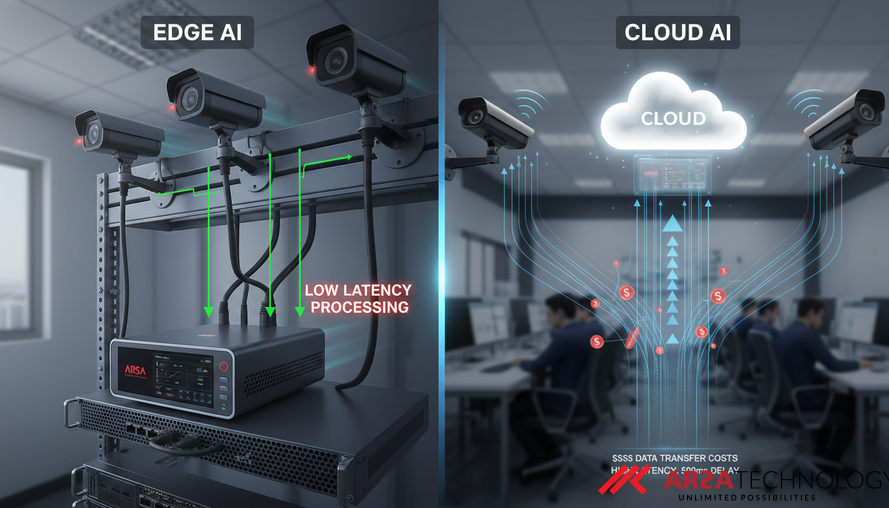

Edge AI vs Cloud AI for Enterprise Video Analytics: A Comparison for CTOs
In the rapidly evolving landscape of enterprise technology, Chief Technology Officers (CTOs) and IT Directors face critical decisions regarding infrastructure architecture, especially when deploying advanced solutions like video analytics. A pivotal choice arises when considering edge AI vs cloud AI for enterprise video analytics comparison: where should the intensive processing of video data occur? This decision profoundly impacts operational efficiency, data security, and long-term costs. For organizations leveraging video for everything from security to marketing insights, understanding the nuances between these two approaches is paramount.
Traditional video surveillance systems, primarily designed for recording, are now being transformed into intelligent operational assets through AI. Whether monitoring public spaces, retail environments, or industrial facilities, the ability to extract real-time, actionable intelligence from video feeds offers a significant competitive advantage. However, the architectural foundation—edge or cloud—determines how effectively these insights are generated and utilized.
Understanding Enterprise Video Analytics Architectures
Enterprise video analytics involves using artificial intelligence to automatically analyze video streams from CCTV cameras to detect events, identify objects, track movements, and gather actionable data. This moves beyond simple recording to proactive monitoring and intelligence gathering. The core challenge lies in processing vast amounts of video data efficiently and securely.
Historically, much of this processing would either happen manually (requiring extensive human oversight) or be offloaded to centralized cloud servers. However, the advent of powerful, compact computing devices has introduced a viable alternative: edge AI.
The Rise of Edge AI in Video Analytics
Edge AI refers to artificial intelligence processing that occurs directly on the device or a local server, close to the data source (e.g., CCTV cameras), rather than sending all data to a remote cloud server. This approach has gained significant traction due to its inherent advantages for video analytics.
With edge AI, video streams are analyzed in real-time, on-device, or within the local network. This minimizes the need to transmit raw video footage over the internet, addressing critical concerns around latency and bandwidth. For instance, ARSA’s AI Box Series offers plug-and-play edge AI hardware that processes video streams locally, delivering instant insights without cloud dependency. This is particularly beneficial for applications requiring immediate responses, such as real-time safety alerts or traffic management.
Key benefits of edge AI include:
- Low Latency: Decisions and alerts are generated almost instantly, as data doesn’t travel far.
- Enhanced Data Privacy: Raw video data remains within the local network, offering superior control over sensitive information.
- Reduced Bandwidth Costs: Only metadata or summarized insights are sent to a central dashboard, not entire video streams.
- Offline Operation: Systems can function even without continuous internet connectivity, ensuring operational reliability in isolated environments.
Cloud AI for Video Analytics: Benefits and Drawbacks
Cloud AI, conversely, relies on powerful, centralized data centers to perform video analytics. Raw video streams are uploaded to the cloud, processed, and then insights are delivered back to the user. This model offers its own set of advantages:
- Scalability: Cloud platforms can easily scale resources up or down to handle fluctuating workloads, making them flexible for unpredictable demands.
- Managed Services: Cloud providers handle infrastructure maintenance, updates, and security, reducing the IT burden on the enterprise.
- Accessibility: Data and insights can be accessed from anywhere with an internet connection, facilitating remote monitoring and distributed teams.
However, cloud AI also comes with notable drawbacks, especially for enterprise video analytics:
- High Data Transfer Costs: Uploading and downloading large volumes of video data can incur significant “egress” fees, leading to high on-premise video analytics vs cloud processing costs.
- Latency Issues: The time it takes for video to travel to the cloud, be processed, and for results to return can introduce delays, making real-time applications challenging.
- Data Privacy Concerns: Storing sensitive video footage on third-party cloud servers raises questions about data privacy edge computing vs cloud CCTV, particularly for regulated industries or government entities.
- Internet Dependency: A stable, high-bandwidth internet connection is crucial for continuous operation, and outages can halt analytics.
Edge AI vs Cloud AI for Enterprise Video Analytics Comparison
When making an edge AI vs cloud AI for enterprise video analytics comparison, CTOs and IT Directors must weigh several factors. The optimal choice often depends on specific operational requirements, budget constraints, and regulatory mandates.
| Feature | Edge AI / On-Premise | Cloud AI |
|---|---|---|
| Processing Location | Local device or on-premise server | Remote cloud data centers |
| Latency | Very low, near real-time | Higher, dependent on internet speed and cloud processing |
| Data Privacy | High control, data stays within local network | Lower control, data stored on third-party servers |
| Bandwidth Needs | Low (only metadata/alerts transmitted) | High (raw video streams uploaded) |
| Cost Structure | Higher upfront hardware, lower recurring operational | Lower upfront, higher recurring data transfer & compute |
| Offline Capable | Yes | No |
| Scalability | Scales by adding more edge devices/servers | Scales easily via cloud provider resources |
| Infrastructure Mgmt. | Managed by enterprise IT | Managed by cloud provider |
For many enterprises, the edge AI box vs cloud video analytics total cost often favors edge solutions in the long run. While initial hardware investment for an edge AI box or on-premise server might be higher, the absence of continuous data transfer fees and reduced bandwidth requirements can lead to substantial savings over time. Furthermore, for organizations where data sovereignty and compliance are non-negotiable, edge computing provides an unparalleled level of control. This is a key reason why choose edge AI over cloud for CCTV in sensitive environments.
ARSA’s On-Premise AI Video Analytics for Media: The DOOH Audience Meter
ARSA Technology understands these critical architectural considerations. Our AI Video Analytics Software, designed for on-premise deployment, offers the robust capabilities of AI without the inherent drawbacks of cloud dependency. A prime example is the ARSA DOOH Audience Meter (Software), specifically engineered for the media industry.
This powerful software transforms digital out-of-home (DOOH) advertising screens into intelligent audience measurement platforms. Deployed on your existing servers or edge infrastructure, it provides:
- Audience Measurement: Accurately counts viewers in front of screens.
- Demographic Profiling: Estimates age and gender, providing valuable insights into who is seeing your ads.
- Engagement Tracking: Measures dwell time and attention, quantifying how long audiences interact with content.
- Campaign Effectiveness Analytics: Delivers comprehensive reports to prove ad performance with real data.
The ARSA DOOH Audience Meter offers network-wide audience analytics, enabling programmatic ad optimization and helping businesses prove DOOH ROI at scale. Its self-hosted nature ensures full data ownership and privacy compliance, crucial for advertising data. With centralized campaign management capabilities and a robust REST API for integration, it empowers media companies to gain granular insights into their audience without compromising security or incurring unpredictable cloud costs. Explore the full range of our AI Video Analytics Software overview to see how on-premise solutions can benefit your operations.
Key Business Outcomes of On-Premise AI for DOOH
Implementing an on-premise AI video analytics solution like ARSA’s DOOH Audience Meter delivers tangible business outcomes:
1. Cost Predictability and Savings: By eliminating continuous cloud data transfer and processing fees, businesses achieve greater cost control and predictability. The total cost of ownership becomes more manageable, allowing for better budget allocation.
2. Enhanced Data Privacy and Compliance: Keeping sensitive audience data within your own infrastructure ensures compliance with local and international data protection regulations (e.g., GDPR, Indonesia PDPA). This builds trust with clients and mitigates legal risks.
3. Real-time, Actionable Insights: Processing at the edge or on-premise means minimal latency, allowing for immediate adjustments to campaigns, dynamic content delivery, and rapid response to audience engagement trends.
4. Operational Efficiency: Centralized processing on your servers simplifies management compared to distributed cloud services, while still providing comprehensive dashboards for monitoring and reporting.
5. Competitive Advantage: Leveraging precise, real-time audience data enables more effective ad targeting, personalized content delivery, and ultimately, higher ROI for advertising campaigns. This also allows for programmatic ad optimization, a significant leap forward for DOOH.
For enterprises in the media sector, the strategic advantage of controlling their own data and processing infrastructure is immense. It allows for innovation and adaptation without being beholden to third-party cloud policies or escalating costs. ARSA Technology is committed to providing solutions that empower businesses with this level of control and performance. You can also explore other edge AI applications, such as the ARSA Traffic Monitor (AI Box), which demonstrates the versatility of edge processing.
Frequently Asked Questions
What are the primary cost differences between on-premise video analytics vs cloud processing?
On-premise solutions typically involve higher upfront hardware investment but lower, more predictable operational costs due to no recurring data transfer or cloud compute fees. Cloud processing has lower initial setup but higher, variable ongoing costs based on data volume and usage, which can quickly escalate for video analytics.
How does edge computing enhance data privacy for CCTV systems compared to cloud solutions?
Edge computing keeps raw video data and its processing entirely within your local network or on-device. This means sensitive footage never leaves your infrastructure and isn’t stored on third-party cloud servers, offering maximum control over data access, retention, and compliance with privacy regulations.
Why should enterprises consider an edge AI box over cloud video analytics for their total cost of ownership?
While an initial investment in an edge AI box is required, the long-term total cost of ownership is often lower than cloud video analytics. This is primarily due to the elimination of recurring cloud data egress fees, reduced bandwidth consumption, and predictable operational expenses, leading to significant savings over the solution’s lifespan.
What are the main advantages of ARSA’s on-premise AI Video Analytics Software for media companies?
ARSA’s on-premise AI Video Analytics Software, like the DOOH Audience Meter, provides media companies with full data ownership, real-time audience measurement, demographic profiling, and engagement tracking without cloud dependency. This ensures data privacy, predictable costs, and enables powerful programmatic ad optimization and centralized campaign management.
Ready to Transform Your Video Analytics Strategy?
The choice between edge AI and cloud AI for enterprise video analytics is a strategic one, with significant implications for your business. For organizations prioritizing data privacy, cost control, and real-time operational intelligence, edge AI and on-premise solutions offer a compelling advantage. ARSA Technology provides production-ready AI solutions designed to meet the demanding requirements of enterprise and government clients.
To learn more about how our AI Video Analytics Software can transform your operations or to discuss your specific needs, explore all ARSA products or contact ARSA solutions team today. Let us help you engineer intelligence into your operations with proven, profitable AI.
Stop Guessing, Start Optimizing.
Discover how ARSA Technology drives profit through intelligent systems.
