

Edge AI vs Cloud AI for Enterprise Video Analytics Comparison: A Retail CTO’s Guide
In the rapidly evolving landscape of retail technology, the strategic decision between edge AI vs cloud AI for enterprise video analytics comparison is becoming paramount for CTOs and IT Directors. As retailers increasingly leverage AI-powered video analytics to gain actionable insights into customer behavior, optimize store operations, and enhance security, understanding the architectural implications of each deployment model is critical. This guide delves into the core differences, advantages, and considerations to help you make an informed choice that aligns with your business objectives, operational realities, and long-term vision.
Traditional video surveillance systems, while providing security, often fall short in delivering real-time operational intelligence. Upgrading these systems with AI capabilities transforms passive CCTV into active, data-generating assets. However, the choice of where this AI processing occurs—at the edge (on-premise) or in the cloud—carries significant implications for performance, cost, and data governance.
Understanding the Core Architectures: Edge AI vs. Cloud AI
Before diving into the specifics, let’s define what each architecture entails in the context of enterprise video analytics:
- Cloud AI for Video Analytics: In a cloud-based model, video streams from your cameras are sent over the internet to remote data centers for AI processing. The cloud provider handles the infrastructure, computation, and often the AI models themselves. Insights and alerts are then sent back to your local systems or a cloud-hosted dashboard.
- Edge AI (On-Premise) for Video Analytics: With edge AI, the video streams are processed locally, either directly on the camera (on-device AI) or on a dedicated computing device (like an AI Box or existing servers) located within your facility or network. Only metadata or aggregated insights, not raw video, may be sent to a centralized dashboard or cloud for further analysis. ARSA Technology offers robust AI Video Analytics Software overview that can be deployed on your existing servers, providing powerful on-premise capabilities.
On-Premise Video Analytics vs Cloud Processing Costs: A TCO Perspective
For enterprise deployments, particularly in retail with numerous locations and cameras, cost is a major factor. While cloud solutions often appear to have lower upfront costs, a comprehensive look at the total cost of ownership (TCO) reveals a different picture.
Cloud processing involves continuous data transfer, which can lead to substantial and unpredictable bandwidth costs, especially with high-resolution video streams from multiple cameras. These recurring operational expenses can quickly accumulate, making on-premise video analytics vs cloud processing costs a critical consideration. Furthermore, cloud providers typically charge based on processing time, data storage, and API calls, which can scale rapidly with increased usage or expanded deployments.
Edge AI, on the other hand, often involves an initial investment in hardware (if not using existing servers) or software licensing. However, once deployed, the operational costs are significantly lower. By processing video locally, bandwidth usage is drastically reduced, mitigating egress fees and network congestion. This model offers greater cost predictability and often a faster return on investment (ROI) in the long run, especially for large-scale retail operations. The ARSA AI Box Series, for instance, offers a plug-and-play edge solution designed to minimize cloud costs.
Data Privacy Edge Computing vs Cloud CCTV: Securing Sensitive Information
In retail, video analytics often involves processing sensitive data related to customer movements, demographics (estimated), and staff activities. Concerns around data privacy are paramount, especially with evolving regulations like GDPR and Indonesia’s PDPA. This makes the data privacy edge computing vs cloud CCTV debate particularly relevant.
When video streams are sent to the cloud, they traverse public networks and reside on third-party servers, introducing potential vulnerabilities and compliance complexities. While cloud providers implement security measures, the sheer act of data leaving your controlled environment can be a sticking point for legal and security teams.
Edge computing inherently offers a stronger privacy posture. With processing occurring on-site, raw video data never leaves your network. Only anonymized metadata or aggregated insights are transmitted, significantly reducing the risk of data breaches and simplifying compliance efforts. This level of data sovereignty is often non-negotiable for large enterprises and government clients, ensuring that sensitive information remains entirely within your control. ARSA Technology prioritizes data security, offering on-premise deployment options for its solutions, including the ARSA Face Recognition & Liveness SDK, for environments demanding zero data exposure.
Why Choose Edge AI Over Cloud for CCTV in Retail?
For retail CTOs and IT Directors, the advantages of choosing edge AI for CCTV are compelling:
1. Reduced Latency and Real-time Action: Processing at the edge means insights are generated almost instantaneously. For applications like real-time queue monitoring, immediate safety alerts, or dynamic digital signage, low latency is crucial. Cloud processing introduces network delays that can hinder immediate operational responses.
2. Bandwidth Efficiency: Sending high-definition video from hundreds or thousands of cameras to the cloud requires immense bandwidth, which can be costly and strain existing network infrastructure. Edge AI processes video locally, sending only small packets of metadata, drastically reducing bandwidth requirements.
3. Enhanced Reliability and Offline Operation: Edge AI systems can operate even if internet connectivity is intermittent or lost. This ensures continuous monitoring and analytics, a critical factor for security and operational continuity in retail stores where uptime is essential.
4. Customization and Control: On-premise solutions offer greater flexibility for customization and integration with existing systems (e.g., POS, ERP). You have full control over the AI models, data retention policies, and system configurations, allowing for tailored solutions that precisely fit your unique retail environment.
5. Lower Total Cost of Ownership (TCO): As discussed, while initial investment might be higher, the long-term operational savings on bandwidth, storage, and cloud service fees often result in a lower edge AI box vs cloud video analytics total cost.
ARSA Smart Retail Counter (Software): Powering Retail Intelligence On-Premise
ARSA Technology’s ARSA Smart Retail Counter (Software) exemplifies the power of on-premise AI for retail. Designed to transform existing CCTV infrastructure into a sophisticated retail intelligence platform, it offers a self-hosted solution that addresses the specific needs of modern retailers.
Deployed on your existing servers, the Smart Retail Counter provides a suite of advanced analytics modules:
- People Counting: Accurately track entry and exit numbers, understanding foot traffic patterns.
- Queue Monitoring: Detect queue lengths and wait times in real-time, enabling proactive staff deployment.
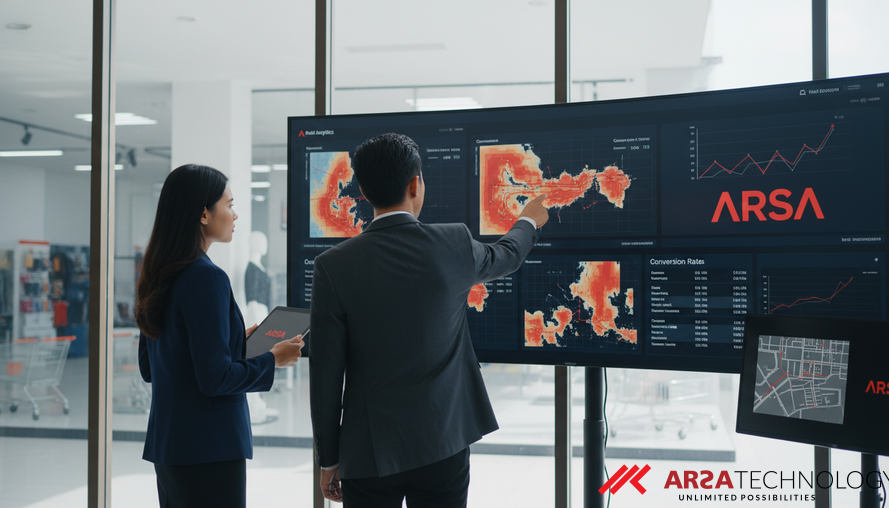
- Heatmap Analysis: Visualize customer movement and dwell times within your store layout to optimize product placement and store design.
- Dwell Time Tracking: Identify popular areas and engagement levels with specific displays or products.
- Conversion Analytics: Correlate foot traffic with sales data to understand conversion rates and identify improvement opportunities.
This software-only approach ensures hardware-agnostic deployment, allowing you to leverage your current infrastructure. The centralized processing capability provides multi-store visibility through a single, intuitive dashboard, offering chain-wide retail intelligence. With its REST API, the ARSA Smart Retail Counter seamlessly integrates with existing POS systems, CRM, and other enterprise applications, enabling a holistic view of your operations. This privacy-first design ensures that all sensitive video data remains within your network, aligning with stringent data protection policies.
The business outcomes are clear: optimize operations across locations by understanding customer flow and behavior, enhance customer experience by reducing wait times, and drive revenue growth through data-backed decisions. The centralized analytics dashboard provides a single source of truth for all retail intelligence, empowering managers and executives with actionable insights.
The Future of Retail Analytics: Secure, Efficient, and On-Premise
The decision between edge AI and cloud AI for enterprise video analytics is a strategic one, with significant implications for your retail business. While cloud offers convenience for certain applications, the benefits of on-premise edge AI—particularly for data-intensive and privacy-sensitive environments like retail—are undeniable. From mitigating on-premise video analytics vs cloud processing costs to ensuring robust data privacy edge computing vs cloud CCTV, edge AI provides the control, security, and performance that modern enterprises demand.
ARSA Technology is committed to delivering production-ready AI solutions that work in the real world. Our all ARSA products portfolio, including the Smart Retail Counter, is engineered for accuracy, scalability, and operational reliability, empowering retailers to unlock new levels of intelligence and efficiency. By understanding why choose edge AI over cloud for CCTV, you can make a strategic investment that safeguards your data, optimizes your operations, and drives measurable ROI.
—
FAQ Section
What are the primary cost differences between on-premise and cloud video analytics for enterprises?
On-premise video analytics typically involves a higher upfront investment in hardware or software licensing but offers lower long-term operational costs due to reduced bandwidth usage and predictable expenses. Cloud solutions often have lower initial costs but incur ongoing, potentially high, recurring fees for data transfer, storage, and processing, making on-premise video analytics vs cloud processing costs a critical factor for TCO.
How does edge computing enhance data privacy compared to cloud CCTV solutions?
Edge computing significantly enhances data privacy by processing video streams locally on your network. This means raw video data never leaves your infrastructure, reducing exposure to external threats and simplifying compliance with data protection regulations. In contrast, cloud CCTV sends video data to third-party servers, raising concerns about data privacy edge computing vs cloud CCTV.
What specific retail operations can benefit from ARSA’s on-premise AI video analytics software?
ARSA’s on-premise AI video analytics software, like the Smart Retail Counter, can benefit retail operations by providing real-time people counting, queue monitoring, heatmap analysis, and dwell time tracking. These insights help optimize store layouts, improve staffing efficiency, enhance customer experience, and ultimately drive conversion rates and revenue.
When should a retail business consider an edge AI box vs cloud video analytics for their total cost strategy?
A retail business should consider an edge AI box or on-premise software when prioritizing data sovereignty, minimizing long-term operational costs, and requiring low-latency, real-time insights. While cloud might seem cheaper initially, the edge AI box vs cloud video analytics total cost often favors edge solutions for large-scale deployments due to savings on bandwidth and predictable expenditure.
—
Ready to transform your retail operations with secure, efficient, and intelligent video analytics? Contact ARSA solutions team today to schedule a consultation and explore how our on-premise AI solutions can empower your business.
Stop Guessing, Start Optimizing.
Discover how ARSA Technology drives profit through intelligent systems.
