
How ARSA’s AI Health Kiosk Can Drastically Reduce Occupational Health Costs for Hospitals
In today’s dynamic healthcare landscape, hospitals face immense pressure to optimize operations while maintaining high standards of care. A significant, often overlooked, area for efficiency improvement and cost reduction lies within occupational health services for their own staff and, for many, their industrial clients. Implementing an advanced solution like the ARSA Self-Check Health Kiosk can drastically reduce occupational health costs with AI health kiosk technology, offering a strategic advantage for hospital decision-makers focused on both financial health and employee well-being.
Traditional occupational health screening processes are often labor-intensive, time-consuming, and prone to inconsistencies. They consume valuable staff resources, create bottlenecks, and delay the early detection of potential health issues. ARSA Technology, with its proven expertise in AI and IoT solutions, provides a transformative answer: an autonomous, medical-grade health screening kiosk designed to streamline these processes and deliver measurable ROI.
The Hidden Costs of Traditional Occupational Health Screening
For hospitals, managing the health of their own extensive workforce – from doctors and nurses to administrative and support staff – is a complex undertaking. Many hospitals also provide occupational health services to external corporate clients, including manufacturing plants, where pre-shift screenings are critical. The challenges typically include:
- Staff Time Allocation: Routine vital sign checks can consume a significant portion of medical staff’s time, diverting them from more critical patient care or specialized tasks. This directly impacts billable hours and overall productivity.
- Inconsistent Data & Manual Errors: Manual measurements and paper-based record-keeping can lead to human error, data fragmentation, and make trend analysis difficult, hindering proactive health interventions.
- Delayed Detection: Without regular, accessible screening, early signs of chronic conditions or acute health issues among staff might go unnoticed until they escalate, leading to higher treatment costs and absenteeism.
- Scalability Limitations: Scaling preventive health programs across a large workforce or multiple client sites becomes economically unsustainable with traditional, personnel-dependent models.
These challenges translate directly into increased operational expenses, reduced efficiency, and potential long-term health liabilities for the organization.
How ARSA’s Self-Check Health Kiosk Delivers Tangible ROI
The ARSA Self-Check Health Kiosk is engineered to address these pain points head-on, providing an autonomous, efficient, and accurate solution for health screening. For CFOs and plant managers, the financial benefits are clear and compelling.
Reduce Occupational Health Costs with AI Health Kiosk Automation
The most immediate and impactful benefit of deploying the ARSA Health Kiosk is the significant reduction in labor costs. By automating routine health screenings, hospitals can reallocate nursing staff from basic vital sign checks to more critical care functions. Our data shows that the kiosk can effectively replace the equivalent of 2-3 full-time nurses per shift for these tasks. This labor reallocation not only frees up valuable medical professionals but also increases patient throughput and billable consultation capacity. The ROI of employee health screening kiosk implementation is typically achieved within 14-18 months, making it a sound financial investment.
Early Detection Employee Health Issues Technology for Proactive Care
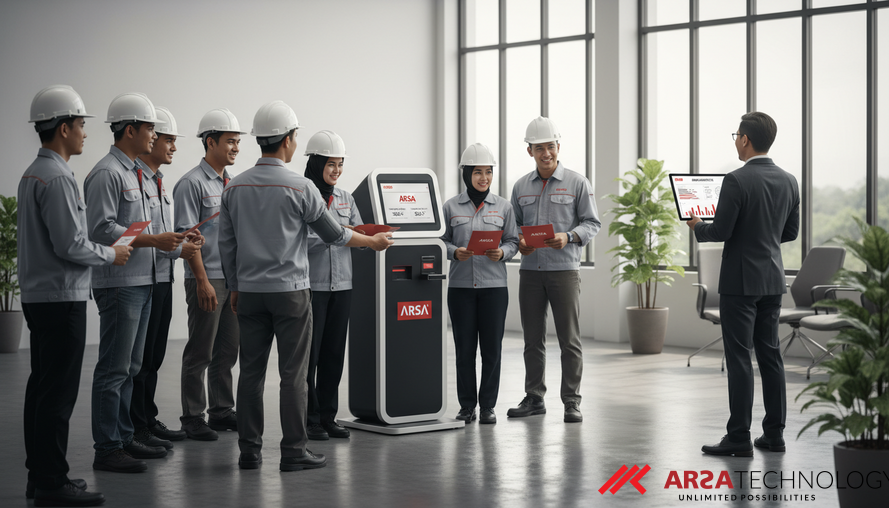
The ARSA Health Kiosk integrates advanced AI and medical-grade sensors to provide fast, accurate, multi-parameter health screenings in just 90 seconds. It measures blood pressure, heart rate, SpO2 (blood oxygen saturation), body temperature, BMI, and even includes an AI-powered Romberg test to assess balance. Optional modules can expand screening to glucose and cholesterol. This early detection employee health issues technology is crucial for identifying potential health concerns before they become severe.
The kiosk’s software intelligence automatically flags critical readings (e.g., hypertension >140/90, fever >38°C, SpO2 <94%) and can auto-route alerts to on-call physicians. This smart triage system significantly reduces emergency response times by up to 73%, preventing minor issues from escalating into costly medical emergencies and reducing the burden on emergency departments.
Preventive Health Monitoring for Manufacturing Workers and Hospital Staff
While the primary persona is a hospital decision-maker, many hospitals manage occupational health for industrial clients. For preventive health monitoring for manufacturing workers, the ARSA Health Kiosk is an invaluable tool. It enables consistent, daily pre-shift screenings, ensuring workers are fit for duty and identifying potential risks before they enter hazardous environments. This proactive approach minimizes workplace accidents, reduces insurance claims, and supports compliance audits.
Within the hospital itself, consistent monitoring of staff health can lead to better overall wellness, reduced absenteeism, and improved productivity. Encrypted health profiles are stored in a cloud dashboard, providing employers with aggregated, de-identified analytics for population health management, which can be leveraged for insurance premium reductions and targeted wellness programs.
Self-Service Health Check Reduces Clinic Visits and Bottlenecks
The intuitive, multi-language UI with voice guidance makes the ARSA Health Kiosk incredibly user-friendly, allowing individuals to perform comprehensive health checks independently. This self-service health check reduces clinic visits for routine screenings, alleviating congestion at intake desks and improving patient flow. For hospitals, this means their own staff can quickly check vitals without needing an appointment or consuming a nurse’s time, ensuring they stay healthy and productive.
The kiosk’s ability to integrate with existing hospital infrastructure via API ensures seamless data flow into electronic health records and other management systems. This eliminates data fragmentation and provides a centralized view of health trends, enabling better decision-making for both individual care and population health strategies.
Key Features Driving Value:
- Autonomous Vitals Capture: Guided interface for 8-parameter screening, no staff intervention needed.
- Instant Digital Records: Encrypted health profiles, SMS/email reports, aggregated analytics for employers.
- Smart Triage Alerts: AI flags critical readings and routes alerts to physicians, reducing response time.
- Medical-Grade Sensors: FDA/CE-certified for accuracy and reliability (e.g., ±3mmHg BP accuracy, ±0.2°C temperature precision).
- Data Sovereignty: On-premise or hybrid cloud deployment options ensure full compliance with EU GDPR and Indonesia PDPA.
- Scalability: Single dashboard manages 1-1000 kiosks, with centralized firmware updates and predictive maintenance.
ARSA Technology’s Commitment to Real-World Impact
ARSA Technology has a seven-year track record of delivering production-ready AI and IoT solutions to government and enterprise clients. Our commitment is to practical AI that works in the real world, providing measurable impact and tangible ROI. From our full range of products to custom AI solutions, we focus on engineering intelligence into operations. For example, our AI Video Analytics Software, similar to how our ARSA Smart Retail Counter (Software) optimizes retail operations, the Health Kiosk optimizes health screening.
Frequently Asked Questions (FAQ)
What is the typical ROI for an employee health screening kiosk in a hospital setting?
The ROI of employee health screening kiosk solutions like the ARSA Self-Check Health Kiosk is typically achieved within 14-18 months. This is primarily driven by significant labor cost savings through staff reallocation, increased patient throughput, and the prevention of costly health escalations due to early detection.
How does ARSA’s technology facilitate early detection of employee health issues?
ARSA’s kiosk uses medical-grade sensors to quickly measure vital signs (blood pressure, SpO2, heart rate, temperature, BMI, Romberg test). Its AI flags critical readings and sends automated alerts to medical personnel, enabling early detection employee health issues technology to intervene proactively.
Can a self-service health check truly reduce clinic visits for hospital staff?
Yes, a self-service health check reduces clinic visits for routine vital sign measurements. Hospital staff can quickly and conveniently check their health parameters at the kiosk, freeing up clinic resources for more complex cases and reducing the administrative burden associated with scheduling and managing routine appointments.
Is the ARSA Health Kiosk suitable for large-scale preventive health monitoring for manufacturing workers?
Absolutely. The ARSA Health Kiosk is highly scalable and ideal for preventive health monitoring for manufacturing workers and other large workforces. A single dashboard can manage up to 1,000 kiosks across multiple sites, ensuring consistent, efficient, and compliant health screening for all employees.
Transforming Occupational Health with ARSA Technology
The decision to invest in an AI-powered health kiosk is a strategic one, promising not just improved employee health, but also significant financial returns for hospitals. By choosing the ARSA Self-Check Health Kiosk, you are investing in a solution that is proven, scalable, and designed for the demands of modern enterprise. It’s time to move beyond traditional methods and embrace intelligent automation to reduce occupational health costs with AI health kiosk technology.
Ready to explore how ARSA Technology can transform your occupational health services and deliver measurable ROI? Contact ARSA solutions team today for a detailed consultation and quotation.
Stop Guessing, Start Optimizing.
Discover how ARSA Technology drives profit through intelligent systems.
