
How to Choose Between AI Software and AI Hardware for CCTV Systems
For solutions architects and enterprise decision-makers, the question of how to choose between AI software and AI hardware for CCTV systems is becoming increasingly critical. As organizations, particularly within the government sector, seek to leverage existing surveillance infrastructure for advanced intelligence, understanding the nuances of AI deployment models is paramount. The right choice impacts everything from data sovereignty and processing latency to scalability and long-term operational costs. ARSA Technology, with over seven years of experience in AI and IoT solutions, specializes in guiding enterprises through this complex decision, ensuring practical AI is deployed, proven, and profitable.
This guide will dissect the core differences between AI video analytics software and dedicated AI hardware, offering a comprehensive AI CCTV deployment model guide for enterprises. We’ll explore the advantages of each, helping you determine the optimal strategy for your specific operational needs and compliance requirements.
Understanding the Core Distinction: Software vs. Hardware
At its heart, the decision boils down to where the AI processing power resides and how it integrates with your existing infrastructure.
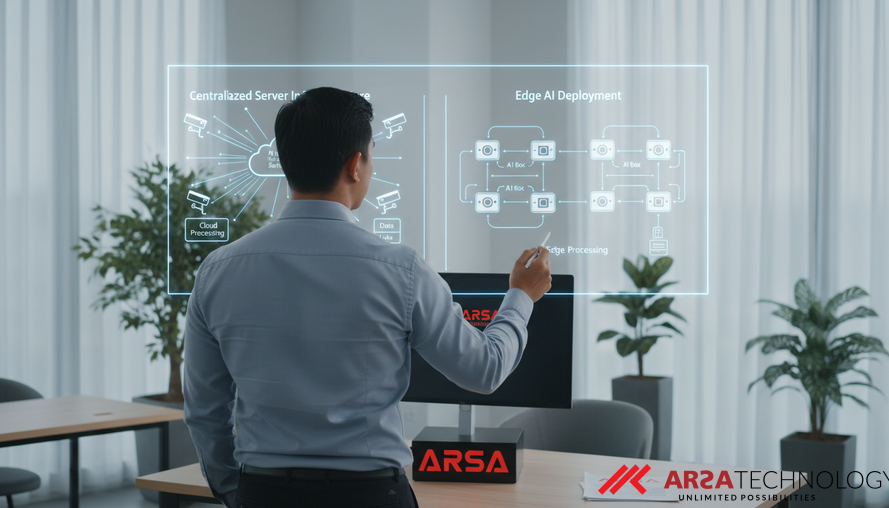
AI Video Analytics Software refers to AI algorithms and platforms deployed on your existing servers, private data centers, or virtualized environments. This model centralizes the intelligence, allowing a single powerful system to analyze streams from numerous cameras. It’s hardware-agnostic, meaning it can run on a variety of compute resources you already own or plan to procure.
AI Hardware, often referred to as edge AI devices or AI Boxes, integrates the AI processing capabilities directly into a dedicated physical unit. These devices are designed to be deployed closer to the data source – at the “edge” of your network – performing inference on-site. They are typically pre-configured with AI modules, offering a plug-and-play experience.
Each approach offers distinct benefits and considerations, making the choice dependent on your specific use case, existing infrastructure, and strategic priorities.
When to Opt for AI Video Analytics Software (On-Premise)
Choosing AI video analytics software is ideal for organizations that prioritize centralized control, data ownership, and flexible integration with existing IT ecosystems. For government entities, this model often aligns perfectly with stringent data privacy and security mandates.
Key Advantages of Self-Hosted AI Video Analytics Software:
- Full Data Ownership and Privacy: With software deployed on your servers, all video streams, inference results, and metadata remain entirely within your infrastructure. This is crucial for government agencies and privacy-sensitive environments that cannot risk data leaving their network, ensuring compliance with regulations like GDPR and Indonesia PDPA.
- Centralized Processing and Management: Analyze multiple camera streams from a central location, simplifying management and providing a unified view across your entire surveillance network. This is particularly beneficial for large-scale deployments where aggregated insights are needed.
- No Hardware Dependency: Leverage your existing servers, private data centers, or edge compute resources. This reduces initial capital expenditure on new dedicated hardware and allows for more efficient utilization of current IT assets.
- Flexible Deployment Architecture: Deploy on bare metal, virtual machines, or containerized environments, aligning seamlessly with your current IT strategy and infrastructure preferences.
- Scalability by Design: Scale analytics capacity by simply allocating more compute resources to your servers, rather than installing new physical devices at each camera site.
- Integration Ready: Integrate effortlessly using a REST API with existing dashboards, alerting systems, and data pipelines, creating a cohesive operational intelligence platform.
Consider the ARSA Traffic Monitor (Software) as a prime example. This solution, part of ARSA’s broader AI Video Analytics Software overview, is deployed on-premise to provide city-wide traffic intelligence. It enables government transport authorities to perform vehicle counting, vehicle classification, and congestion analysis across numerous intersections from a central command center. The real-time dashboards and historical analytics derived from this self-hosted platform empower data-driven transport planning and real-time incident response, significantly reducing infrastructure costs by utilizing existing server capacity.
When to Use AI Box Series (Edge Hardware)
The ARSA AI Box Series, our dedicated edge AI hardware, offers a different set of advantages, particularly for rapid deployment, distributed processing, and environments with limited IT infrastructure. This is where the “when to use AI box vs self-hosted analytics” question becomes clear.
Key Advantages of Edge AI Hardware (AI Box Series):
- Plug-and-Play Deployment: AI Boxes are pre-configured, making installation quick and straightforward. Connect power, network, and existing CCTV cameras, and you’re ready to configure analytics. This minimizes IT overhead and is ideal for rapid rollout projects across multiple sites.
- Distributed Edge Processing: AI processing runs locally on the AI Box, right where the video stream is captured. This ensures ultra-low latency for real-time actionable insights, as data doesn’t need to travel to a central server or the cloud for analysis.
- Enhanced Privacy at the Edge: Video streams are analyzed on-device and do not leave your local network unless explicitly configured. This provides a strong privacy posture, as raw footage remains localized.
- Operational Reliability in Isolated Environments: AI Boxes can operate fully offline, making them suitable for remote or air-gapped environments where continuous cloud connectivity is not guaranteed or desired.
- Minimal Infrastructure Management: For sites without extensive server infrastructure, an AI Box provides a complete, self-contained solution, simplifying hardware management.
For instance, while the ARSA Traffic Monitor (Software) handles large-scale centralized traffic analysis, an edge device like the ARSA DOOH Audience Meter (AI Box) demonstrates the power of edge processing for specific, localized tasks. It performs audience measurement for digital signage on-site, providing instant demographic estimation and engagement tracking without sending raw video to a central server. This illustrates a clear use case for distributed edge processing.
AI Video Analytics Software vs AI Box Comparison: A Decision Framework
To help solutions architects navigate this choice, here’s a direct comparison focusing on critical factors:
| Feature / Consideration | AI Video Analytics Software (e.g., ARSA Traffic Monitor) | ARSA AI Box Series (Edge Hardware) |
|---|---|---|
| Deployment Model | On-premise servers, private data centers, virtual machines, containers | Dedicated physical units at the edge (near cameras) |
| Processing Location | Centralized (on your servers) | Distributed (on-device at the edge) |
| Data Ownership | Full control, data remains entirely within your infrastructure | Full control, raw video analyzed on-device, data remains local unless configured |
| Hardware Requirement | Utilizes existing servers/compute resources; hardware-agnostic | Requires dedicated ARSA AI Box hardware (Mini PC or Server Model) |
| Setup & Installation | Software installation and configuration on existing IT infrastructure | Plug-and-play, minimal setup, integrates with existing CCTV |
| Latency | Low, but dependent on network bandwidth to central server | Ultra-low, real-time insights as processing is on-site |
| Scalability | Scale by allocating more compute resources to central servers | Scale by deploying more AI Boxes; available in Mini PC (up to 3 cameras) and Server (up to 30 cameras) models |
| Connectivity | No cloud dependency for core operations; integrates via REST API | Cloud optional; can operate fully offline (air-gapped) |
| Best For | Large-scale, complex deployments requiring centralized management, deep analytics, and existing IT infrastructure. Government, smart cities, large enterprises. | Rapid deployment, remote sites, distributed intelligence, minimal IT overhead, and strict low-latency needs. Industrial, retail branches, smaller facilities. |
| Cost Structure | Software licensing, leverages existing hardware, potential server upgrade costs | Hardware purchase + software licensing, fixed bundle pricing for some models |
This “AI CCTV deployment model guide for enterprises” highlights that the optimal choice hinges on your specific operational context. For government agencies managing city-wide traffic or critical infrastructure, the robust, centralized control and data sovereignty offered by self-hosted analytics often make it the preferred solution.
Edge Device vs On-Premise Server for Video AI: Making the Strategic Choice
The decision between an edge device and an on-premise server for video AI is a strategic one, impacting your long-term operational efficiency and compliance.
For government applications, where data security and sovereignty are non-negotiable, the ability to maintain full control over sensitive information is paramount. An on-premise server deployment, like that offered by ARSA’s AI Video Analytics Software, ensures that all processing and data storage occur within your secure network. This minimizes exposure to external threats and simplifies compliance audits. The centralized nature also allows for sophisticated, multi-camera analytics and reporting across an entire city or large facility, providing comprehensive insights for urban planning, public safety, and resource allocation.
Conversely, edge devices excel in scenarios demanding immediate, localized action or in environments with limited network infrastructure. Imagine a remote industrial site needing real-time PPE compliance monitoring, where sending all video streams to a central server would be impractical due to bandwidth constraints. An AI Box could process these streams on-site, triggering instant alerts without relying on external connectivity. While ARSA offers both, the focus for government-level traffic management often leans towards the comprehensive capabilities of our software solution.
Ultimately, the best approach might even be a hybrid one, combining the strengths of both. For example, edge devices could handle initial filtering and localized alerts, while aggregated, anonymized data is sent to a central on-premise server for deeper historical analysis and strategic planning. ARSA Technology is equipped to provide both standalone and integrated solutions, ensuring your AI deployment meets your exact needs.
Business Outcomes and ROI for Government Applications
Implementing the right AI CCTV solution, particularly for government, translates into significant business outcomes and a strong return on investment.
With ARSA’s AI Video Analytics Software, specifically the ARSA Traffic Monitor (Software), government entities can achieve:
- City-Wide Traffic Intelligence: Gain unprecedented visibility into traffic patterns, congestion hotspots, and vehicle movements across an entire urban landscape. This enables proactive management and optimization of traffic flow.
- Reduced Infrastructure Costs: By deploying on existing servers, you avoid the significant capital outlay associated with purchasing and maintaining new dedicated hardware for every camera. This optimizes IT budgets and extends the life of current assets.
- Data-Driven Transport Planning: Move beyond anecdotal evidence to make informed decisions based on real-time and historical traffic data. This leads to more effective road network design, public transport scheduling, and infrastructure investments.
- Real-Time Incident Response: Automated detection of accidents, unusual congestion, or unauthorized vehicle movements allows for immediate alerts and faster response times from emergency services, improving public safety and minimizing disruption.
- Enhanced Compliance and Security: Maintain full control over sensitive data, aligning with government regulations and ensuring the integrity of public surveillance systems.
ARSA Technology has a proven track record of delivering mission-critical systems for government and enterprise clients, including the Indonesian Ministry of Defense and National Police, demonstrating our expertise in secure, scalable, and reliable AI deployments. Our solutions are engineered to deliver measurable impact, transforming passive CCTV infrastructure into intelligent decision engines.
Conclusion
Deciding how to choose between AI software and AI hardware for CCTV is a strategic decision that requires careful consideration of your operational environment, data governance policies, and desired outcomes. For solutions architects in government and large enterprises, the choice often hinges on balancing centralized control and data sovereignty with the need for real-time edge processing and rapid deployment.
ARSA Technology offers a comprehensive portfolio of all ARSA products, including robust AI Video Analytics Software for centralized, on-premise deployments and versatile AI Box Series for edge computing. Whether you prioritize leveraging existing server infrastructure for city-wide intelligence with solutions like the ARSA Traffic Monitor (Software) or require distributed, low-latency processing at the edge, ARSA provides production-ready, proven solutions.
To explore which AI CCTV deployment model best suits your organization’s unique requirements and to begin engineering your competitive advantage, we invite you to contact ARSA solutions team for a consultation.
FAQ
1. What is the primary difference in deployment between AI video analytics software and an AI Box?
AI video analytics software is typically deployed on existing on-premise servers or private cloud infrastructure, allowing for centralized processing of multiple CCTV streams. An AI Box, conversely, is a dedicated edge hardware device that processes video streams locally at the camera site, offering distributed intelligence.
2. When should an enterprise consider self-hosted analytics over an AI Box for their video AI needs?
Enterprises should consider self-hosted analytics (like ARSA’s AI Video Analytics Software) when they have existing server infrastructure, prefer centralized AI processing, require full data ownership within their network, and need flexible deployment architecture for large-scale, multi-camera analysis.
3. How does the choice between an edge device vs on-premise server for video AI impact data privacy for government clients?
Both edge devices and on-premise servers offer strong data privacy by keeping processing and data within your network, avoiding cloud dependency. However, an on-premise server provides a single point of control for all data, simplifying governance and compliance for sensitive government applications, while edge devices ensure raw video never leaves the immediate vicinity of the camera.
4. What are the key business benefits of using ARSA Traffic Monitor (Software) for government traffic management?
The ARSA Traffic Monitor (Software) provides city-wide traffic intelligence, enabling data-driven transport planning, real-time incident response, and optimized traffic flow. By deploying on existing servers, it also helps reduce infrastructure costs while maintaining full data ownership and compliance for government agencies.
Stop Guessing, Start Optimizing.
Discover how ARSA Technology drives profit through intelligent systems.
