

How to Measure Retail Store Conversion Rate with AI Analytics for Optimal Performance
In today’s competitive retail landscape, understanding customer behavior is paramount to success. While traditional metrics like sales figures offer a glimpse into performance, they often fail to explain *why* certain outcomes occur. This is where advanced technology steps in. Learning how to measure retail store conversion rate with AI analytics transforms raw data into actionable insights, providing retailers with the intelligence needed to optimize operations, enhance customer experience, and ultimately, drive profitability.
For retail store operations managers, the ability to accurately quantify foot traffic, engagement, and purchasing patterns is no longer a luxury but a necessity. AI-powered video analytics offers a robust solution, converting existing CCTV infrastructure into a powerful data collection engine. By leveraging these insights, businesses can move beyond guesswork, making data-driven decisions that directly impact their bottom line.
Understanding Retail Conversion Rate: Beyond Just Sales
At its core, retail conversion rate is the percentage of visitors to a store who make a purchase. While seemingly simple, accurately calculating this requires precise data on both sales and visitor numbers. Traditional methods often rely on manual clicker counts or estimations, which are prone to human error and lack the granularity needed for deep analysis.
A low conversion rate can signal various issues, from ineffective store layouts and poor product placement to inadequate staffing or lengthy queue times. Conversely, a high conversion rate indicates that your store is effectively turning browsers into buyers. The challenge lies in identifying the specific factors influencing this rate and developing targeted strategies for improvement. This is where a sophisticated people counting system for retail stores becomes indispensable.
The Role of AI in Measuring Retail Store Conversion Rate with AI Analytics
Artificial intelligence revolutionizes how retailers approach conversion rate measurement. Instead of mere counting, AI analytics provides a comprehensive understanding of the customer journey, from entry to exit. By processing video streams from existing security cameras, AI can detect and track individuals, categorize their movements, and even estimate demographics, all without compromising privacy.
ARSA Technology’s ARSA Smart Retail Counter (AI Box) is an exemplary solution designed for this purpose. This edge AI device integrates seamlessly with your existing CCTV cameras, offering a plug-and-play setup that takes as little as 5 minutes. It processes data locally, ensuring privacy and eliminating ongoing cloud costs, making it a cost-effective choice for businesses looking to implement advanced analytics.
With AI, you gain access to:
- Accurate People Counting: Precisely track the number of visitors entering and exiting your store, providing the denominator for your conversion rate calculation.
- Visitor Footfall Tracking: Understand traffic flow patterns throughout the day, week, or month.
- Dwell Time Analysis: Measure how long customers spend in specific areas, indicating product interest or potential bottlenecks.
- Queue Management: Monitor queue lengths and wait times in real-time to prevent abandonment.
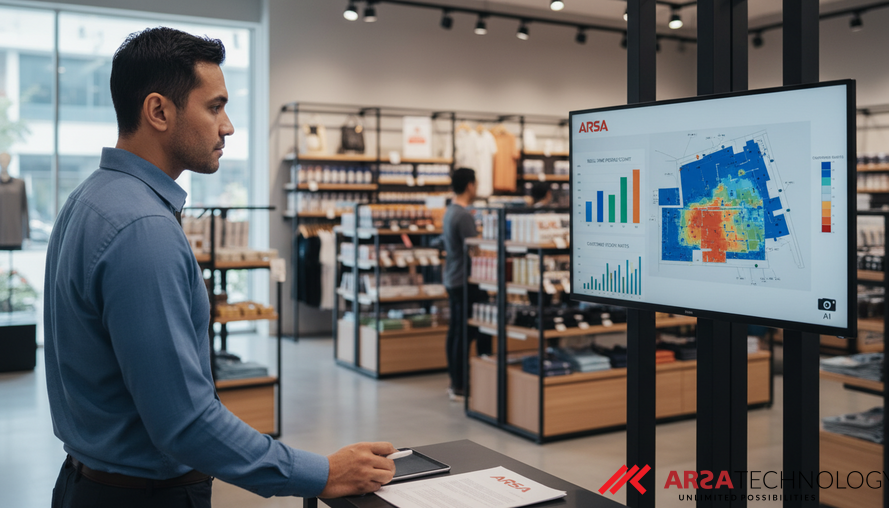
- Heatmap Visualization: Visually identify hot and cold zones within your store, revealing popular areas and overlooked sections.
These metrics are crucial for a holistic understanding of customer behavior, directly informing strategies to improve conversion.
Key AI Analytics for Retail Success
To truly optimize your retail space and boost conversion, several AI analytics modules work in concert:
1. People Counting and Footfall Tracking
The foundation of conversion rate measurement is accurate visitor data. An advanced people counting system for retail stores precisely counts individuals entering and exiting, providing the exact number of potential customers. Beyond simple counts, AI customer footfall tracking for shopping malls and individual stores reveals peak hours, popular entrances, and overall traffic trends. This data helps in optimizing staffing schedules, understanding marketing campaign effectiveness, and even negotiating lease terms in multi-tenant properties.
2. Store Heatmap Analysis Using Existing CCTV
Imagine knowing exactly which aisles draw the most attention and which corners are consistently ignored. Store heatmap analysis using existing CCTV provides this visual intelligence. AI processes video footage to create color-coded maps of your store, highlighting areas with high foot traffic (hot zones) and those with minimal engagement (cold zones). This insight is invaluable for:
- Optimizing Store Layout: Repositioning high-value products in hot zones or redesigning cold zones to attract more attention.
- Merchandising Effectiveness: Assessing the impact of new displays or promotional setups.
- Customer Flow Improvement: Identifying areas where customers get stuck or bypass sections entirely.
ARSA’s Smart Retail Counter excels at generating these detailed heatmaps, turning passive surveillance into active business intelligence.
3. Real-Time Queue Management Analytics
Long queues are a notorious conversion killer. Customers, especially in fast-paced environments, are quick to abandon purchases if wait times are excessive. Real-time queue management analytics uses AI to monitor checkout lines, alerting staff when queues exceed a predefined threshold. This allows managers to:
- Optimize Staffing: Deploy additional cashiers instantly during peak times.
- Reduce Abandonment Rates: Minimize lost sales due to frustrated customers.
- Improve Customer Satisfaction: Enhance the overall shopping experience.
By proactively managing queues, retailers can significantly reduce friction points in the purchasing process, directly impacting conversion rates.
4. Dwell Time Analysis
Dwell time measures how long customers spend in front of particular displays, product categories, or promotional areas. High dwell times in relevant sections indicate strong interest, while low dwell times might signal a lack of engagement or confusing signage. AI can automatically calculate dwell times, providing data that helps retailers:
- Assess Product Appeal: Understand which products or promotions genuinely capture attention.
- Evaluate Display Effectiveness: Determine if visual merchandising is working as intended.
- Personalize Experiences: Tailor in-store marketing based on observed engagement.
Implementing an AI People Counting System for Retail Stores
Deploying an AI-powered analytics solution doesn’t have to be complex or disruptive. ARSA’s AI Box Series overview offers a straightforward path to advanced retail intelligence. The Smart Retail Counter, a key component of this series, is designed for rapid deployment. Simply connect it to your existing CCTV cameras, and within minutes, it begins processing video streams at the edge.
This edge computing approach means that data is analyzed on-site, close to the source, ensuring minimal latency and maximum data privacy. There’s no need for extensive network overhauls or costly cloud subscriptions for continuous processing. The system is built to work with up to three cameras per AI Box, making it suitable for various store sizes and layouts. For larger deployments or centralized processing needs, ARSA also offers its AI Video Analytics Software, providing flexible options for every enterprise.
Real-World Impact: Business Outcomes with ARSA Smart Retail Counter
The tangible benefits of implementing an AI-driven retail analytics solution are significant. Businesses using ARSA’s Smart Retail Counter have reported:
- Increased Sales Conversion by 25%: By optimizing store layouts based on heatmap analysis and improving queue management, retailers can convert more visitors into paying customers.
- Optimized Staffing Costs: Accurate footfall and queue data enable precise staffing adjustments, reducing unnecessary labor expenses during slow periods and ensuring adequate coverage during peak times.
- Improved Store Layout and Merchandising: Data-backed insights from heatmaps and dwell time analysis guide strategic product placement and visual merchandising decisions, creating a more engaging and efficient shopping environment.
- Reduced Queue Abandonment: Real-time alerts for long queues allow for immediate intervention, preventing frustrated customers from leaving without a purchase.
Beyond these direct impacts, the system also supports broader business intelligence. For instance, understanding customer demographics and engagement duration, much like the capabilities of the ARSA DOOH Audience Meter (Software), can inform targeted marketing efforts and product development strategies.
Ensuring Data Privacy and Security
For many retailers, data privacy is a significant concern, especially when dealing with video surveillance. ARSA Technology prioritizes a privacy-first approach. The edge deployment model of the AI Box Series ensures that video streams are processed locally, and only anonymized metadata or aggregated insights are stored or transmitted. This means sensitive raw footage never leaves your premises, aligning with strict data protection regulations and building trust with your customers.
Frequently Asked Questions
What is a people counting system for retail stores?
A people counting system for retail stores uses technology, often AI-powered video analytics, to accurately count the number of individuals entering and exiting a store. This data is crucial for calculating conversion rates, optimizing staffing, and understanding foot traffic patterns.
How does AI customer footfall tracking for shopping malls work?
AI customer footfall tracking for shopping malls utilizes existing CCTV cameras and advanced computer vision algorithms to detect and track visitors. It analyzes movement patterns across different areas, providing insights into popular zones, traffic flow, and overall visitor engagement within the mall environment.
Can AI help with real-time queue management analytics?
Yes, AI is highly effective for real-time queue management analytics. It monitors checkout lines or service queues through video feeds, identifies when queue lengths exceed predefined thresholds, and can trigger automated alerts to staff, enabling prompt action to reduce wait times and improve customer satisfaction.
Is store heatmap analysis using existing CCTV effective?
Absolutely. Store heatmap analysis using existing CCTV is highly effective. AI processes video data to create visual representations of customer density and movement, highlighting ‘hot’ and ‘cold’ zones. This helps retailers optimize store layouts, product placement, and merchandising strategies to enhance customer engagement and conversion.
Conclusion
Mastering how to measure retail store conversion rate with AI analytics is a transformative step for any modern retailer. By moving beyond traditional, often inaccurate, methods, businesses can gain unparalleled insights into customer behavior, operational efficiency, and revenue generation. Solutions like the ARSA Smart Retail Counter (AI Box) offer a powerful, privacy-conscious, and easy-to-deploy path to achieving these goals. With ARSA Technology’s proven expertise in AI video analytics and edge computing, retailers can unlock their full potential, ensuring every square foot of their store works harder for their business.
Ready to transform your retail operations with intelligent AI analytics? Explore our all ARSA products or contact ARSA solutions team today to schedule a consultation and discover how our solutions can deliver measurable impact for your business.
Stop Guessing, Start Optimizing.
Discover how ARSA Technology drives profit through intelligent systems.
