
How to Reduce Workplace Accidents with AI Video Analytics: A CFO’s Guide to ROI
Workplace accidents are more than just unfortunate incidents; they represent significant financial liabilities, operational disruptions, and reputational damage. For CFOs in high-risk industries like oil and gas, mitigating these risks is paramount. The good news is that advanced technology now offers a powerful solution: you can reduce workplace accidents with AI video analytics. This article provides a comprehensive overview of how AI-powered safety monitoring delivers a compelling return on investment (ROI) by enhancing safety, ensuring compliance, and driving substantial cost savings.
In demanding environments such as oil and gas facilities, traditional safety protocols often fall short. Human error, fatigue, and the sheer scale of operations make continuous, infallible monitoring almost impossible. This is where AI video analytics steps in, transforming passive CCTV footage into an active, intelligent safety system that identifies risks in real-time, preventing incidents before they escalate.
The True Cost of Workplace Accidents in High-Risk Industries
Before delving into solutions, it’s crucial to understand the full financial impact of workplace accidents. Beyond immediate medical expenses and workers’ compensation claims, the costs ripple through an organization, affecting profitability and long-term sustainability.
- Direct Costs: These are easily quantifiable and include medical treatment, rehabilitation, workers’ compensation premiums, and property damage. In the oil and gas sector, a single incident can lead to millions in direct costs, not to mention potential fines from regulatory bodies.
- Indirect Costs: Often overlooked, these costs can be far more substantial. They include lost productivity due to downtime, investigation time, legal fees, administrative costs, hiring and training replacement workers, decreased employee morale, and negative publicity. A tarnished safety record can also impact a company’s ability to attract and retain top talent, secure new contracts, and maintain investor confidence.
Considering these factors, investing in proactive safety measures is not merely an expense but a strategic imperative that directly impacts the bottom line.
How AI Video Analytics Reduces Safety Incidents
ARSA Technology’s AI Video Analytics Software overview, particularly the ARSA Basic Safety Guard (Software) module, is engineered to address these challenges head-on. By leveraging existing CCTV infrastructure, this on-premise solution provides real-time, intelligent monitoring that human operators simply cannot match in consistency or scale.
Key capabilities that directly contribute to accident reduction:
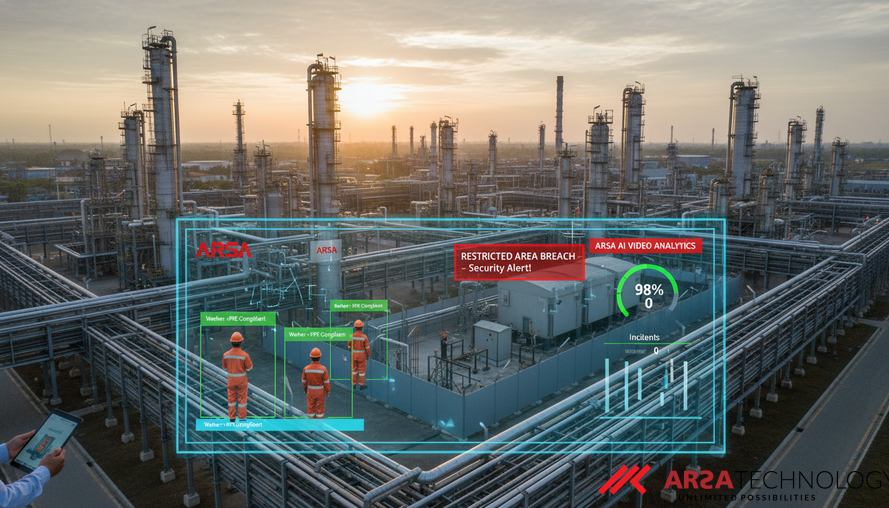
- PPE Detection: In oil and gas, the correct use of Personal Protective Equipment (PPE) like hard hats, safety vests, and masks is non-negotiable. ARSA’s AI can automatically detect if personnel are wearing the required PPE, issuing immediate alerts for non-compliance. This proactive monitoring drastically reduces the risk of injuries related to inadequate protection.
- Restricted Area Monitoring: High-risk zones, machinery, or hazardous material storage areas often require strict access control. The AI Basic Safety Guard module identifies unauthorized entry into these restricted areas, triggering alerts to security personnel. This prevents accidents from untrained individuals or those without proper authorization entering dangerous zones.
- Safety Violation Alerts: Beyond PPE, the system can be configured to detect a wide range of unsafe behaviors or conditions, such as climbing on equipment, operating machinery incorrectly, or even identifying spills that could lead to slips and falls. Real-time alerts allow for immediate intervention, preventing potential accidents.
- Compliance Reporting and Event Logging: For CFOs, robust compliance is critical. The system automatically logs all detected events, violations, and alerts, providing an indisputable audit trail. This data is invaluable for demonstrating adherence to safety regulations (e.g., OSHA, local government safety standards), preparing for audits, and identifying recurring safety issues for targeted training or infrastructure improvements. This feature significantly strengthens a company’s position in the event of an incident investigation.
By providing continuous, objective monitoring, ARSA’s AI solution acts as an omnipresent safety supervisor, drastically improving response times and preventing incidents that would otherwise go unnoticed until it’s too late.
The ROI of AI Safety Monitoring in Manufacturing and Oil & Gas
A thorough cost benefit analysis AI safety system reveals a compelling financial case for adopting AI video analytics. The ROI of AI safety monitoring in manufacturing and oil and gas industries is realized through several key avenues:
1. Reduced Accident Costs: The most direct financial benefit comes from preventing accidents. By reducing the frequency and severity of incidents, companies save significantly on workers’ compensation claims, medical expenses, legal fees, and property damage. Even a small reduction in accidents can lead to substantial savings over time.
2. Increased Operational Uptime: Accidents often lead to operational shutdowns for investigations, cleanup, and repairs. By preventing these incidents, AI safety systems ensure continuous operations, maximizing productivity and revenue generation.
3. Lower Insurance Premiums: A demonstrably improved safety record, backed by AI-driven compliance reporting, can lead to lower insurance premiums. Insurers are more likely to offer favorable rates to companies that proactively manage risk.
4. Enhanced Compliance and Reduced Fines: Proactive detection and reporting capabilities ensure continuous adherence to safety regulations. This minimizes the risk of costly fines and penalties from regulatory bodies, which can be particularly severe in the oil and gas sector.
5. Improved Employee Morale and Retention: A safer workplace fosters a more positive work environment, leading to higher employee morale, reduced turnover, and increased productivity. Employees who feel valued and protected are more engaged and less likely to seek employment elsewhere.
6. Optimized Resource Allocation: Instead of deploying numerous human safety officers for constant surveillance, AI handles the repetitive monitoring tasks. This allows human personnel to focus on higher-value activities, such as training, safety program development, and direct supervision where human judgment is indispensable.
The AI workplace safety system cost savings are not hypothetical. With ARSA’s self-hosted AI Video Analytics Software, businesses gain full data ownership and can integrate the system with existing IT infrastructure, avoiding recurring cloud costs and ensuring long-term financial predictability.
ARSA Basic Safety Guard: On-Premise AI for Uncompromised Control
ARSA Technology understands that for critical infrastructure like oil and gas facilities, data sovereignty and security are paramount. The ARSA Basic Safety Guard is deployed as an on-premise solution, meaning all video streams, inference results, and metadata remain entirely within your infrastructure. There is no cloud dependency, ensuring maximum privacy and compliance readiness.
This software-only approach allows deployment on existing servers or edge compute, making it hardware-agnostic and reducing the need for significant new hardware investments. It integrates seamlessly using a REST API with existing dashboards, alerting systems, and data pipelines, allowing for centralized safety monitoring across sites. The system is scalable by design; analytics capacity can be increased by allocating compute resources, not by installing new devices. This flexibility makes it an ideal choice for enterprises with established IT infrastructure seeking to enhance safety without overhahauling their entire system.
While the focus here is on safety, ARSA offers a full suite of all ARSA products that leverage AI video analytics for various operational efficiencies. For example, the ARSA Smart Retail Counter (AI Box) demonstrates how similar AI principles can be applied to optimize customer flow and staffing in commercial environments, showcasing the versatility of ARSA’s AI engine.
Frequently Asked Questions
What is the typical ROI of AI safety monitoring in manufacturing and oil-gas?
The ROI of AI safety monitoring can be substantial, often realized through reduced accident costs (workers’ compensation, medical, legal), increased operational uptime, lower insurance premiums, and avoided regulatory fines. While specific figures vary, many organizations achieve ROI within 12-24 months by preventing just a few significant incidents.
How does AI CCTV reduce safety incidents effectively?
AI CCTV systems, like ARSA’s Basic Safety Guard, reduce safety incidents by providing continuous, real-time monitoring for PPE compliance, unauthorized access to restricted areas, and unsafe behaviors. They issue immediate alerts, enabling rapid intervention and preventing accidents before they occur, a level of vigilance impossible with human monitoring alone.
What are the primary components of a cost benefit analysis AI safety system?
A comprehensive cost benefit analysis for an AI safety system should include the initial investment (software, minimal hardware upgrades), ongoing maintenance, and training, weighed against projected savings from reduced direct and indirect accident costs, improved compliance, increased operational efficiency, and potential insurance premium reductions.
Can ARSA’s AI workplace safety system provide cost savings for small and large enterprises?
Yes, ARSA’s AI workplace safety system offers cost savings for both small and large enterprises. Its flexible, software-only deployment on existing infrastructure minimizes initial outlay, while its scalability ensures it can grow with your needs. By preventing accidents and ensuring compliance, it delivers measurable financial benefits regardless of company size.
Conclusion
For CFOs tasked with optimizing financial performance and mitigating risk, the decision to reduce workplace accidents with AI video analytics is a clear strategic advantage. ARSA Technology’s Basic Safety Guard offers a robust, on-premise solution that not only enhances safety and ensures compliance but also delivers a tangible ROI through significant cost savings. By transforming passive CCTV into an active, intelligent safety network, organizations in the oil and gas industry can protect their most valuable assets – their people and their profitability.
Ready to explore how ARSA Technology can help your organization achieve superior safety and financial outcomes? Contact ARSA solutions team today for a consultation and a detailed quotation.
Stop Guessing, Start Optimizing.
Discover how ARSA Technology drives profit through intelligent systems.
