
Understanding How to Implement AI Traffic Analytics with Existing CCTV Cameras: A Business Leader’s Guide
For government agencies and property management firms, optimizing urban mobility and managing traffic flow are critical challenges. Traditional methods often involve manual observation or expensive infrastructure overhauls. However, a transformative solution lies in leveraging existing assets: your current CCTV camera network. This guide explores how to implement AI traffic analytics with existing CCTV cameras, turning passive surveillance into an active, intelligent traffic management system.
The ability to extract real-time, actionable insights from video feeds without replacing costly hardware represents a significant leap forward. By integrating advanced AI at the edge, organizations can achieve unprecedented levels of efficiency, enhance public safety, and make data-driven decisions that lead to smarter, more responsive urban environments. This approach not only streamlines operations but also delivers substantial cost savings and a rapid return on investment.
The Challenge: From Passive Surveillance to Proactive Intelligence
Many cities and large properties are equipped with extensive CCTV networks primarily used for security and forensic review. While invaluable for post-incident analysis, these systems typically lack the capability for real-time, proactive intelligence gathering. Manually monitoring countless camera feeds for traffic anomalies, vehicle counts, or congestion patterns is resource-intensive, prone to human error, and simply not scalable.
The demand for smarter cities and more efficient property management necessitates a shift. Government IT procurement leaders are increasingly seeking solutions that can provide:
- Accurate vehicle counting and classification.
- Real-time traffic flow analysis.
- Early congestion detection.
- Insights into lane utilization.
- Automated incident detection.
The key is to achieve these capabilities without disrupting existing infrastructure or incurring prohibitive costs associated with new sensor deployment. This is where AI-powered video analytics, specifically designed to work with legacy CCTV, offers a compelling answer.
How to Implement AI Traffic Analytics with Existing CCTV Cameras: A Step-by-Step Approach
The process of upgrading your existing CCTV network for advanced traffic analytics is more straightforward than many realize, especially with purpose-built edge AI solutions.
1. Assess Your Existing CCTV Infrastructure
The first step is to evaluate your current CCTV camera network. Modern AI video analytics solutions are largely hardware-agnostic, meaning they can integrate with a wide range of IP cameras. Key considerations include:
- Camera Type: Are they IP cameras? What resolution do they offer?
- Network Connectivity: Is there stable network access (Ethernet or Wi-Fi) at each camera location or a central point?
- Power Supply: Is reliable power available for edge devices?
Most existing surveillance cameras are suitable for this upgrade, making it a highly cost-effective starting point.
2. Choose an Edge AI Solution for Traffic Analytics
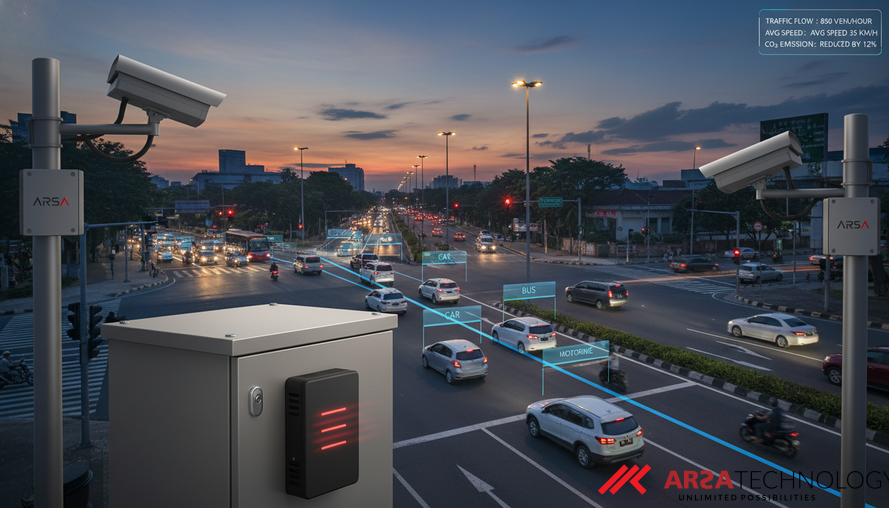
For government and property management, edge computing is often the preferred deployment model due to its benefits in data privacy, low latency, and reduced bandwidth usage. An edge AI device, such as the ARSA Traffic Monitor (AI Box), is designed to process video streams locally, directly at the source or a nearby aggregation point.
When selecting a solution, look for:
- Plug-and-Play Setup: Minimal installation time, ideally within minutes.
- Local Processing: Ensures data remains within your network, addressing privacy and compliance concerns.
- Scalability: The ability to deploy a single unit or scale across multiple sites and camera networks.
- Specific Analytics Modules: Ensure the solution offers modules for vehicle counting, vehicle classification, traffic flow analysis, and congestion detection.
The ARSA Traffic Monitor, part of the AI Box Series overview, exemplifies this approach. It’s designed for rapid deployment, allowing you to upgrade traffic cameras with edge AI quickly and efficiently.
3. Connect and Configure the Edge AI Device
Once the edge AI device is selected, the implementation involves a few simple steps:
- Connect: Physically connect the AI Box to power, your network, and your existing CCTV cameras. This typically involves standard network cables.
- Configure: Access the device’s interface (often a web dashboard) to select the desired analytics modules. For traffic, this would include modules for vehicle counting, classification, and flow analysis. Define detection zones, virtual tripwires, and alert rules specific to your operational needs.
- Monitor: Once configured, the system immediately begins processing video streams. You can then access real-time dashboards, alerts, and historical reports either locally or remotely.
This seamless integration allows you to add AI traffic counting to security cameras and other advanced analytics without complex IT overhauls.
4. Data Analysis and Actionable Insights
The true power of AI traffic analytics lies in its ability to convert raw video data into actionable intelligence. The ARSA Traffic Monitor provides:
- Real-time Dashboards: Visualize current traffic conditions, vehicle counts, and congestion levels.
- Historical Reports: Analyze trends over time to understand peak hours, traffic patterns, and the impact of urban planning initiatives.
- Automated Alerts: Receive instant notifications for incidents like unusual congestion, stopped vehicles, or unauthorized access to restricted lanes.
These insights empower government bodies and property managers to make data-driven decisions, leading to optimized traffic flow by up to 40%, more effective urban planning, and a significant reduction in congestion.
The Business Outcomes: Why This Matters for Government and Property Management
Implementing AI traffic analytics with existing CCTV cameras offers a multitude of tangible benefits:
Cost Efficiency and ROI
By leveraging existing CCTV infrastructure, organizations avoid the massive capital expenditure of deploying new, specialized traffic sensors. The plug-and-play nature of solutions like the ARSA Traffic Monitor minimizes installation costs and time. With local processing, there are no recurring cloud costs for video analysis, leading to a rapid ROI, often within months. This allows government IT procurement teams to maximize budget efficiency while delivering advanced capabilities.
Enhanced Operational Efficiency
Automated vehicle counting and classification free up personnel from manual monitoring tasks, allowing them to focus on higher-value activities. Real-time data enables dynamic traffic signal adjustments, intelligent routing, and proactive incident response, significantly improving overall traffic management. This capability helps to retrofit CCTV for vehicle classification and other advanced functions, transforming operational workflows.
Data-Driven Urban Planning
Accurate historical data on traffic patterns, vehicle types, and congestion hotspots provides invaluable intelligence for urban planners. This data supports evidence-based decisions for infrastructure development, public transport planning, and policy adjustments, leading to more sustainable and livable cities. You can effectively convert surveillance cameras to traffic sensors to gather this crucial data.
Improved Public Safety and Security
Beyond traffic management, the ability to detect incidents in real-time (e.g., accidents, illegal parking, pedestrian safety violations) enhances public safety. Automated alerts ensure a faster response from emergency services or law enforcement, potentially saving lives and reducing property damage.
Data Privacy and Compliance
For government and public sector entities, data sovereignty and privacy are paramount. Edge AI solutions like ARSA’s ensure that video streams and inference results are processed locally and do not leave your infrastructure unless explicitly configured. This adherence to strict data handling protocols aligns with regulations such as GDPR and Indonesia PDPA, building trust with citizens.
ARSA Technology: Your Partner in Smart Traffic Solutions
ARSA Technology has a proven track record of delivering robust AI and IoT solutions for governments and enterprises across Southeast Asia. Our expertise in AI video analytics and edge computing ensures that our solutions are not just innovative but also practical, reliable, and compliant with the highest standards.
The ARSA Traffic Monitor (AI Box) is a prime example of our commitment to practical AI. It’s a dedicated edge AI system pre-configured with ARSA’s video analytics software, designed for fast on-site deployment. It works with your existing CCTV, processes data at the edge, and eliminates cloud costs, making it an ideal choice for property management and government applications. Our solutions are built for real-world operations, trusted by leaders in government and industry.
Beyond traffic management, ARSA offers a comprehensive suite of AI products, including advanced face recognition systems. For instance, our ARSA Face Recognition & Liveness API provides enterprise-grade biometric capabilities for secure identity verification. You can explore all ARSA products to see how our AI and IoT solutions can address various operational challenges.
Frequently Asked Questions
What are the primary benefits of using existing CCTV cameras for AI traffic analytics?
Leveraging existing CCTV cameras for AI traffic analytics offers significant cost savings by avoiding new hardware deployment, enables rapid implementation, ensures data privacy through edge processing, and provides real-time, actionable insights for traffic management and urban planning.
Can ARSA’s AI Box truly retrofit CCTV for vehicle classification without replacing cameras?
Yes, the ARSA AI Box is specifically designed to integrate with your existing CCTV infrastructure. It processes video streams from your current cameras at the edge, enabling advanced functionalities like vehicle counting and classification without requiring camera replacement.
How does ARSA’s solution help government agencies with data-driven urban planning?
ARSA’s AI Traffic Monitor provides granular data on vehicle counts, types, traffic flow, and congestion patterns. This real-time and historical data empowers urban planners to make informed decisions regarding infrastructure development, traffic signal optimization, and policy adjustments to improve city efficiency and livability.
Is cloud connectivity required for ARSA’s AI Box to convert surveillance cameras to traffic sensors?
No, cloud connectivity is optional. The ARSA AI Box processes all video streams and performs AI inference locally at the edge. This ensures full data ownership and privacy, making it ideal for environments where data sovereignty and offline operation are critical, such as government and public sector deployments.
Conclusion
The era of intelligent traffic management is here, and it doesn’t require a complete overhaul of your existing infrastructure. By understanding how to implement AI traffic analytics with existing CCTV cameras, government IT procurement leaders and property managers can unlock unprecedented operational efficiencies, achieve significant cost savings, and lay the groundwork for truly smart, responsive environments. Solutions like the ARSA Traffic Monitor offer a practical, proven path to transforming passive surveillance into a powerful tool for urban optimization.
Ready to transform your traffic management? Discover how ARSA Technology can help you leverage your existing CCTV infrastructure for intelligent traffic analytics. Contact our solutions team today for a consultation and demonstration.
Stop Guessing, Start Optimizing.
Discover how ARSA Technology drives profit through intelligent systems.
