
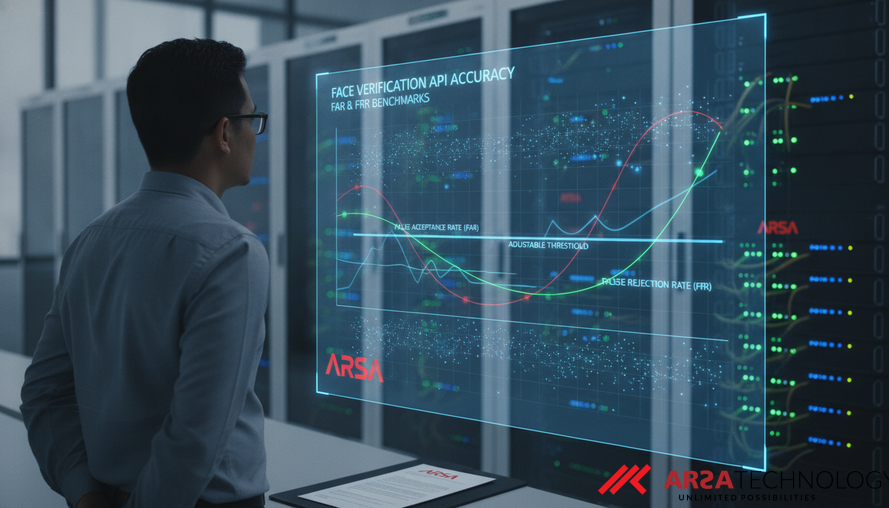

Understanding How to Read FAR and FRR Benchmarks When Choosing a Face Verification API
For engineers tasked with integrating robust identity solutions, understanding how to read FAR and FRR benchmarks when choosing a face verification API is paramount. In the rapidly evolving landscape of digital identity, particularly within sectors like telecommunications, the accuracy metrics of biometric systems directly translate to security, user experience, and compliance. False Acceptance Rate (FAR) and False Rejection Rate (FRR) are not just abstract numbers; they are critical indicators that define the real-world performance and reliability of any face recognition system.
As organizations increasingly adopt biometric authentication for everything from customer onboarding to secure access, the ability to critically evaluate vendor claims and tune system performance becomes a core competency. This guide will demystify these essential metrics, explain their interplay, and provide a framework for making informed decisions when selecting a face verification API.
False Acceptance Rate vs. False Rejection Rate Face Recognition: The Fundamental Trade-off
At the heart of biometric accuracy lies a fundamental trade-off between two opposing error types: False Acceptance Rate (FAR) and False Rejection Rate (FRR).
False Acceptance Rate (FAR), also known as False Match Rate (FMR), quantifies the likelihood that a biometric system incorrectly authenticates an unauthorized individual. In simpler terms, it’s the chance that an impostor is mistakenly granted access. A low FAR is crucial for security-sensitive applications, as even a minute percentage can lead to significant vulnerabilities, especially when dealing with a large user base or high-value transactions. For instance, in a telecommunications context, a high FAR could allow fraudsters to access customer accounts or register services under false identities.
False Rejection Rate (FRR), also also known as False Non-Match Rate (FNMR), measures the probability that a biometric system incorrectly denies access to an authorized individual. This means a legitimate user is mistakenly rejected. While less catastrophic than a false acceptance, a high FRR can severely degrade the user experience, leading to frustration, increased support costs, and potential abandonment of the system. Imagine a customer repeatedly failing to log in to their mobile banking app due to an overly sensitive face verification API.
The critical insight for engineers is that these two metrics are inversely related. Adjusting the system’s matching threshold to decrease FAR (making it more secure) will inherently increase FRR (making it less convenient), and vice-versa. There is no single setting that eliminates both errors simultaneously. The goal is to find the optimal balance that aligns with the specific security requirements and user experience expectations of your application.
Understanding Face Recognition Accuracy Benchmarks Explained
Beyond FAR and FRR, another common metric is the Equal Error Rate (EER). EER represents the point on a Detection Error Tradeoff (DET) curve where FAR and FRR are equal. While EER provides a convenient single number for comparing different systems, it’s important to recognize that real-world deployments rarely operate at this exact point. Instead, systems are typically tuned to prioritize either security (lower FAR) or convenience (lower FRR), depending on the use case.
When evaluating how accurate is face verification API, it’s essential to look beyond headline “accuracy percentages” that often lack context. A claim of “99.9% accuracy” can be misleading if it doesn’t specify the corresponding FAR and FRR at a given threshold, the size and diversity of the dataset used for testing, and the conditions under which the tests were performed. For example, top-performing face recognition algorithms in NIST FRVT 1:1 verification tests in 2023 achieved False Non-Match Rates (FNMR) as low as 0.1% at a False Match Rate (FMR) of 1e-6 on large visa datasets. However, these figures are often derived from controlled lab environments.
The Reality of Lab vs. Real-World Performance
A significant challenge in evaluating face recognition systems is the gap between laboratory-tested accuracy and real-world performance. In controlled lab settings, conditions like lighting, pose, and image quality are optimized, leading to impressive benchmark numbers. However, in uncontrolled environments, such as a customer performing digital onboarding for a telecom provider using a smartphone, factors like variable lighting, camera angles, facial expressions, and even the presence of masks can significantly degrade performance. Research indicates that face recognition error rates can climb 5-10 times higher in uncontrolled environments compared to lab conditions (BiometricScannerInfo.com).
This discrepancy highlights the importance of choosing a face verification API that is robust enough to handle diverse real-world scenarios. ARSA Technology, for instance, offers an ARSA Face Recognition & Liveness API designed for enterprise-grade deployments, understanding that practical AI must perform reliably under varied conditions.
The Role of Liveness Detection and Anti-Spoofing
In 2026, liveness detection is no longer a luxury but a necessity for any secure face verification API. Presentation-attack detection (PAD), as defined by standards like ISO/IEC 30107-3, is crucial for distinguishing a live person from a spoofing attempt using photos, videos, or 3D masks. Without effective PAD, the effective FAR of a system can be dramatically higher, as attackers can bypass the biometric matching algorithm entirely.
It’s vital to differentiate PAD, which addresses presentation attacks at the camera, from injection attacks or deepfakes that bypass the camera altogether. While liveness detection is a powerful defense, it is not sufficient on its own to counter all forms of sophisticated synthetic identity fraud. ARSA’s Face Recognition & Liveness API includes both passive and active liveness detection with head movement challenges to prevent common spoofing attempts, helping organizations meet critical obligations under regulations like PSD2, eIDAS, FinCEN, and RBI V-CIP.
Face Matching Threshold Tuning: Optimizing for Your Use Case
The ability to perform face matching threshold tuning is a powerful feature for engineers. This allows you to adjust the sensitivity of the face matching algorithm to prioritize either lower FAR (higher security) or lower FRR (better convenience), based on the specific risk profile of your application.
For high-security scenarios, such as accessing sensitive customer data in telecommunications, you would set a stricter threshold to minimize false acceptances. This might result in a slightly higher number of legitimate users being asked to re-verify, but the enhanced security outweighs the minor inconvenience. Conversely, for less critical applications, a more lenient threshold could be used to reduce friction and improve user flow.
ARSA’s Face Recognition & Liveness API offers configurable similarity thresholds, allowing developers to fine-tune the balance between security and convenience. The API also supports multiple images per face ID during enrollment, which can significantly improve accuracy by providing the system with a more comprehensive template of the user’s face.
Choosing the Right Face Verification API: What to Look For
When evaluating face verification APIs, consider these factors:
- Accuracy Benchmarks: Demand clear, paired FAR and FRR figures at specified thresholds, along with details on the test dataset size, diversity, and capture conditions. Independent testing results, such as those from NIST FRVT, provide the most credible evidence.
- Liveness Detection: Ensure the API offers robust active and passive liveness detection to combat presentation attacks. Top FR systems achieved 99.5% presentation attack detection in ISO tests in 2022 (Gitnux.org).
- Scalability and Performance: A cloud-based SaaS solution like the ARSA Face Recognition & Liveness API offers scalability without infrastructure management, supporting 1:N face recognition against large databases and 1:1 face verification with a 99.9% uptime target.
- Ease of Integration: Look for a REST API with comprehensive documentation, quick setup (ARSA boasts a first API call in under 5 minutes), and support for common image/video formats.
- Data Privacy and Ownership: For telecommunications, isolated per-account face databases are crucial for data privacy and tenant separation.
- Pricing Model: A transparent, usage-based pricing model, like ARSA’s tiered plans (Basic free, Pro $29/mo, Ultra $149/mo, Mega $1,290/mo), allows you to pay only for what you use, with all features included on every plan. You can even create a free Face API account to get started.
The facial recognition software market is projected to reach USD 12.49 billion by 2026, reflecting its growing importance across industries, including telecommunications, where 68% of banks were already using FR for KYC in 2023 (Gitnux.org).
Frequently Asked Questions
What is the difference between false acceptance rate vs false rejection rate face recognition?
False Acceptance Rate (FAR) is the probability of an unauthorized person being incorrectly accepted by the system, representing a security breach. False Rejection Rate (FRR) is the probability of an authorized person being incorrectly rejected, leading to inconvenience. These two rates have an inverse relationship: improving one often worsens the other.
How can I ensure the face recognition accuracy benchmark explained by a vendor is reliable?
To ensure reliability, always ask for FAR and FRR figures at the *same* matching threshold, details on the dataset size and diversity, and the environmental conditions of the tests. Prioritize vendors who can cite results from independent third-party evaluations like NIST FRVT, as these are more transparent and less prone to cherry-picking.
What is face matching threshold tuning and why is it important for a face verification API?
Face matching threshold tuning involves adjusting the sensitivity level of the face recognition algorithm. A stricter threshold reduces FAR (improves security) but increases FRR (reduces convenience), while a more lenient threshold does the opposite. It’s important because it allows engineers to optimize the API’s performance to meet the specific security and user experience requirements of their application.
How accurate is face verification API in real-world telecommunications deployments?
While lab benchmarks for top algorithms show very high accuracy (e.g., FNMR as low as 0.1% at FMR 1e-6), real-world accuracy in telecommunications can be impacted by factors like varying lighting, camera quality, user cooperation, and the presence of masks. It’s generally expected that real-world error rates can be 5-10 times higher than lab conditions. Robust liveness detection and careful threshold tuning are crucial for optimal performance.
Conclusion
Navigating the complexities of face verification API accuracy requires a deep understanding of metrics like FAR and FRR. For engineers in telecommunications and beyond, the ability to critically assess these benchmarks, understand the trade-offs, and implement effective face matching threshold tuning is essential for deploying secure, user-friendly, and compliant identity solutions.
ARSA Technology’s Face Recognition & Liveness API provides a powerful, cloud-based platform that offers the core functions needed to build robust identity verification systems, from 1:N identification to active liveness detection. With features like isolated per-account face databases and a focus on preventing presentation attacks, it’s designed to help you launch secure face login in days, not months, and meet stringent regulatory obligations. Explore the Face API pricing plans or contact ARSA solutions team to learn how our technology can transform your digital identity strategy.
Stop Guessing, Start Optimizing.
Discover how ARSA Technology drives profit through intelligent systems.