
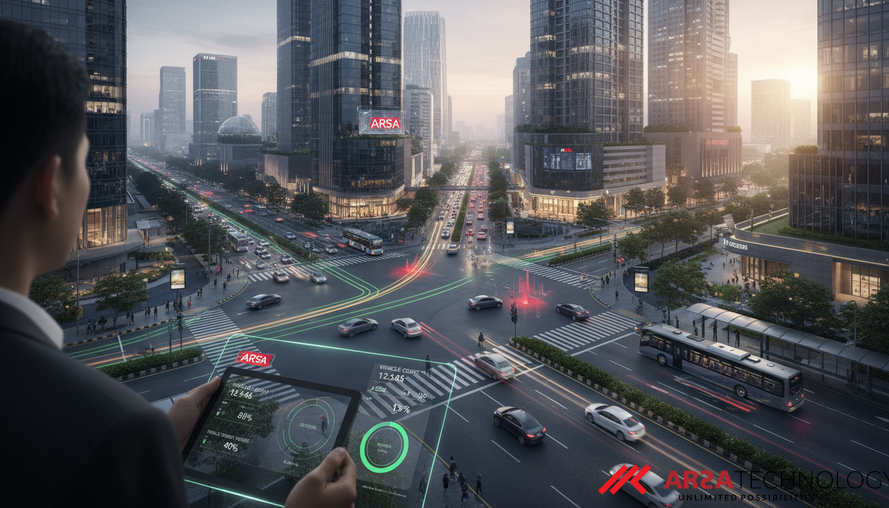

Unlocking Urban Efficiency: The Real-time Congestion Detection System for Urban Traffic Planning
Urban centers worldwide grapple with the persistent challenge of traffic congestion, leading to lost productivity, increased pollution, and frustrated citizens. For smart city project managers, the quest for a robust real-time congestion detection system for urban traffic planning is paramount. Such a system is not just about identifying bottlenecks; it’s about transforming raw traffic data into actionable intelligence that drives proactive management, optimizes infrastructure, and ultimately enhances the quality of urban life.
Traditional traffic monitoring often relies on outdated methods or fragmented data sources, providing a reactive rather than predictive approach. However, with the advent of advanced AI video analytics, cities can now deploy sophisticated solutions that offer unprecedented visibility and control over their transportation networks. ARSA Technology offers an enterprise-grade AI Video Analytics Software, specifically its ARSA Traffic Monitor, designed for on-premise deployment, providing comprehensive traffic intelligence without the inherent risks and costs associated with cloud-dependent alternatives.
The Imperative for Real-time Congestion Detection in Urban Planning
Effective urban traffic planning hinges on precise, up-to-the-minute data. Without it, decisions about signal timing, lane management, and emergency response remain speculative. A real-time congestion detection system empowers city operators to:
- Respond Instantly: Identify incidents, accidents, or sudden congestion spikes as they occur, enabling rapid deployment of emergency services or rerouting strategies.
- Optimize Flow: Dynamically adjust traffic light sequences and variable message signs to alleviate pressure points and maintain optimal traffic flow.
- Plan Proactively: Leverage historical data and predictive analytics to anticipate future congestion patterns, informing long-term infrastructure investments and urban development.
- Enhance Public Safety: Detect anomalous behaviors or stationary vehicles that could indicate hazards, improving overall road safety.
The shift towards data-driven traffic management system is not merely an upgrade; it’s a fundamental change in how cities operate and evolve.
Comparing Deployment Models: On-Premise Software vs. Cloud & Edge Hardware
When considering a real-time congestion detection system for urban traffic planning, smart city project managers face a critical decision regarding deployment architecture: cloud-based, edge hardware, or on-premise software. Each has its merits, but for mission-critical urban infrastructure, the advantages of an on-premise software solution are compelling.
1. Cloud-Based Solutions:
Cloud platforms offer scalability and ease of initial setup. However, they introduce several challenges for sensitive urban traffic data:
- Data Sovereignty & Privacy: Sending vast amounts of video and metadata to third-party cloud servers raises concerns about data ownership, privacy, and compliance with local regulations.
- Latency: Real-time decision-making for traffic management demands ultra-low latency. Cloud processing can introduce delays, impacting the effectiveness of immediate responses to incidents.
- Recurring Costs: Cloud subscriptions often come with escalating data transfer and processing fees, which can become substantial for city-wide deployments with numerous camera feeds.
2. Edge Hardware Solutions:
Edge AI devices, like ARSA’s own AI Box Series, process data locally, offering low latency and reducing bandwidth requirements. While excellent for distributed, rapid rollout projects (e.g., specific intersections or industrial sites), they can present challenges for centralized urban planning:
- Distributed Management: Managing and updating numerous individual edge devices across a city can be complex and resource-intensive for a centralized operations team.
- Limited Centralized Analytics: While each edge device provides local insights, aggregating and analyzing city-wide data for comprehensive traffic flow optimization for smart cities requires an additional layer of centralized software.
- Hardware Procurement & Maintenance: Requires purchasing and maintaining dedicated hardware at each deployment point, adding to capital expenditure and operational overhead.
3. On-Premise AI Video Analytics Software (ARSA’s Approach):
ARSA Technology’s AI Video Analytics Software, including the Traffic Monitor module, offers a powerful alternative. This self-hosted platform is deployed directly on a city’s existing servers or private data centers, providing the best of both worlds for comprehensive urban traffic planning.
Why ARSA Traffic Monitor Software Excels for Urban Traffic Planning
The ARSA Traffic Monitor, deployed as on-premise software, is specifically engineered to meet the stringent demands of smart city infrastructure. It transforms existing CCTV networks into intelligent monitoring systems without requiring costly hardware replacements at every camera location.
Key Advantages for Smart City Project Managers:
- Full Data Ownership and Privacy: All video streams, inference results, and metadata remain entirely within your city’s infrastructure. This ensures compliance with data sovereignty laws and robust privacy protection, critical for public sector applications.
- No Hardware Dependency: Deploy the ARSA Traffic Monitor on existing servers, private data centers, or edge compute infrastructure. This eliminates the need to purchase dedicated AI appliances, significantly reducing initial investment and leveraging existing IT assets.
- Centralized Processing and Control: Analyze multiple camera streams from a central location, providing a unified vehicle counting analytics dashboard for city operators. This centralized approach simplifies management, updates, and overall system oversight.
- Scalability by Design: Scale analytics capacity by simply allocating more compute resources to your existing infrastructure, rather than installing new physical devices. This offers unparalleled flexibility as your city’s needs evolve.
- Seamless Integration: The software is integration-ready, utilizing a REST API to connect with existing dashboards, alerting systems, and data pipelines. This ensures that the traffic intelligence seamlessly feeds into your broader smart city ecosystem.
- Real-time Operational Intelligence: The ARSA Traffic Monitor converts raw video streams into immediate alerts and notifications, operational and safety metrics, and historical analytics. This enables automated incident detection on highways and urban roads, facilitating rapid response.
Core Analytics Capabilities of ARSA Traffic Monitor
The ARSA Traffic Monitor provides a suite of advanced analytics modules critical for effective urban traffic planning:
- Vehicle Counting and Classification: Accurately count vehicles by type (cars, trucks, motorcycles, buses) across multiple lanes and directions. This granular data is vital for understanding traffic composition and planning for specific vehicle types.
- Congestion and Flow Analysis: Identify traffic density, average speed, and queue lengths in real-time. The system pinpoints areas of congestion, predicts potential bottlenecks, and visualizes traffic flow patterns on a dynamic dashboard.
- Origin-Destination Analysis: Understand common routes and travel patterns, helping to identify popular corridors and inform route optimization strategies.
- Incident Detection: Automatically detect anomalies such as stopped vehicles, illegal parking, wrong-way driving, or pedestrian intrusions, triggering immediate alerts for operators.
- Historical Reporting: Generate detailed reports on traffic volumes, speeds, and congestion over time, providing invaluable insights for long-term urban traffic planning and infrastructure development.
For example, by identifying peak hour congestion patterns, city planners can strategically adjust public transport schedules or implement dynamic lane assignments. The same technology that powers traffic monitoring can also be adapted for other urban applications, such as the ARSA DOOH Audience Meter, which measures audience exposure and demographics for digital signage, showcasing the versatility of ARSA’s AI capabilities.
Measurable Business Outcomes and ROI
Investing in a real-time congestion detection system for urban traffic planning with ARSA Technology translates into tangible benefits and a clear return on investment for smart cities:
- Reduced Operational Costs: By leveraging existing CCTV infrastructure and deploying on-premise software, cities avoid recurring cloud fees and the need for extensive new hardware. Automated monitoring also reduces the reliance on manual surveillance.
- Improved Traffic Efficiency: AI traffic flow optimization for smart cities leads to smoother commutes, reduced travel times, and lower fuel consumption for citizens and commercial fleets.
- Enhanced Public Safety: Faster incident detection and response minimize accident severity and improve emergency service deployment times.
- Data-Driven Decision Making: Comprehensive analytics provide city operators and planners with the insights needed to make informed decisions about infrastructure upgrades, public transport routes, and policy changes.
- Environmental Benefits: Optimized traffic flow reduces idling time and vehicle emissions, contributing to cleaner urban air and a healthier environment.
ARSA Technology has a proven track record of deploying mission-critical AI solutions for governments and enterprises, ensuring accuracy, reliability, and data control. Our 7+ years of experience in the field, including work with Indonesia’s Ministry of Defense and National Police, underscores our commitment to delivering production-ready systems that solve real-world operational problems.
Conclusion
The future of urban mobility lies in intelligent, data-driven systems that provide real-time insights and enable proactive management. A robust real-time congestion detection system for urban traffic planning is not just a technological luxury but a strategic necessity for any smart city aiming to improve efficiency, safety, and liveability.
By choosing ARSA Technology’s on-premise AI Video Analytics Software, smart city project managers gain full control over their data, leverage existing infrastructure, and benefit from scalable, high-performance analytics. This approach ensures that your city’s traffic management is not only intelligent but also secure, compliant, and cost-effective. Explore all ARSA products and capabilities to see how our solutions can transform your urban environment. Ready to engineer a smarter, more efficient city? Contact our solutions team today for a consultation.
—
FAQ
What is the primary benefit of an on-premise real-time congestion detection system for urban traffic planning?
The primary benefit is full data ownership and enhanced privacy, as all video streams and analytics data remain within your city’s infrastructure, ensuring compliance with local regulations and eliminating cloud dependency.
How does ARSA’s Traffic Monitor contribute to AI traffic flow optimization for smart cities?
ARSA’s Traffic Monitor provides real-time vehicle counting, classification, and congestion analysis, enabling dynamic adjustments to traffic signals and routes, and offering historical data for long-term strategic planning to optimize overall traffic flow.
Can ARSA’s system integrate with existing city infrastructure for data-driven traffic management?
Yes, ARSA’s AI Video Analytics Software is designed for seamless integration using a REST API, allowing it to connect with existing CCTV networks, dashboards, alerting systems, and other data pipelines for comprehensive data-driven traffic management.
What types of incidents can ARSA’s automated incident detection on highways identify?
ARSA’s system can automatically detect various incidents such as stopped vehicles, illegal parking, wrong-way driving, and pedestrian intrusions on highways and urban roads, triggering immediate alerts for rapid response.
Stop Guessing, Start Optimizing.
Discover how ARSA Technology drives profit through intelligent systems.
