
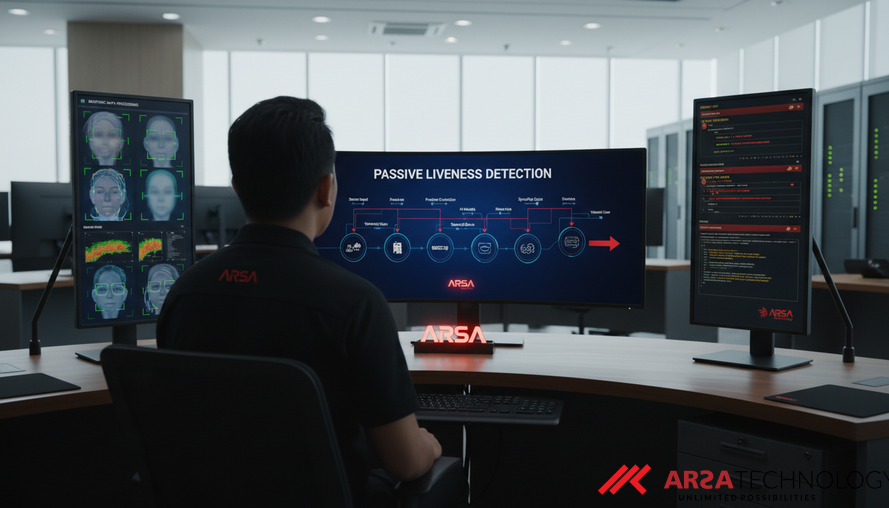

What is Passive Liveness Detection and How Does It Work? A Security Engineer’s Guide
In the rapidly evolving landscape of digital identity, ensuring that a user is a real, live person and not an imposter is paramount. For security engineers, understanding what is passive liveness detection and how does it work is no longer optional—it’s a critical component of robust anti-fraud strategies, especially in high-stakes sectors like digital banking. This advanced biometric security measure operates seamlessly in the background, verifying authenticity without requiring any explicit actions from the user.
Passive liveness detection represents a significant leap forward from traditional methods, offering a frictionless user experience while providing formidable protection against sophisticated presentation attacks. ARSA Technology’s Face Recognition & Liveness API leverages this cutting-edge technology to empower enterprises to launch secure face login and meet stringent compliance obligations like PSD2, eIDAS, and FinCEN, often in days, not months.
Understanding Passive Liveness Detection and How It Works
Passive liveness detection is an AI-driven technique designed to determine if a biometric sample (typically a face image or video frame) is from a live person or a spoofing attempt. Unlike active liveness detection, which requires users to perform specific actions like blinking or turning their head, passive liveness operates without any user interaction. This makes the onboarding and authentication process incredibly smooth and fast, enhancing user experience while maintaining high security.
The core principle behind how anti-spoofing face API works with passive liveness is the analysis of subtle, inherent characteristics of a live human face that are virtually impossible to replicate with static images, videos, or 3D masks. This single image liveness detection capability is crucial for preventing various forms of digital identity fraud.
Step-by-Step: The Mechanics of Passive Liveness Detection
Here’s a breakdown of the typical steps involved in passive liveness detection:
1. Image Capture and Pre-processing
When a user presents their face to a camera for verification (e.g., during e-KYC or login), the system captures a single image or a short video stream. This raw input is then pre-processed to normalize lighting, scale, and orientation, ensuring optimal conditions for AI analysis. The ARSA Face Recognition & Liveness API is designed to handle standard JPEG/PNG image formats, making integration straightforward.
2. Feature Extraction with Deep Learning
The pre-processed image is fed into a sophisticated deep learning model. This model is trained on vast datasets of both genuine human faces and various spoofing artifacts. It extracts intricate features that distinguish living tissue from inanimate objects or digital reproductions. These features can include:
- Texture Analysis: Detecting minute skin pores, wrinkles, and subtle irregularities unique to human skin, which are often absent or distorted in printed photos or screens.
- Reflectance and Specular Highlights: Analyzing how light interacts with the face. Live skin reflects light differently than paper, screens, or silicone masks. The presence and movement of specular highlights (bright spots of reflected light) can reveal authenticity.
- Micro-movements: Even when a person tries to stay still, there are involuntary micro-movements, blood flow, and subtle changes in facial expression. While less pronounced than in active liveness, these can be detected over a very short video sequence or even inferred from a single high-quality image.
- Depth Cues: Analyzing subtle depth information, even from a 2D image, to infer if the face has a natural 3D structure or is flat like a photo.
3. Spoof Detection and Confidence Scoring
Based on the extracted features, the AI model calculates a “liveness score.” This score indicates the probability that the presented face is from a live person. A high score suggests authenticity, while a low score flags a potential spoofing attempt. The system then makes a decision:
- Live: The user is deemed a real person, and the process continues to face recognition or verification.
- Spoof: The system detects a presentation attack, such as a photo replay attack prevention, and rejects the authentication attempt.
4. Integration with Face Recognition and Verification
Once liveness is confirmed, the live face image proceeds to the next stage: either 1:1 face verification (confirming the user is who they claim to be) or 1:N face recognition against a database (identifying the user from a collection of enrolled faces). ARSA’s API seamlessly integrates these functions, providing a complete identity layer.
Passive vs. Active Liveness Explained
While both passive and active liveness detection aim to prevent presentation attacks, they differ fundamentally in their approach:
- Passive Liveness: Requires no user interaction. It analyzes the inherent properties of the presented face.
- Pros: Extremely user-friendly, fast, reduces friction in onboarding, ideal for quick authentication.
- Cons: Can be more computationally intensive, requires highly sophisticated AI models to be effective against advanced spoofing.
- Active Liveness: Requires the user to perform specific actions (e.g., head turns, blinking, speaking a phrase).
- Pros: Can offer a very high level of assurance, as specific actions are harder to spoof.
- Cons: Introduces friction, can be cumbersome for users, may not be accessible for all users (e.g., those with motor impairments).
ARSA’s Face Recognition & Liveness API offers both active and passive liveness detection, allowing businesses to choose the best fit for their specific use case and risk tolerance. For instance, high-security e-KYC processes might combine both for maximum assurance, while routine logins could rely on passive liveness for speed. You can learn more about how ARSA helps prevent sophisticated fraud in our article Combating Synthetic Threats: How to Prevent Deepfake Fraud with Face Liveness Detection.
Business Outcomes and ARSA’s Solution for Digital Banking
For digital banking, the implications of robust passive liveness detection are profound. It directly addresses critical business outcomes:
- Enhanced Security and Fraud Prevention: By effectively preventing photo replay attack prevention and other presentation attacks, banks can significantly reduce instances of synthetic identity fraud and account takeover. This directly safeguards customer assets and the institution’s reputation.
- Streamlined Customer Onboarding (e-KYC): A frictionless onboarding process, enabled by single image liveness detection, leads to higher conversion rates for new customers. This is vital for meeting KYC and AML obligations under regulations like PSD2 and eIDAS, without creating unnecessary hurdles for legitimate users.
- Reduced Operational Costs: Automating liveness checks reduces the need for manual review, freeing up valuable human resources and cutting operational expenses.
- Compliance Readiness: ARSA’s API is built with compliance in mind, offering features like per-account isolated databases for data privacy and tenant separation, crucial for adhering to global data protection regulations like GDPR and Indonesia PDPA.
- Scalability and Flexibility: As a cloud SaaS solution, the Face Recognition & Liveness overview scales effortlessly to meet demand, from basic free tiers (100 calls/month, 100 face IDs) to enterprise-grade MEGA plans (500,000 calls/month, 500,000 face IDs) at $1,290/month. All features, including age estimation, gender classification, and expression detection, are included across all plans, ensuring you pay only for what you use without hidden costs.
ARSA Technology provides a production-ready Face Recognition & Liveness API that allows security engineers to integrate these capabilities with minimal effort. With simple x-key-secret API key authentication and comprehensive Face Recognition API documentation, developers can make their first API call in under 5 minutes. The developer dashboard provides usage analytics, offering full transparency and control. For those requiring self-hosted solutions, ARSA also offers an on-premise SDK version.
The Future of Secure Digital Identity
As digital interactions become more prevalent, the sophistication of fraud attempts will continue to rise. Passive liveness detection stands as a critical defense, offering both advanced security and an unparalleled user experience. For security engineers in digital banking, integrating a robust solution like ARSA’s Face Recognition & Liveness API is an investment in future-proofing their systems against evolving threats. It’s about building trust, ensuring compliance, and enabling seamless, secure digital transactions.
Ready to enhance your digital banking security with advanced liveness detection? Contact ARSA solutions team today to discuss your specific needs or create a free Face API account to experience the power of passive liveness detection firsthand.
FAQ
What is the primary benefit of passive liveness detection over active methods?
The primary benefit is a frictionless user experience. Passive liveness detection verifies a user’s authenticity without requiring them to perform any actions, leading to faster onboarding and authentication processes, which is ideal for digital banking and e-KYC.
How does ARSA’s Face API prevent photo replay attacks?
ARSA’s Face Recognition & Liveness API utilizes advanced AI algorithms for single image liveness detection. It analyzes subtle characteristics like texture, light reflection, and micro-movements to distinguish a live person from a static photo or video replay, effectively preventing photo replay attacks and synthetic identity fraud.
Is ARSA’s passive liveness detection compliant with international regulations?
Yes, ARSA’s Face Recognition & Liveness API is designed with compliance in mind. It offers features like per-account isolated databases for data privacy and tenant separation, helping organizations meet international standards and regulations such as GDPR, PSD2, eIDAS, and FinCEN.
Can ARSA’s Face API be scaled for large enterprise needs?
Absolutely. ARSA’s cloud-based Face API offers flexible Face API pricing plans ranging from a free tier to a MEGA Enterprise Tier supporting up to 500,000 API calls and 500,000 face IDs per month. This ensures scalability to meet the demands of any enterprise, including large digital banking operations.
Stop Guessing, Start Optimizing.
Discover how ARSA Technology drives profit through intelligent systems.