
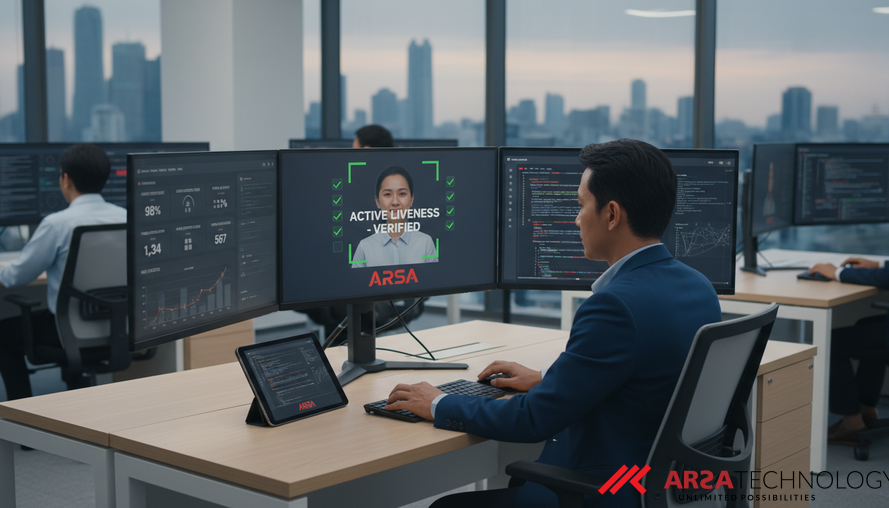

A Complete Guide to How Active Liveness Detection Challenge Response Works
In the evolving landscape of digital identity, securing user authentication against sophisticated fraud attempts is paramount. Fraud prevention engineers continually seek robust solutions to verify that a user is a real, live person and not an imposter using a photo, video, or even a deepfake. This guide delves into how active liveness detection challenge response works, a critical technology that forms the bedrock of secure digital onboarding and authentication processes across industries like edtech. By understanding its mechanics, organizations can significantly bolster their defenses against presentation attacks and synthetic identity fraud.
The core challenge in digital identity verification is distinguishing between a genuine user and a fraudulent attempt. Traditional methods often fall short against increasingly clever spoofing techniques. This is where advanced liveness detection, particularly the active challenge-response method, becomes indispensable. ARSA Technology’s Face Recognition & Liveness API offers a powerful, cloud-based SaaS solution designed to integrate seamlessly into existing platforms, enabling secure identity management with minimal overhead.
Understanding How Active Liveness Detection Challenge Response Works
Active liveness detection is a sophisticated biometric security measure designed to confirm the physical presence of a user during an identity verification process. Unlike passive liveness detection, which analyzes subtle cues without user interaction, active liveness directly engages the user with specific, real-time challenges. The fundamental principle of how active liveness detection challenge response works is to prompt the user to perform a series of actions that are difficult, if not impossible, for a static image, recorded video, or even a sophisticated deepfake to replicate convincingly in real-time.
These challenges are typically randomized to prevent pre-recorded responses and ensure a high level of security. The system analyzes the user’s response to these prompts, looking for specific movements, patterns, and biological indicators to confirm liveness. This method is crucial for meeting stringent compliance obligations under frameworks like PSD2, eIDAS, and FinCEN, which demand high assurance in identity verification.
The Mechanics of Active Liveness: Head Movement Challenges
One of the most common and effective forms of active liveness detection involves `active liveness head movement challenge`. During this process, the user is instructed to perform specific head movements, such as turning their head left, right, up, or down, or nodding. The system captures video of these movements and analyzes several factors:
- Movement Trajectory: The AI model tracks the path and fluidity of the head movement, comparing it against expected human motion.
- Depth and Perspective Changes: As the head moves, the perspective of the face changes, revealing 3D characteristics that are absent in 2D photos or flat video replays.
- Texture and Reflection Analysis: The way light reflects off the skin and changes with movement provides strong indicators of a live person versus a static image or mask.
- Randomization: To prevent attackers from simply recording and replaying a set sequence, the system often employs `random head pose liveness verification`. This means the specific sequence of movements is unpredictable, making it significantly harder for fraudulent attempts to succeed.
ARSA’s Face Recognition & Liveness overview highlights how this technology is engineered to detect and prevent photo and video replay attacks, ensuring that only genuine users gain access.
Building a Secure Video-Based Liveness Check Flow
For developers and fraud prevention engineers, understanding `how to build a liveness check video flow` is key to seamless integration and robust security. Implementing a `video based liveness detection API` like ARSA’s simplifies this process dramatically. Instead of building complex AI models from scratch, organizations can leverage a ready-to-use API that handles the heavy lifting.
The typical flow involves:
1. Initiation: The application requests a liveness check from the API.
2. User Prompt: The API instructs the user (via the application’s UI) to perform a specific challenge, such as an `active liveness head movement challenge`.
3. Video Capture: The user’s device captures a short video (e.g., MP4/WebM format) of them performing the challenge.
4. API Submission: The captured video is securely sent to the ARSA Face Recognition & Liveness API.
5. Analysis & Response: The API processes the video in real-time, analyzing the movements, facial features, and other liveness indicators. It then returns a confidence score and a liveness verdict (live/spoof).
ARSA’s API is designed for rapid deployment, allowing you to make your first API call in under 5 minutes. This efficiency means you can launch secure face login or identity verification systems in days, not months, significantly accelerating your time to market and enhancing security posture. For detailed integration steps, refer to the Face Recognition API documentation.
ARSA Face Recognition & Liveness API: Your Solution for Robust Fraud Prevention
The ARSA Face Recognition & Liveness API is a comprehensive cloud-based solution engineered for enterprises and developers seeking to integrate advanced biometric security. It offers a suite of powerful functions beyond just active liveness detection:
- 1:1 Face Verification: Confirm if two faces belong to the same person, ideal for login and step-up authentication.
- 1:N Face Identification: Identify a person against a large face database, useful for access control and monitoring.
- Face Detection with Bounding Boxes: Accurately locate faces within images and videos.
- Passive Liveness Detection: An additional layer of security that works alongside active liveness, analyzing subtle cues without explicit user interaction.
- Age Estimation, Gender Classification, Expression Detection: Extract valuable demographic and emotional data (neutral, happy, sad, surprise, anger).
- Face Database Management: Securely enroll, update, and remove identities, with isolated per-account face databases ensuring data privacy and tenant separation.
For organizations in the edtech sector, this translates into tangible business outcomes. You can secure online examinations, verify student identities for remote learning, and prevent account sharing or impersonation, all while maintaining full compliance with data privacy regulations like GDPR and HIPAA. The API’s scalability, with plans ranging from a Basic free 30-day trial (100 calls/month, 100 face IDs) to a Mega Enterprise Tier ($1,290/mo for 500,000 calls), ensures you only pay for what you use, with no infrastructure to manage. Explore the Face API pricing plans to find the right fit for your needs.
Why Choose ARSA for Liveness Detection in EdTech
In the edtech industry, the integrity of student identity and the security of academic records are paramount. ARSA Technology, with over seven years of experience delivering production-ready AI solutions, understands these critical needs. Our Face Recognition & Liveness API provides a reliable and accurate method for student verification, ensuring that the person interacting with an online course or taking an exam is indeed who they claim to be. This directly addresses the growing concern of digital fraud and impersonation in remote learning environments.
By integrating ARSA’s API, edtech platforms can:
- Enhance Exam Security: Prevent proxy test-takers by requiring robust liveness checks before and during online assessments.
- Streamline Onboarding: Securely verify new student identities, reducing manual review processes and combating synthetic identity fraud.
- Improve Access Control: Implement secure face login for student portals, protecting sensitive academic and personal data.
Our commitment to data privacy, with on-premise and edge deployment options available across all ARSA products, ensures that sensitive biometric data is handled with the utmost care, aligning with global standards. For instance, while the Face Recognition & Liveness API is cloud-based, ARSA also offers an On-Premise SDK for environments requiring absolute data sovereignty, as discussed in Face Recognition API vs On-Premise SDK: Which to Choose for SaaS Insurtech Workloads?. This flexibility empowers organizations to choose the deployment model that best fits their architectural and compliance needs.
Furthermore, ARSA’s expertise extends to broader AI video analytics, such as the ARSA Basic Safety Guard (Software), demonstrating our comprehensive approach to intelligent solutions. Our blog also features insights into Combating Synthetic Threats: How to Prevent Deepfake Fraud with Face Liveness Detection, further showcasing our commitment to educating on critical security topics.
In conclusion, understanding how active liveness detection challenge response works is vital for any organization serious about digital identity security. ARSA Technology provides a production-ready, scalable, and compliant solution that empowers fraud prevention engineers to build more secure digital ecosystems. By leveraging our Face Recognition & Liveness API, businesses can effectively combat sophisticated fraud, ensure regulatory compliance, and provide a seamless yet secure user experience.
Frequently Asked Questions
What is an active liveness head movement challenge?
An active liveness head movement challenge is a type of biometric verification where a user is prompted to perform specific, randomized head movements (e.g., turn left, right, nod) in front of a camera. The system analyzes these movements in real-time to confirm the user is a live person and not a spoofing attempt.
How can a video based liveness detection API prevent deepfake fraud?
A video-based liveness detection API, especially one employing active challenge-response, prevents deepfake fraud by requiring real-time, dynamic interactions that are extremely difficult for pre-recorded videos or synthetic media to replicate convincingly. It analyzes subtle biological cues and 3D movements. For more on this, see Leveraging a Face Recognition API for Fraud Prevention and Duplicate Account Detection in Healthtech.
What are the key steps for how to build a liveness check video flow?
To build a liveness check video flow, you typically integrate a liveness detection API. The steps involve prompting the user for a challenge (e.g., head movement), capturing a short video, sending it to the API for real-time analysis, and receiving a liveness verdict. ARSA’s API simplifies this with clear documentation and code examples.
Why is random head pose liveness verification more secure?
Random head pose liveness verification enhances security by making the challenge unpredictable. This prevents attackers from using pre-recorded videos of a fixed sequence of movements, forcing them to respond in real-time to a unique prompt, which is a significant hurdle for spoofing attempts.
Ready to enhance your digital identity security? Contact ARSA solutions team today to discuss how our Face Recognition & Liveness API can protect your operations.
Stop Guessing, Start Optimizing.
Discover how ARSA Technology drives profit through intelligent systems.