
Edge AI vs. Cloud: Choosing the Right Face Recognition API for Attendance Management System in Healthcare
In the rapidly evolving landscape of healthcare, efficiency, security, and compliance are paramount. System integrators are constantly seeking robust solutions to streamline operations, enhance patient safety, and protect sensitive data. One technology at the forefront of this transformation is facial recognition, particularly a face recognition API for attendance management system. But with options ranging from cloud-based services to edge AI deployments, choosing the right architecture can be a complex decision.
This guide will dissect the strategic considerations for system integrators, comparing the benefits and trade-offs of cloud versus edge AI for identity verification in healthcare settings. We’ll explore how ARSA Technology’s solutions, especially our cloud-based Face Recognition & Liveness API, deliver measurable impact by preventing identity fraud, automating onboarding, and significantly reducing manual verification costs.
The Evolving Landscape of Identity Verification in Healthcare
Healthcare facilities are dynamic environments with unique security and operational challenges. Managing access for hundreds, if not thousands, of staff members, contractors, and visitors daily, while ensuring patient privacy and regulatory compliance, demands sophisticated systems. Traditional methods like ID cards, PINs, or manual sign-in sheets are often inefficient, prone to error, and vulnerable to security breaches.
The need for a reliable, fast, and secure identity verification method has never been greater. From ensuring only authorized personnel access restricted areas to accurately tracking employee work hours and managing visitor flow, AI-powered facial recognition offers a compelling solution. It promises not just enhanced security but also significant operational efficiencies, freeing up valuable healthcare staff to focus on patient care.
Edge AI vs. Cloud: A Strategic Comparison for System Integrators
For system integrators, the choice between edge AI and cloud-based solutions for facial recognition hinges on several factors: data sovereignty, latency, scalability, and cost. Both have their merits, but their suitability varies depending on the specific application and existing infrastructure.
Cloud-Based Face Recognition APIs: Agility and Scalability
Cloud-based face recognition API for attendance management system solutions offer unparalleled agility and scalability. They leverage powerful, centralized computing resources to process and store biometric data, making them ideal for organizations that require rapid deployment and extensive reach without significant upfront hardware investment.
Advantages for System Integrators:
- Rapid Deployment: Integrate quickly into existing applications or platforms using a simple REST API. ARSA Technology’s Face Recognition & Liveness API, for instance, is available on RapidAPI, allowing developers to start building immediately with a free tier.
- Scalability: Easily scale operations from a few hundred users to hundreds of thousands without managing underlying infrastructure. Cloud providers handle the computational load, ensuring consistent performance even during peak times.
- Reduced IT Overhead: No need to purchase, install, or maintain expensive on-premise servers or specialized hardware. This significantly lowers operational costs and frees up internal IT resources.
- Continuous Updates & Maintenance: Cloud APIs benefit from continuous improvements, security patches, and model updates managed by the provider, ensuring access to the latest advancements in AI.
- Cost Efficiency: With tiered pricing models based on usage, businesses only pay for what they need, making it a cost-effective solution for many use cases.
For scenarios like a widespread face verification for employee check-in system across multiple clinics or a centralized biometric API for visitor management platform for a hospital network, a cloud API provides the flexibility and power needed. The Face Recognition & Liveness overview demonstrates how such a system can be a complete identity layer.
Edge AI Solutions: When Local Processing is Paramount
Edge AI, where processing occurs directly on local devices (like an ARSA AI Box) rather than in the cloud, is often chosen for environments with stringent data sovereignty requirements, limited internet connectivity, or extremely low-latency demands.
Advantages for System Integrators:
- Data Sovereignty: Biometric data remains entirely within the local network, never leaving the premises. This is crucial for highly regulated industries or government entities with strict data privacy mandates.
- Low Latency: Processing at the source minimizes delays, which can be critical for real-time applications like high-speed access control gates.
- Offline Operation: Systems can function independently of an internet connection, ensuring continuity even during network outages.
- Reduced Bandwidth Usage: Only metadata or alerts might be sent to a central server, significantly reducing network traffic.
While edge AI offers these benefits, it typically involves higher upfront hardware costs, more complex deployment and maintenance, and less inherent scalability compared to cloud solutions. For instance, while ARSA offers edge solutions like the ARSA Traffic Monitor (AI Box) for specific traffic analytics needs, the flexibility and ease of integration of a cloud API often make it a more practical choice for attendance and access control systems in many healthcare contexts.
Why a Face Recognition API for Attendance Management System Matters in Healthcare
The application of facial recognition in healthcare goes beyond simple security. It’s about creating a smarter, safer, and more efficient environment for everyone. A dedicated face recognition API for attendance management system can revolutionize daily operations.
Streamlining Employee Check-in with Face Verification
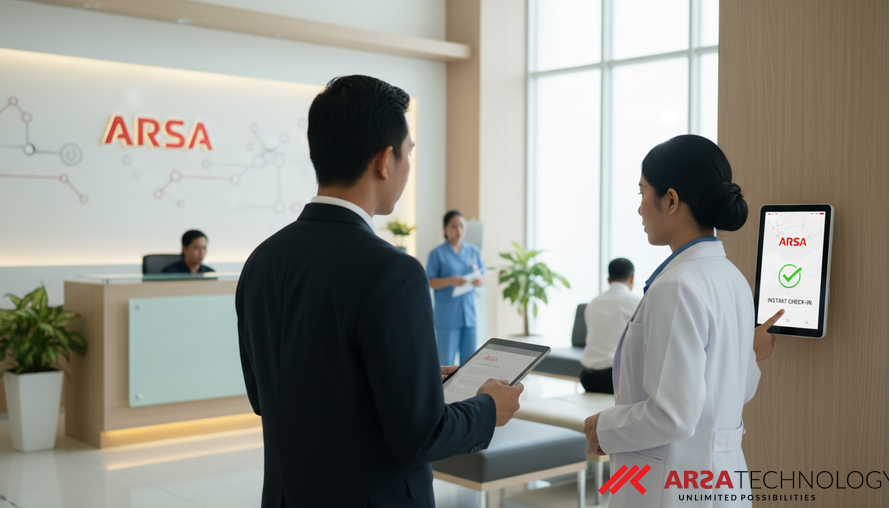
Manual time clocks or swipe cards are prone to “buddy punching” and administrative errors. A face verification for employee check-in system eliminates these issues. Healthcare staff can simply present their face to a camera, and the system instantly verifies their identity and logs their attendance. This ensures accurate payroll, reduces administrative burden, and provides an undeniable audit trail. For system integrators, integrating a robust API means delivering a solution that is both secure and user-friendly, leading to high adoption rates and tangible ROI through reduced labor costs and improved compliance.
Enhancing Security with Facial Authentication for Access Control
Hospitals contain sensitive areas—pharmacies, operating rooms, data centers, and patient records rooms—that require strict access control. A facial authentication API for access control app ensures that only authorized personnel can enter these zones. By integrating facial recognition with existing access control infrastructure, system integrators can create a seamless yet highly secure environment. This prevents unauthorized access, enhances physical security, and helps maintain compliance with regulations like HIPAA, which mandate strict controls over patient information. The speed and accuracy of ARSA’s API (99.67% on LFW) ensure that authorized staff experience no delays, while unauthorized individuals are immediately flagged.
Optimizing Visitor Management with Biometric APIs
Managing visitors in a healthcare facility is a critical security challenge. A biometric API for visitor management platform can automate and secure the entire process. Visitors can quickly register, have their identity verified, and be issued temporary access based on their appointment or purpose. This not only enhances security by creating a verifiable record of everyone on premises but also improves the visitor experience by reducing wait times. For a face ID API for building access control, this means a comprehensive solution that covers all entry points, from staff to visitors, providing a unified security posture.
ARSA Face Recognition & Liveness API: Your Solution for Secure Healthcare Operations
For system integrators looking to implement a scalable, secure, and efficient face recognition API for attendance management system in healthcare, ARSA Technology’s Face Recognition & Liveness API stands out as a premier cloud-based solution. Our API is engineered to meet the stringent demands of enterprise and government clients, offering a blend of high accuracy, robust security, and ease of integration.
Key Features and Business Outcomes
The ARSA Face Recognition & Liveness API provides a complete identity layer designed for secure authentication and verification.
- 1:1 Face Verification: Confirms if two faces belong to the same person, ideal for login and step-up authentication.
- 1:N Face Identification: Identifies a person against a face database, perfect for access control and monitoring.
- Active & Passive Liveness Detection: Crucial for anti-spoofing, preventing fraud from photos, videos, or masks. This ensures that the person presenting their face is a live, real individual.
- Face Database Management: Securely enroll, update, and remove identities, organizing data by application or tenant.
- High Accuracy: Achieves 99.67% accuracy on the Labeled Faces in the Wild (LFW) benchmark, ensuring reliable performance in real-world scenarios.
The business outcomes for healthcare organizations are significant:
- Prevent Identity Fraud: Robust liveness detection and high accuracy virtually eliminate biometric spoofing.
- Automate e-KYC Onboarding: Streamline patient and employee onboarding processes, reducing manual effort and errors.
- Reduce Manual Verification Costs by 80%: Automating attendance and access control translates directly into substantial labor cost savings.
- Sub-Second Verification Response: Ensures a frictionless experience for users, minimizing queues and delays.
Seamless Integration for System Integrators
ARSA understands the needs of system integrators. Our API is built on a standard REST API, making it easy to integrate into existing applications, custom web platforms, or mobile apps. Available on RapidAPI, it offers a developer-friendly experience with comprehensive documentation and a free tier for testing. This allows integrators to quickly prototype and deploy solutions, accelerating time-to-market for their healthcare clients.
ARSA Technology has a proven track record of delivering mission-critical AI and IoT solutions, trusted by government institutions and enterprises across Southeast Asia. Our expertise ensures that our Face Recognition & Liveness API is not just a product, but a reliable foundation for your next-generation healthcare identity management system. While the API is cloud-based, ARSA also offers an on-premise SDK for clients with specific air-gapped or sovereign data requirements, demonstrating our commitment to flexible deployment models. For a comprehensive view of all our offerings, you can explore all ARSA products.
Conclusion
Choosing between edge AI and cloud for a face recognition API for attendance management system is a strategic decision that impacts scalability, cost, and data control. While edge solutions offer localized processing and data sovereignty, cloud-based APIs like ARSA Technology’s Face Recognition & Liveness API provide unparalleled agility, scalability, and ease of integration, making them an ideal choice for many healthcare system integrators. By leveraging ARSA’s proven technology, integrators can deliver secure, efficient, and cost-effective identity verification solutions that transform healthcare operations.
Ready to integrate a cutting-edge face recognition solution into your healthcare projects? Contact ARSA solutions team today to discuss your specific requirements and explore how our API can enhance your offerings.
FAQ
1. How does a facial authentication API for access control app improve security in hospitals?
A facial authentication API for access control app significantly enhances security by ensuring only authorized personnel can enter restricted areas. It provides real-time, tamper-proof identity verification, preventing unauthorized access, reducing the risk of stolen credentials, and creating a detailed audit trail for compliance and incident response.
2. What are the benefits of using a face verification for employee check-in system over traditional methods?
A face verification for employee check-in system eliminates “buddy punching” fraud, ensures accurate timekeeping, and reduces administrative overhead associated with manual attendance tracking. It offers a touchless, hygienic, and faster check-in experience for staff, improving efficiency and providing reliable data for payroll and compliance.
3. Can a biometric API for visitor management platform integrate with existing hospital systems?
Yes, ARSA’s biometric API for visitor management platform is designed for seamless integration. Built on a standard REST API, it can easily connect with existing visitor management software, security systems, and hospital databases, allowing for centralized control and data flow without requiring a complete overhaul of your current infrastructure.
Stop Guessing, Start Optimizing.
Discover how ARSA Technology drives profit through intelligent systems.
