

Retail in 2026: How AI Video Analytics Is Changing the Game and How to Measure Retail Store Conversion Rate with AI Analytics
The retail landscape is constantly evolving, and by 2026, artificial intelligence (AI) will be an indispensable tool for businesses seeking a competitive edge. For retail operations managers, understanding customer behavior and optimizing store performance is paramount. A key metric in this pursuit is the conversion rate, and knowing how to measure retail store conversion rate with AI analytics has become a game-changer, transforming raw video footage into actionable intelligence. This shift allows retailers to move beyond guesswork, embracing data-driven strategies that directly impact profitability and customer experience.
Traditional methods of measuring retail performance often rely on manual counts, point-of-sale (POS) data, and periodic observations, which can be prone to human error and lack real-time granularity. AI video analytics, however, offers a robust, automated solution, providing unprecedented insights into every facet of store operations, from customer entry to purchase.
The Evolution of Retail Intelligence: From Footfall to Conversion
For decades, retailers have understood the importance of footfall – the number of people entering a store. However, footfall alone tells only part of the story. The true measure of a store’s effectiveness lies in its ability to convert those visitors into paying customers. This is where AI video analytics steps in, providing the tools to accurately track customer journeys and calculate conversion rates with precision.
By leveraging existing CCTV infrastructure, advanced AI algorithms can identify and track individuals anonymously, distinguishing between staff and customers, and monitoring their movements throughout the store. This capability forms the foundation for a comprehensive people counting system for retail stores, which is far more accurate and consistent than human observation. These systems can be deployed on-premise, ensuring data privacy and eliminating cloud dependency, a critical factor for many enterprises.
How to Measure Retail Store Conversion Rate with AI Analytics: A Deep Dive
Measuring conversion rate with AI analytics involves several integrated steps, all powered by intelligent video processing. At its core, the process combines accurate entry/exit counts with sales data.
1. Accurate People Counting: The first step is to precisely count the number of unique visitors entering and exiting the store. ARSA Technology’s Smart Retail Counter module, part of our AI Video Analytics Software, excels at this. It uses computer vision to detect individuals, filtering out staff to ensure only genuine customer traffic is recorded. This provides the ‘visitors’ component of the conversion rate formula.
2. Sales Data Integration: The ‘sales’ component comes from your existing POS system. The power of AI analytics is unlocked when these two data streams are brought together. Through robust REST API integration, ARSA’s platform can seamlessly connect with your POS, allowing for automated conversion rate calculations.
3. Formula Application: The conversion rate is then calculated as (Number of Transactions / Number of Visitors) * 100. With AI providing precise visitor counts and real-time integration with sales data, this metric becomes dynamic and highly reliable.
This comprehensive approach provides chain-wide retail intelligence, allowing operations managers to compare performance across multiple locations and identify best practices.
Beyond Conversion: Unlocking Deeper Retail Insights
While conversion rate is crucial, AI video analytics offers a wealth of other data points that contribute to a holistic understanding of store performance and customer experience.
AI Customer Footfall Tracking for Shopping Malls
For larger retail environments like shopping malls, understanding macro-level customer movement is vital. AI customer footfall tracking for shopping malls can monitor traffic patterns across different zones, entrances, and common areas. This data helps mall management optimize tenant mix, allocate marketing resources effectively, and improve overall visitor flow. By identifying peak hours and popular routes, malls can enhance security, manage cleaning schedules, and even inform rental strategies for prime locations. This granular insight extends beyond individual stores, providing a bird’s-eye view of the entire retail ecosystem.
Real-Time Queue Management Analytics
Long queues are a significant pain point for customers and a major cause of lost sales. Real-time queue management analytics, powered by AI video analytics, can detect queue formation, measure queue length, and track average wait times. When a queue exceeds a predefined threshold, the system can trigger immediate alerts to staff, enabling them to open new registers or reallocate personnel. This proactive approach minimizes customer frustration, improves service efficiency, and directly impacts customer satisfaction and retention. The ARSA Smart Retail Counter module includes this capability, ensuring seamless operations.
Store Heatmap Analysis Using Existing CCTV
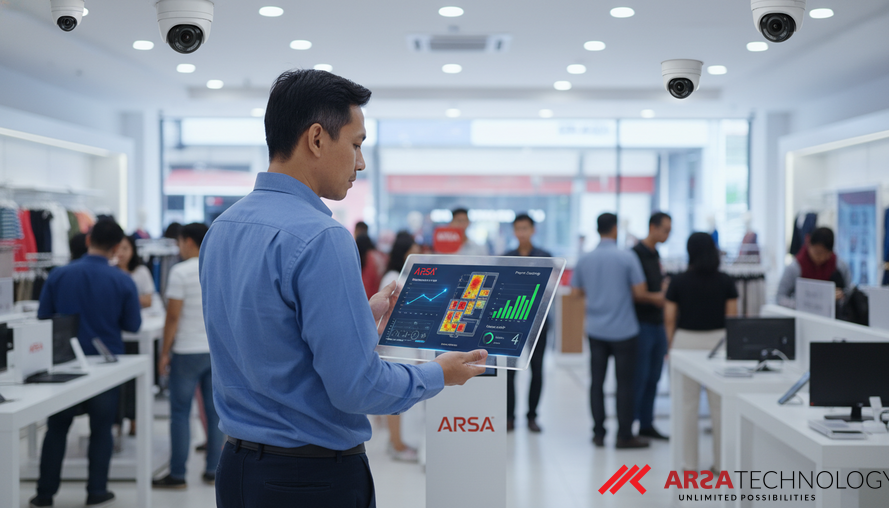
Imagine knowing exactly which areas of your store attract the most attention and which are overlooked. Store heatmap analysis using existing CCTV provides a visual representation of customer density and movement patterns. Hotter areas on the map indicate higher traffic and dwell times, while cooler areas suggest less engagement. This insight is invaluable for optimizing store layout, product placement, and promotional displays. Retailers can test different merchandising strategies and instantly see their impact on customer flow and engagement, leading to improved sales per square foot. Since ARSA’s solutions work with existing CCTV, implementation is cost-effective and non-disruptive.
Dwell Time Tracking and Behavioral Insights
Beyond simply counting people, AI can track how long customers spend in specific zones (dwell time) and observe their interactions with products or displays. High dwell times in certain areas might indicate strong interest, while low dwell times could signal confusion or lack of appeal. By analyzing these subtle behavioral cues, retailers can refine their strategies, from optimizing product presentations to training staff on how to approach customers in specific zones. This level of detail offers truly actionable insights for improving the in-store experience.
The ARSA Advantage: On-Premise, Centralized, and Privacy-First
ARSA Technology understands that for enterprises and government entities, data security and control are paramount. Our AI Video Analytics Software, including the Smart Retail Counter, is designed for on-premise deployment. This means all video streams, inference results, and metadata remain entirely within your infrastructure, with no cloud dependency. This self-hosted approach ensures full data ownership, privacy, and compliance with stringent regulations like GDPR and Indonesia PDPA.
Key advantages of ARSA’s approach include:
- No Hardware Dependency: Deploy on your existing servers or private data centers, eliminating the need for dedicated AI appliances.
- Centralized Processing: Analyze multiple camera streams from a central location, providing a unified view across all your stores.
- Scalability by Design: Easily scale analytics capacity by allocating compute resources, adapting to your growing needs without installing new devices.
- Multi-Store Visibility: Gain a comprehensive overview of performance across all your retail locations from a single, intuitive centralized analytics dashboard.
- Integration Ready: Seamlessly integrate with existing dashboards, alerting systems, and POS systems using our robust REST API. This allows for a truly connected retail ecosystem.
- Privacy-First: With on-premise deployment, you maintain complete control over sensitive data, aligning with internal security and compliance reviews.
By choosing ARSA, retailers gain a powerful tool for optimizing operations across locations, driving efficiency, and ultimately, boosting their bottom line.
The Future of Retail is Intelligent
As we look towards 2026 and beyond, AI video analytics will continue to redefine retail operations. The ability to precisely measure retail store conversion rate with AI analytics, understand customer journeys, and react in real-time to operational challenges will be the hallmark of successful retailers. From improving customer satisfaction through efficient queue management to optimizing store layouts with detailed heatmap analysis, AI provides the intelligence needed to thrive in a competitive market.
ARSA Technology is committed to empowering retailers with practical, proven, and profitable AI solutions. Our expertise in edge computing and on-premise deployments ensures that your data remains secure, private, and fully under your control. To explore how ARSA’s AI Video Analytics Software can transform your retail business, we invite you to contact ARSA solutions team today. You can also explore our full range of AI and IoT products, including our Face Recognition & Liveness API for secure identity management applications.
—
Frequently Asked Questions
What is a people counting system for retail stores?
A people counting system for retail stores uses AI video analytics to accurately count the number of visitors entering and exiting a store, distinguishing them from staff. This provides crucial data for calculating conversion rates and understanding traffic patterns.
How can AI customer footfall tracking benefit shopping malls?
AI customer footfall tracking for shopping malls helps management understand macro-level traffic patterns across various zones and entrances. This data is used to optimize tenant mix, marketing efforts, security, and cleaning schedules, enhancing the overall visitor experience and operational efficiency.
What are the advantages of real-time queue management analytics?
Real-time queue management analytics proactively detects and measures queue lengths and wait times. It triggers alerts when thresholds are exceeded, allowing staff to respond quickly, reduce customer wait times, improve service, and prevent lost sales due to long queues.
Can store heatmap analysis using existing CCTV improve sales?
Yes, store heatmap analysis using existing CCTV provides visual insights into customer density and movement, highlighting popular and overlooked areas. Retailers can use this to optimize product placement, store layout, and promotional displays, directly influencing customer engagement and sales.
Stop Guessing, Start Optimizing.
Discover how ARSA Technology drives profit through intelligent systems.