
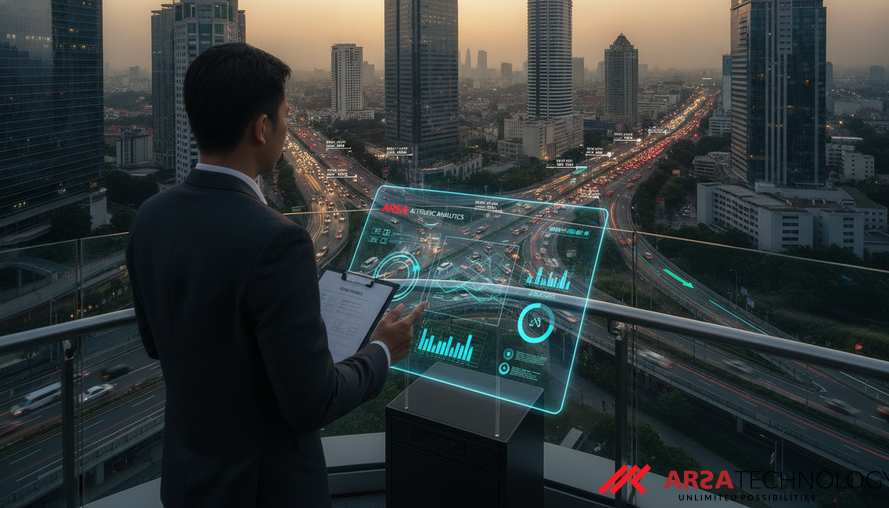

In the rapidly evolving landscape of urban development, city planners face the constant challenge of managing increasingly complex traffic flows. Congestion, pollution, and inefficient infrastructure are not just inconveniences; they are significant economic and environmental burdens. This is where an AI vehicle counting system for smart city traffic management emerges as a critical solution, offering unprecedented insights and control over urban mobility. By leveraging advanced artificial intelligence at the edge, cities can transform passive surveillance into active, intelligent traffic ecosystems.
The global smart mobility market is experiencing rapid expansion, projected to reach an impressive $194.13 billion by 2032, growing at a 20.8% Compound Annual Growth Rate (CAGR) from $51.77 billion in 2025, according to Fortune Business Insights. This growth underscores the urgent need for innovative solutions that can keep pace with urban expansion and evolving transportation demands. ARSA Technology, with its proven track record in AI video analytics, offers robust systems designed to meet these challenges head-on.
The Power of Real-Time Traffic Flow Analytics at the Edge
Traditional traffic management often relies on outdated methods, leading to reactive rather than proactive solutions. An AI-powered system fundamentally changes this by providing granular, real-time data. Imagine knowing the exact number of vehicles, their types, and their speed at any given intersection, moment by moment. This level of detail empowers city transport planners to make informed decisions that directly impact urban efficiency.
ARSA’s ARSA Traffic Monitor (AI Box) is a prime example of this transformative technology. It processes video streams directly at the edge, meaning data is analyzed on-device without constant reliance on cloud connectivity. This approach is crucial for minimizing latency and ensuring data privacy, as video streams are processed locally and do not leave the network unless explicitly configured. This aligns with modern data governance principles, such as those outlined in the EU AI Act, which classifies AI systems used for traffic management as high-risk, requiring robust risk management and human oversight from August 2, 2026.
Automated Vehicle Classification Using CCTV for Enhanced Planning
Beyond simple counting, the ability to perform automated vehicle classification using CCTV is a game-changer for urban planning. The ARSA Traffic Monitor can distinguish between cars, trucks, buses, motorcycles, and even pedestrians. This detailed classification allows city planners to:
- Optimize Lane Utilization: Understand which lanes are underutilized or overutilized by specific vehicle types.
- Tailor Infrastructure Improvements: Design roads and intersections that better accommodate the actual mix of traffic.
- Inform Public Transport Strategies: Identify areas where public transport might be more effective in reducing private vehicle reliance.
- Support Environmental Initiatives: Monitor the prevalence of different vehicle types to assess and promote sustainable mobility programs.
By transforming existing CCTV infrastructure into intelligent sensors, cities can gain actionable insights without costly overhauls. This capability is a cornerstone of effective smart city development.
AI Traffic Monitoring Without Cloud: Ensuring Data Sovereignty and Performance
For many public sector entities, data sovereignty and security are paramount. The concept of AI traffic monitoring without cloud dependency offers a significant advantage. ARSA’s AI Box Series operates on-premise, ensuring that all video streams, inference results, and metadata remain entirely within the city’s infrastructure. This provides full data ownership and control, addressing concerns about sensitive urban data leaving local networks.
Edge computing, as implemented in the ARSA Traffic Monitor, is projected to cut data transfer requirements by up to 80% in dense smart mobility deployments. This not only enhances security but also significantly improves performance by reducing bandwidth usage and processing delays. The AI Box Series overview highlights its plug-and-play installation, allowing for rapid deployment and minimal IT overhead, making it an ideal smart traffic counting device for intersections and other critical points.
Key Benefits for City Transport Planners
Implementing an advanced AI vehicle counting system delivers tangible business outcomes for smart cities:
- Optimize Traffic Flow: AI-powered traffic optimization has been shown to reduce urban travel times by up to 25% and emissions by 20% in deployed cities, according to a StartUs Insights 2026 report. This directly translates to less time spent in traffic and improved air quality.
- Data-Driven Urban Planning: Access to comprehensive, real-time traffic data enables planners to move beyond assumptions, basing decisions on verifiable metrics. This supports more effective resource allocation and infrastructure investment.
- Reduce Congestion: By understanding congestion patterns and vehicle distribution, cities can implement dynamic traffic light adjustments, rerouting strategies, and intelligent signage to alleviate bottlenecks.
- Support Sustainable Mobility Programs: Accurate data on vehicle types and movements helps measure the impact of initiatives promoting walking, cycling, and public transport, fostering greener urban environments.
ARSA Technology’s solutions are designed for organizations that demand control over their infrastructure and data. Our seven years of experience, coupled with partnerships with industry leaders like NVIDIA and Intel, ensure that our systems are engineered for accuracy, scalability, privacy, and operational reliability. For more insights into how edge AI can transform urban infrastructure, you might find our article on Choosing the Best Edge AI Traffic Monitoring Device for Toll Roads valuable. Another relevant read is The Best Edge AI Traffic Monitoring Device for Toll Roads: A Comprehensive Guide.
Flexible Deployment and Scalability
The ARSA Traffic Monitor is available in two distinct hardware configurations: a Mini PC Model for distributed deployments (processing up to 3 cameras) and a Server Model for high-density, centralized monitoring (processing up to 30 cameras). This flexibility ensures that cities can choose the architecture that best fits their existing infrastructure and scaling needs. Whether deploying a single unit at a critical intersection or scaling across multiple sites, the system offers centralized visibility and control.
For those interested in the financial aspects, our article on ARSA Traffic Monitor (AI Box) Pricing provides a detailed look at the value proposition.
Conclusion
The challenges of urban traffic management are complex, but the solutions offered by an AI vehicle counting system for smart city traffic management are powerful and practical. By embracing edge AI, cities can unlock real-time intelligence, optimize their infrastructure, and create more livable, sustainable environments. ARSA Technology is committed to delivering production-ready AI and IoT solutions that move beyond experimentation into measurable impact for governments and enterprises worldwide.
Ready to transform your city’s traffic management? Contact ARSA’s solutions team today to discuss how our ARSA Traffic Monitor can be tailored to your specific urban mobility needs. Explore all ARSA products to see our full range of AI and IoT innovations.
FAQ
- What is the primary benefit of an AI vehicle counting system for smart city traffic management?
The primary benefit is the ability to gain real-time, accurate insights into traffic flow, vehicle types, and congestion patterns, enabling data-driven decisions that optimize urban mobility, reduce travel times, and support sustainable city planning.
- How does ARSA’s system enable automated vehicle classification using CCTV?
ARSA’s Traffic Monitor (AI Box) leverages advanced AI algorithms to process existing CCTV footage at the edge, automatically identifying and classifying different vehicle types (cars, trucks, buses, motorcycles) and even pedestrians, providing granular data for traffic analysis.
- Can ARSA’s AI traffic monitoring operate without cloud dependency?
Yes, ARSA’s AI Box Series is designed for on-premise, edge deployment, allowing all AI processing and data analysis to occur locally on the device. This ensures full data ownership, minimizes latency, and provides robust security without requiring constant cloud connectivity.
- What kind of data does a smart traffic counting device for intersections provide?
A smart traffic counting device like the ARSA Traffic Monitor provides data on vehicle counts, classification by type, speed, direction, traffic density, congestion levels, and lane utilization, all in real-time, accessible via local or remote dashboards.
Stop Guessing, Start Optimizing.
Discover how ARSA Technology drives profit through intelligent systems.