
Traffic Monitoring And Vehicle Analytics For Transport Authorities
Per-intersection counting hardware costs five figures per approach. Your network already has cameras. ARSA produces counts, classes, and congestion state from the feeds you already backhaul.
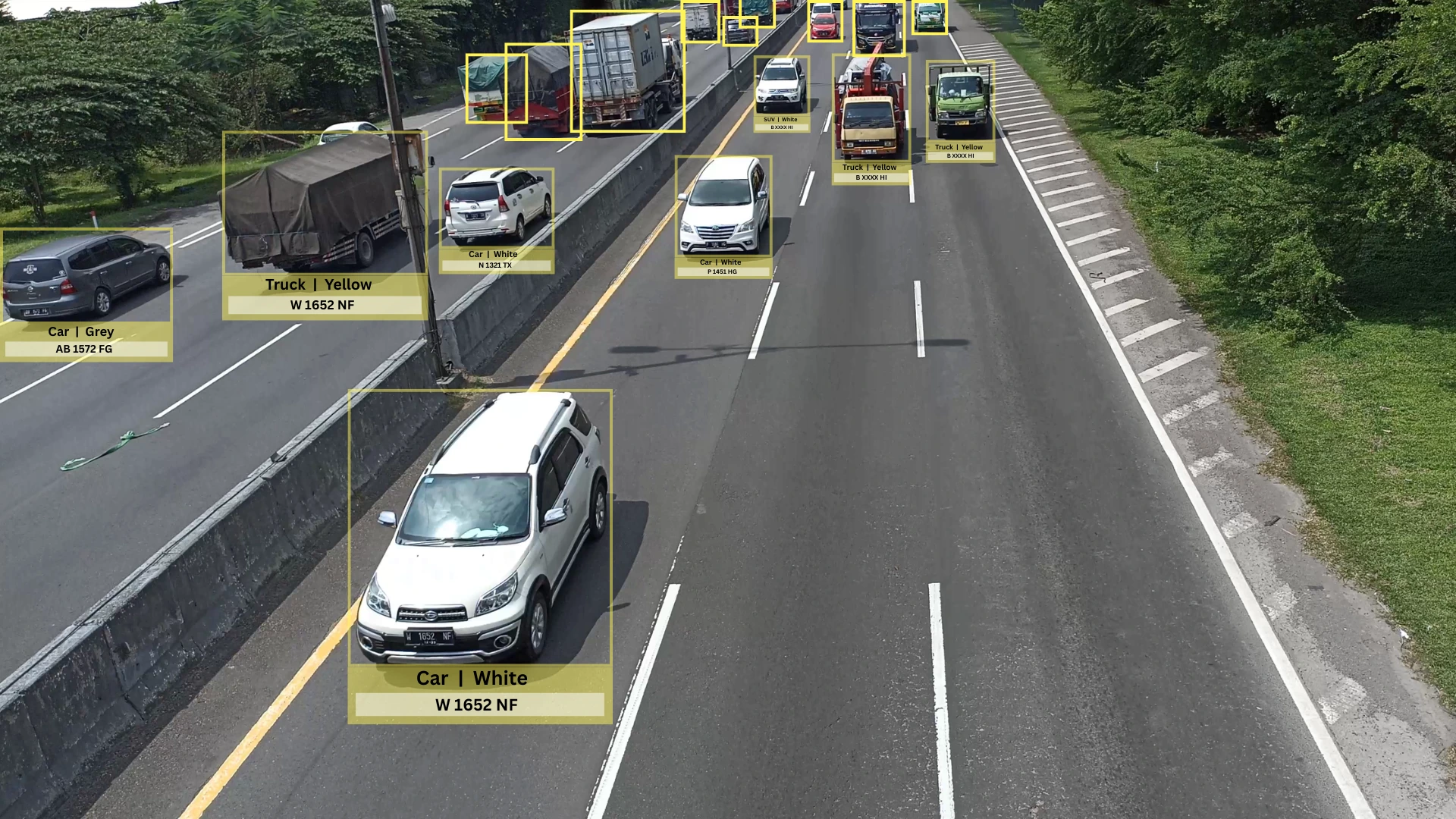
Core Applications
Vehicle Counting, Classification And Congestion Analytics
Most road agencies already run cameras at junctions, toll plazas and along main corridors, and almost nobody watches the footage for traffic data. Counts still come from occasional manual surveys or from sensors that need roadworks to install and repair, so planners decide from data that is old and covers a handful of sites. Video analytics reads the cameras you have, counts every vehicle by lane, direction and class around the clock, and shows congestion building while there is still time to act on it.
- Road camera
- AI Box at the roadside
- Counts to your traffic system
Counting & Classification
Vehicle counts by direction and by class (Car, Truck, Bus, Motorcycle, Bicycle) across your entire road network. Generate historical time-series data without per-approach sensors.
Flow & Congestion
Measure flow rate, congestion state, and queue length at signals. Monitor intersection throughput and identify bottlenecks automatically from existing camera angles.
Licence Plate Recognition
Where lawfully permitted, plate recognition with a watchlist, as an add-on to Traffic Monitor. Origin-destination studies, VIN tamper detection and other special cases are custom work.
Airports And Seaports
AI Video Analytics For Airport And Seaport Security
Airports, seaports, container terminals and ferry ports run cameras at every vehicle gate, staff door, fence line and passenger hall, and most of that footage is only reviewed after an incident. ARSA reads those cameras for four jobs, each delivered by a product or module available today. Video is processed on site and stays inside the operator’s network; only the alerts, counts and events you choose reach your security and operations systems.
Plate Reading At Gates
Licence plate recognition at port, terminal and cargo gates and at landside car park entrances, where lawfully permitted. Read plates are checked against a watchlist your admins keep. The reader is built for Indonesian plates; other countries’ plate formats are custom work. It runs as the plate recognition add-on to Traffic Monitor, and special cases are handled as custom work.
Face Verification At Staff Access Points
Face recognition with liveness detection checks staff at airside doors, crew gates and restricted terminal areas, and rejects a printed photo or a screen replay. It runs on your own servers and connects to the access control system you already operate through its API.
Perimeter And Restricted Zone Alerts
Draw restricted and hazard zones on fence line, apron, quay and yard cameras, and get an alert the moment a person enters one. Conditions that need more than a zone, such as someone staying at the quay edge for more than five minutes, are written as ARSA Rules.
Queue And Crowd Counting In Terminals
Queue length, wait time and entry and exit counts at check-in counters, immigration and security lanes and ferry boarding gates, so supervisors see each queue building and can open another lane in time.
To see what your own cameras can do, send up to three one-minute clips through the Free AI Assessment, or ask for an on-site survey of your gates, fences and terminal halls.
Portfolio
Deployment References

License Plate Recognition & VIN Tamper Detection
National Police, Republic of Indonesia
Licence plate recognition and VIN tamper detection for physical vehicle registration checks. Manual inspection replaced with automated forensic verification.
Challenges
What A Road Network Deployment Has To Handle
Procurement And Comparison
Per-intersection appliance systems in this category commonly run into five figures per approach plus recurring data fees. Software licensing against existing backhauled cameras changes the unit of comparison from cost per intersection to cost per camera.
Backhaul
Where video already reaches a control centre, central processing is cheaper and easier to maintain. Where it does not, processing at the pole avoids the network build entirely. Most networks are a mix.
Public Procurement
Perpetual licensing, with Care included for the first 12 months and optional at 18% per year after that, is available for tenders that cannot accept subscription. ARSA publishes list prices, which supports open comparison in a rules-based tender.
Camera Placement For Vehicle Counting And Classification
Counting works when each vehicle is large enough in the frame and seen from a usable angle, and telling a truck from a bus needs more detail than counting it. Our camera standard, ARSA-CVS-001, sets the figures every road and toll camera is checked against before a deployment:
- Cameras: 2 MP minimum, 4 MP recommended, at 15 fps or more, with the minimum shutter set by hand so moving vehicles do not smear.
- Size on screen: at least 67 PPM (pixels per metre) at the vehicle for counting and 107 PPM for classification. With a standard 60 degree lens, a 2 MP camera counts up to 24.9 m away and classifies up to 15.6 m; a 4 MP camera reaches 33.3 m and 20.8 m.
- Tilt: 15 to 35 degrees below horizontal is optimal for counting, up to 45; for classification 10 to 25 degrees is optimal, up to 40.
- Light: at least 10 lux on the road for counting and 20 lux for classification.
- Outdoor cameras: IP66 minimum, IP66 and IK08 recommended for poles and roadside cabinets.
Maximum distance with a standard 60 degree lens
Plate recognition, an add-on to Traffic Monitor where it is lawfully permitted, needs its own camera framed far tighter on a single lane, so it is planned camera by camera. If one of your cameras falls short, the free AI assessment report says which one and how to move it; the full figures are on the system requirements page.
FAQ
AI For Transportation Traffic FAQ
How does this compare to per-intersection counting hardware?
Per-intersection systems in this category commonly run into five figures per approach plus an annual data fee. Software licensing against cameras you already backhaul is $48 per camera per month, or $1,430 per camera perpetual, with no per-approach hardware.
What if an approach has no video backhaul?
Process at the pole. An AI Box in the roadside cabinet produces counts locally and pushes only the numbers upstream.
How accurate is counting at night and in rain?
Accuracy is maintained provided there is at least 10 lux at the target plane for counting, and 20 lux for classification. Extreme low light or heavy rain will degrade classification before it degrades basic counting.
Can it integrate with our existing traffic management platform?
Event metadata and aggregated counts are pushed via REST API or webhook directly into your ATMS or reporting stack. The system does not lock your data into a proprietary dashboard.
Is licence plate recognition included?
Available where lawfully permitted in your jurisdiction, as an add-on to Traffic Monitor, with the legal basis established before deployment. Plate recognition cuts each unit to one third of its cameras: AI Box Mini 1 lane, Server 12 up to 4 lanes, Server 25 up to 8 lanes. Prices are on the pricing page.
How do I test vehicle counting on my own traffic cameras?
Send up to three one-minute clips from your road or toll cameras through the free AI assessment. An ARSA engineer runs counting and classification on them and returns an annotated clip, a report that compares the counts by class with a manual count, and a 30-minute call, within 3 business days.
Can it count each lane separately at a toll plaza or junction?
Yes. Counting lines are drawn per lane and per direction on each camera, so a toll approach or a junction arm reports vehicles by lane, by class and over time. The counts export as CSV, Excel or PDF, or go straight to your systems through the API.
Does video from our road cameras leave our network?
No. Detection runs on an AI Box in the roadside cabinet or on your own servers in the control centre, and works without an internet connection. Only the counts and events travel upstream to your dashboard, API or webhook.
Talk With Our Consultants
Send us up to three one-minute clips from your own traffic cameras and an ARSA engineer returns an annotated clip, a report with the numbers and a 30-minute call within 3 business days, free. When you are ready to plan a rollout, a feasibility assessment measures our models against your network’s lighting, angles and constraints, and its fee is deducted from the project.
Every deployment follows the same steps: a site survey, a check of each camera against our placement standard, installation on an AI Box in the roadside cabinet or on your own servers in the control centre, tuning on your footage and a handover. Video is processed on site and works without an internet connection, and the clips you send for an assessment are never used to train our models. ARSA built the plate, VIN and engine number recognition platform for Korlantas Polri.
Related reading: a guide to AI vehicle counting for traffic management, traffic analytics on existing CCTV cameras, setting up lane-by-lane counting zones and FHWA vehicle classification counts.