
AI Video Analytics For Mining Operations, From Pit To Processing Plant
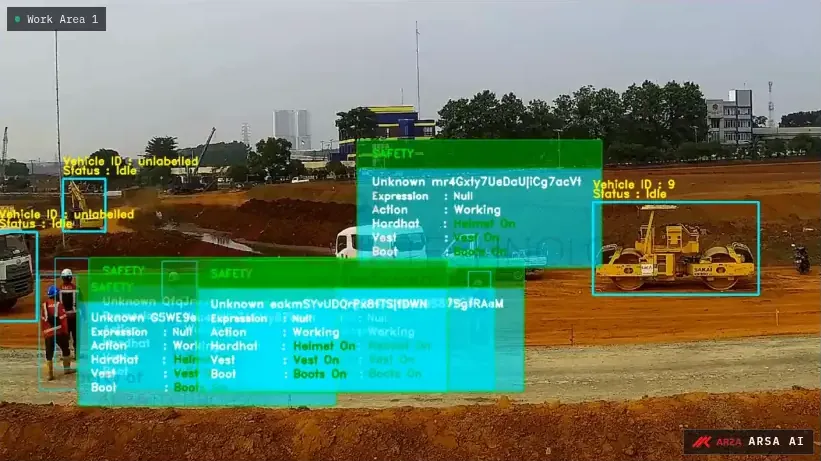
Check PPE at the crusher, workshop and plant, keep people out of heavy-equipment zones and count every truck on the haul road. Detection runs on an AI Box at the site, so it keeps working where the internet link does not.
Core Applications
Mining Use Cases On The Cameras You Already Have
A mine spreads its risk across kilometres of pit, haul road, crusher, workshop and plant, often on a satellite or radio link too thin to carry video. Cameras already watch the gates and the plant, and nobody has time to watch them. Video analytics reads them where they stand, flags a person in an exclusion zone or without a helmet, counts the haul-road traffic and records each event for the safety file.
- Pit or plant camera
- AI Box on site
- Alert to the shift supervisor
PPE At The Crusher, Workshop And Plant
Helmets, high-visibility vests and safety boots checked wherever your site rules require them: the crusher, the maintenance workshop, the processing plant and the shift-change gate. Each violation is logged with a snapshot, so the safety team reviews a whole shift in minutes.
Heavy-Equipment Exclusion Zones
Draw an exclusion zone around a loading point, a dump edge or a workshop bay, and get an alert the moment a person walks inside it. The alert can also sound a siren at the zone.
Haul-Road And Weighbridge Vehicle Counts
Count vehicles by direction on the haul road and at the weighbridge approach, sorted into car, truck, bus, motorcycle and bicycle, and flag a vehicle that has stopped. Counts are written on site and pushed to your own systems through the API.
Challenges
What A Mine Site Deployment Has To Handle
Dust, Heat And Distance
Haul roads throw dust and plants run hot. Outdoor cameras need IP66 housings, and IP66 and IK08 cabinets where they can be struck. The AI Box wants a spot under 35 °C with clear airflow, such as the site control room, on a UPS with at least 15 minutes of hold-up.
Limited Connectivity
Remote pits and processing plants often run on a satellite or radio link. Detection runs on the AI Box with no internet connection at all, the video stays on site, and only events and counts travel over whatever link you have.
Evidence For K3 Minerba
Mining safety inspections ask for records. Every event is logged with time, camera, zone and detection class, with a snapshot, and exports as CSV for your safety team or the inspector. The judgement of compliance stays with them; ARSA supplies the records.
Camera Placement For Mine Sites
Our camera standard, ARSA-CVS-001, sets the figures each camera is checked against before a deployment:
- Cameras: 2 MP minimum, 4 MP recommended, at 15 fps or more.
- PPE: at least 262 PPM (pixels per metre) at the worker for helmets and 153 PPM for vests, with a tilt of 10 to 25 degrees; up to 35 degrees for helmets and 40 for vests, never steeper than 45.
- Haul roads: vehicle counting needs 67 PPM at a tilt of 15 to 35 degrees; telling vehicle classes apart needs 107 PPM at 10 to 25 degrees.
- Light: at least 50 lux for PPE and 10 lux for vehicle counting. Vest detection at night needs white light, since infrared gives a monochrome image.
- Outdoor cabinets: IP66 and IK08.
Maximum distance with a standard 60 degree lens
A typical PPE setup at a plant walkway is a camera mounted at 3.5 m, 6.0 m from the zone it watches, tilted 22 degrees. On a haul road a 2 MP camera counts vehicles to 24.9 m, while helmet checks need the worker within 6.3 m, so one camera rarely does both jobs. The free AI assessment report says which of your cameras fall short and how to move them; the full figures are on the system requirements page.
FAQ
AI For Mining FAQ
Questions mine operators and mining contractors ask before a deployment.
Does it work at a remote pit with no reliable internet?
Yes. Detection runs on the AI Box at the site with no internet connection. Only events and counts go to your dashboard, webhook or email.
Will the equipment cope with dust and heat?
Yes, when it is housed for the site: IP66 and IK08 cabinets outdoors, and the AI Box in a cool, ventilated control room. Give us your site conditions during the assessment and we specify the enclosures to match.
Can it keep people away from haul trucks and excavators?
Yes, in the areas a fixed camera covers. Draw an exclusion zone around a loading point, a dump edge or a workshop bay and the system alerts when a person enters it. Rules can also flag a person who comes close to a detected vehicle inside a designated zone.
Can we count and classify trucks on the haul road and at the weighbridge?
Yes. Traffic Monitor counts vehicles by direction, sorts them into car, truck, bus, motorcycle and bicycle, and reports congestion and stopped vehicles. It runs on an AI Box at the roadside or as vehicle counting software on your own servers. Separating your own equipment types is a custom addition we scope with you.
Does AI safety monitoring help with K3 Minerba inspections?
It gives you the evidence: a timestamped, exportable record of every violation with its snapshot. The assessment of compliance stays with the inspector.
Can we start with one crusher or one gate?
Yes. A three-camera AI Box Mini covers a single crusher, workshop or shift-change gate, and the 12-camera and 25-camera units take a whole plant. PPE runs as the PPE detection AI Box or as PPE detection software on servers you already run.
How do I test it on footage from my own mine?
Send up to three one-minute clips through the free AI assessment. An ARSA engineer runs the full PPE model on them and returns an annotated clip, a report with compliance per camera and violations per hour, and a 30-minute call, within 3 business days. Where footage cannot leave the site, ask for an on-site assessment instead.
Test It On Your Own Site
Send us up to three one-minute clips from your pit, plant or gate cameras and get an annotated clip, a report and a call within 3 business days, free. To plan a rollout, or when footage cannot leave the site, a feasibility assessment measures our models against your dust, lighting and angles on site, and its fee is deducted from the project.
Every deployment follows the same steps: a site survey, a check of each camera against our placement standard, installation on an AI Box or your own servers, tuning on your footage and a handover. Haul-road counting is added with Traffic Monitor on the same kind of unit. ARSA has also built an automated UHF RFID vehicle gate for a logistics warehouse.
Related reading: turning existing CCTV into PPE monitoring for mining, PPE monitoring under K3 Minerba (in Indonesian), edge video analytics for low-connectivity sites, PPE detection in low light and extreme environments and setting up lane-by-lane vehicle counting zones.