
DOOH Audience Measurement Software
Campaign and creative reporting for a screen network. Impressions and attention per screen, matched to your play logs and delivered into the ad server your buyers already read.
Aggregate audience figures only, and no identity is created. The camera is recorded continuously, kept 3 days by default and configurable.
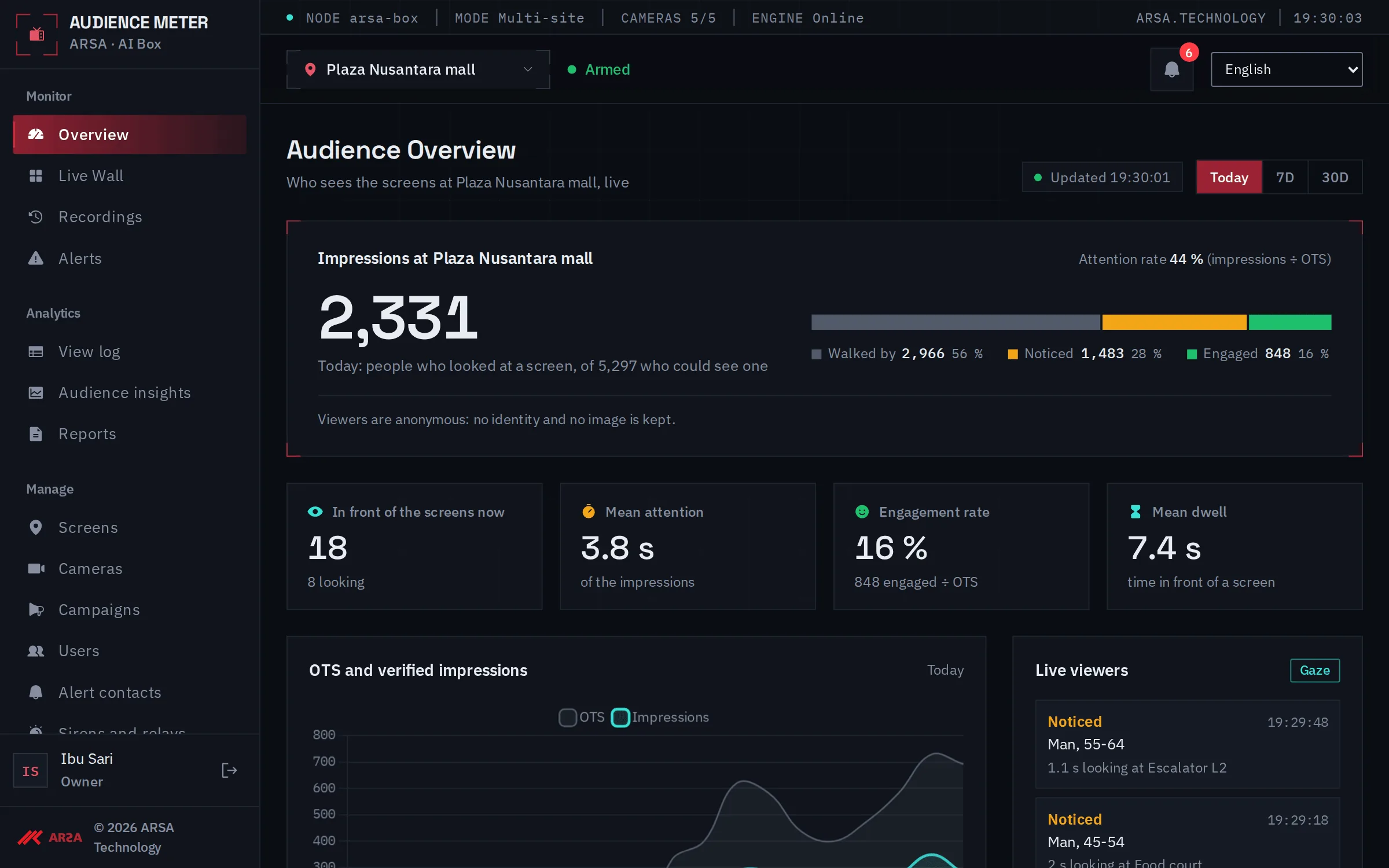
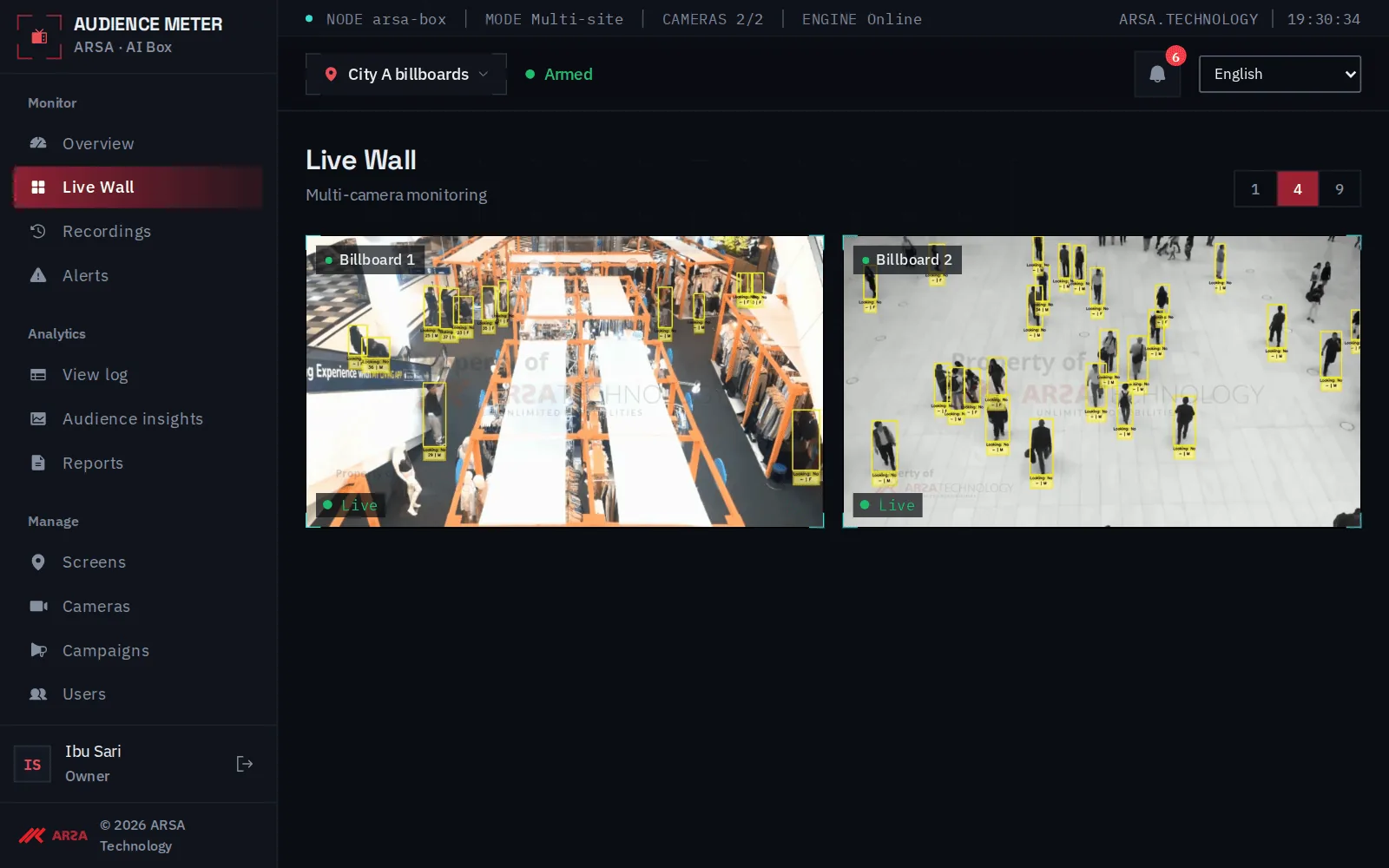
Software-Based Audience Measurement Platform
ARSA DOOH Audience Meter (Software Edition) is part of the ARSA AI Video Analytics Software platform, delivered as a fully self-hosted analytics solution.
It connects directly to camera feeds monitoring digital billboards or display areas, processes video locally on customer-owned infrastructure, and generates audience metrics through dashboards, reports, and APIs.
This product:
- Runs entirely on on-premise or private infrastructure
- Requires no edge AI appliances
Audience & Engagement Analytics
All analytics are designed for anonymous, aggregated measurement, supporting privacy-compliant deployments.
Audience, Engagement, & Attention Metrics
- Opportunity to see and impressions
- Engaged views and attention time
- Emotion mix and a crowd alert
Demographic Analytics (Anonymous)
- Eight age bands, 0-12 to 65+
- Gender distribution
- Aggregated demographic reporting
Campaign Performance Insights
- Audience per campaign and creative
- Time-of-day and day-of-week analysis
- Estimated CPM from your slot price
Audience Measurement Software For A Whole Screen Network
Ideal for media owners, advertising networks, and enterprises with established IT infrastructure. One screen, or no servers? The DOOH audience measurement system runs on a node behind the display.
Deploy on existing servers or private infrastructure
Maintain full data ownership and privacy
Integrate with existing dashboards or alert systems
IMPLEMENTATION
How It Deploys
- Screen camera
- Your own server
- Audience data to your ad server
Central deployment
Containers on your own servers. Instrumented screens stream back over your existing network.
Define campaigns and windows
Set up campaigns and creatives, and import play logs from your CMS or a CSV so impressions attribute to the right creative.
Deliver to the ad server
An audience feed per screen by 15 minutes, hour or day for your ad server, plus the API and scheduled reports.
TRANSPARENT
DOOH Audience Measurement Software Pricing
| Licence | Price |
|---|---|
| Subscription, per screen per month, billed annually | $35 |
| Perpetual, per screen, one time | $1,040 |
| Care on perpetual, per year, from year 2 | 18% of licence value, optional |
Four-screen minimum. Includes model updates and support.
MINIMUM
Technical Specifications
Maximum distance with a standard 60 degree lens
| Streams per GPU | 2 to 3 streams per 6 GB GPU; scales linearly with memory footprint |
| Export formats | CSV, Excel, PDF |
| API Integration | REST API, webhooks, audience feed (JSON) |
| Historical retention | Configurable by operator based on local storage allocation |
Deliver Audience Data To Your Ad Server
Detection results are only useful where your team already works. Every event is routable.
Push
- REST API payloads
- Webhook event push
- Webhook summaries every 15 min, hour or day
Pull
- CSV or Excel export
- Historical query API
- Scheduled PDF or Excel reports
Identity & Access
- Role-based access control
- Audit log
- Roles per site
FAQ
DOOH Audience Measurement Software Questions
Can this report across a national screen estate?
Yes. One deployment holds every screen whose camera it reaches, grouped into sites, with views per screen, per campaign and per creative. Several deployments report together through the API and the audience feed.
How is an impression defined?
Every person in view of the screen counts as an opportunity to see (OTS). An impression is a viewer who looks at the screen for at least 1 s, and an engaged view lasts at least 3.5 s; under 1 s is a walk-by. Both thresholds are defaults that site admins can change for each site, and viewers are measured inside the 400 PPM cone facing the display.
Is licensing per screen or per camera?
Per screen measured. One camera measuring one screen is one licence.
What is required for privacy compliance in public spaces?
Audience figures are aggregated and no identity is created. The camera is recorded continuously, kept 3 days by default and configurable. Signage and notification obligations remain the operator’s responsibility and vary by jurisdiction.
How far from the screen does it measure viewers?
Counting audience exposure needs 400 pixels per metre at the viewer, up to 4.2 m on a 2 MP camera with a 60-degree lens, looking almost level at 0 to 15 degrees of tilt and no more than 25, with at least 30 lux on the viewers.
How much does DOOH audience measurement software cost?
$35 per screen per month, billed annually, or $1,040 per screen as a perpetual licence with optional Care at 18% a year from year 2. There is a four-screen minimum, and model updates and support are included.
Deploy Audience Measurement On Your Infrastructure
Bring transparency and accountability to DOOH campaigns. Request a quotation for your screen network below. To see the measurement on your own screens first, send up to three one-minute clips from a camera facing the audience through our free AI assessment, and an ARSA engineer returns an annotated clip, a report and a 30-minute call within 3 business days.
Every deployment follows the same steps: a site survey, a check of each camera against our placement standard, installation on your own servers or a node behind the display, tuning on your footage and a handover. Video is processed on site, works without an internet connection (a subscription checks in once every 7 days), and the clips you send for an assessment are never used to train our models. ARSA has delivered video analytics in public-facing spaces, such as the queue and service quality proof of concept in BRI branches.
Related reading: verifying campaign delivery with audience data, comparing audience performance across a screen network, anonymized audience counting without facial data and adding audience measurement to an existing signage network.