
ENGINEERING STANDARD ARSA-CVS-001
Camera And Site Requirements For
AI Video Analytics
The conditions under which ARSA warrants analytic accuracy, stated in measurable terms. Issued before commercial commitment so both parties work from the same physical facts.
WHY THIS EXISTS
Software Cannot Add Information The Camera Did Not Capture
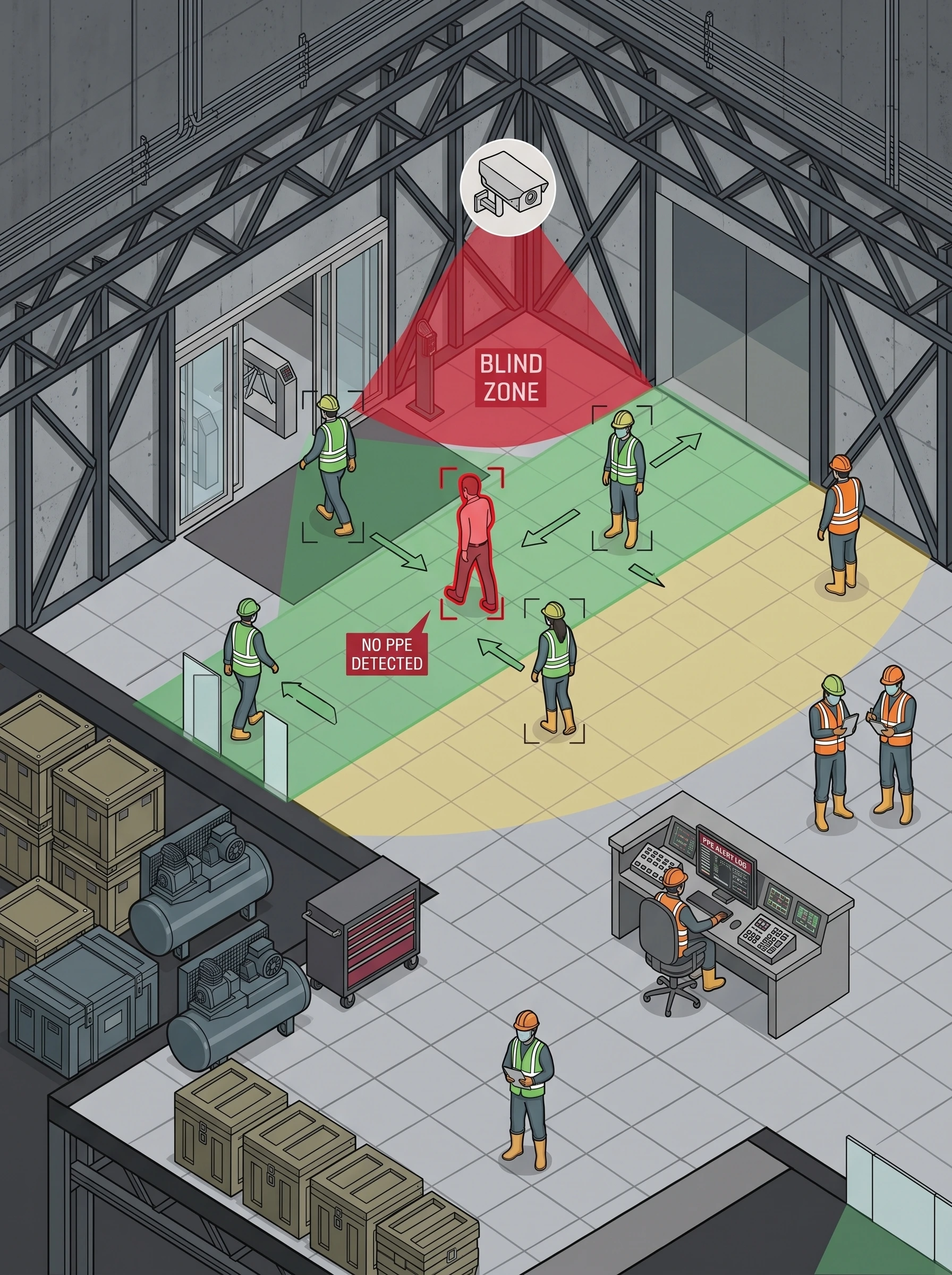
ARSA analytics run on your existing cameras. That avoids rip-and-replace, new cabling, and hardware lock-in. It carries one condition. A camera that cannot resolve a safety helmet cannot be made to resolve one by better software, because the information is not present in the image.
This page states, in measurable terms, what each analytic function needs from a camera. It is published before commercial commitment so that any remediation is identified and priced up front rather than discovered during commissioning.
How this affects your contract
The accuracy figures in your proposal apply to detection zones recorded as ACCEPTED in the Site Acceptance Record.
Where a camera cannot meet these requirements, ARSA will say so before contract, propose the specific remediation, and price it. Positions are assessed before contract rather than explained after commissioning.
THE GOVERNING NUMBER
Every Requirement Reduces to One Number
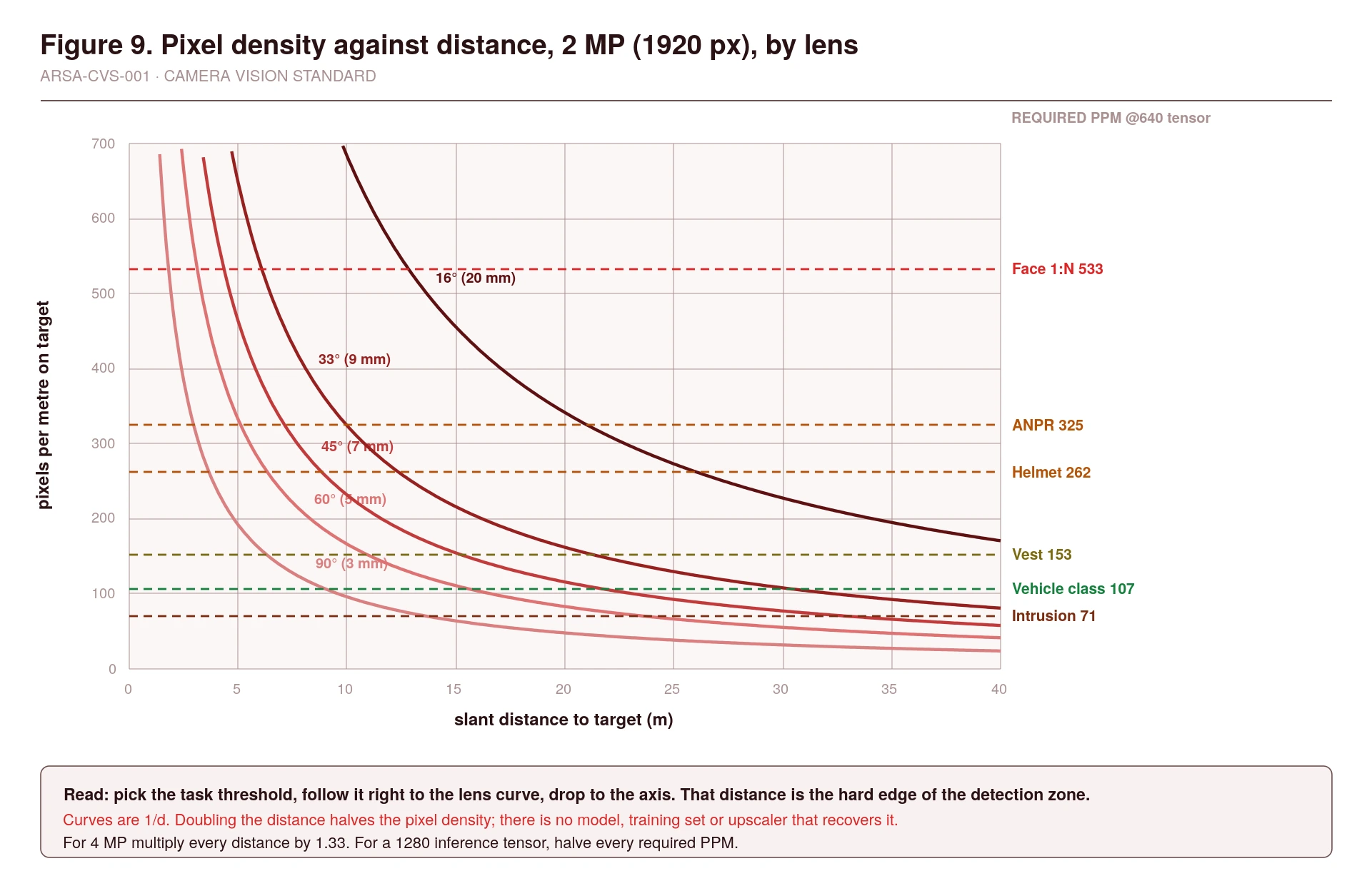
Pixel density: how many pixels the camera places across one metre of the real scene at the point where the analytic must work. Written as PPM.
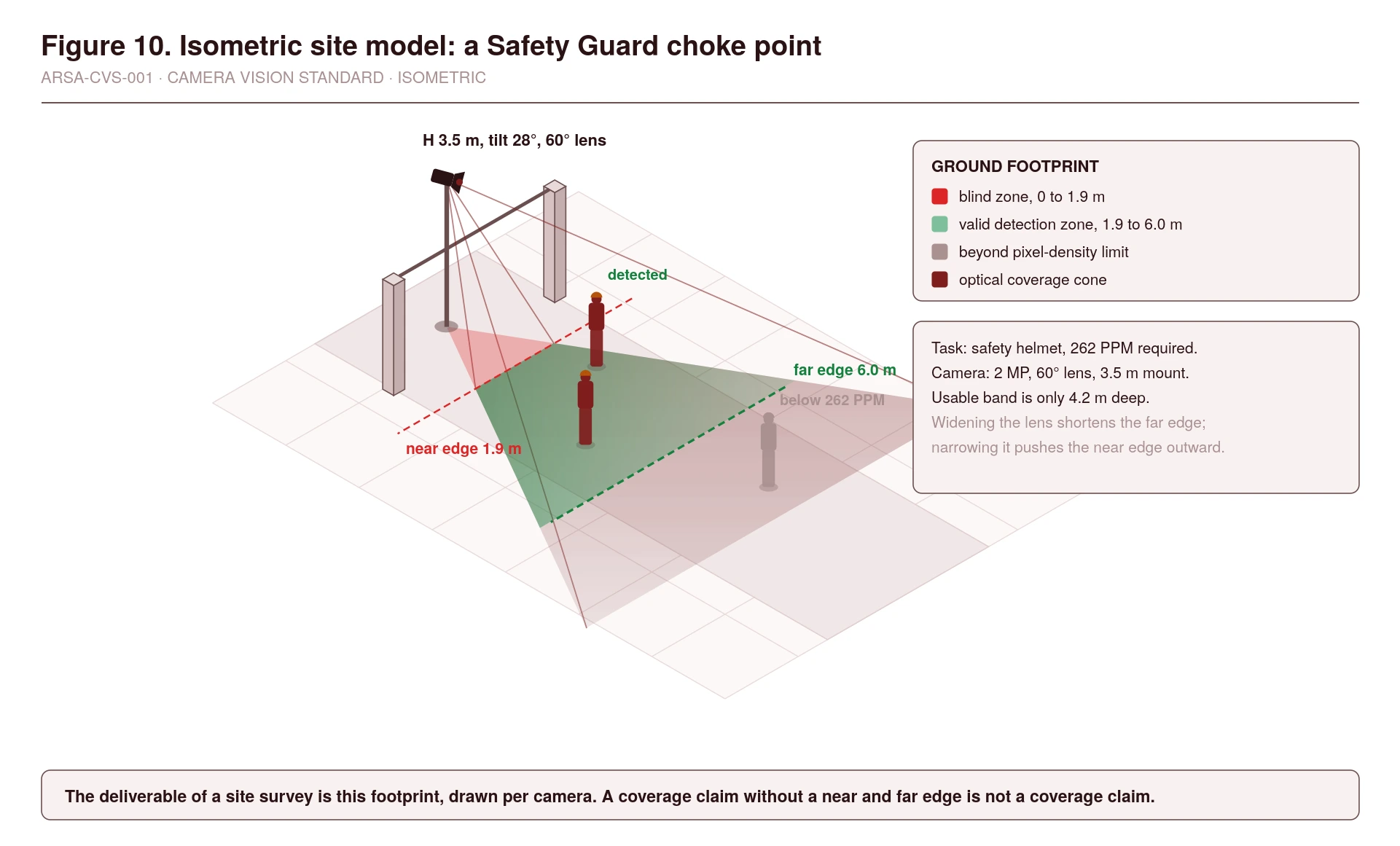
Pixel density falls as one over distance. Doubling the distance halves it. A 2 MP camera with a standard lens delivers roughly 275 PPM at 6 metres and 137 PPM at 12 metres. Helmet detection needs 262 PPM. That camera works at 6 metres and does not work at 12, and no configuration changes that.
Requirements by Analytic Function
| Analytic function | Pixel density | Camera angle below horizontal | Minimum light at target |
|---|---|---|---|
| Restricted-zone intrusion | 71 PPM | optimal 15 to 40°, max 55° | 10 lux |
| Person tracking / re-ID within scene | 113 PPM | optimal 10 to 25°, max 45° | 20 lux |
| Safety helmet present / absent | 262 PPM | optimal 10 to 25°, max 35° | 50 lux |
| Hi-vis vest present / absent | 153 PPM | optimal 10 to 25°, max 40° | 50 lux |
| Vehicle detection and counting | 67 PPM | optimal 15 to 35°, max 45° | 10 lux |
| Vehicle type classification | 107 PPM | optimal 10 to 25°, max 40° | 20 lux |
| Licence plate recognition | 325 PPM | optimal 10 to 25°, max 30° | 0 lux |
| Entry / exit line counting | 113 PPM | optimal 60 to 90°, max 90° | 50 lux |
| Queue length and wait time | 99 PPM | optimal 30 to 50°, max 55° | 50 lux |
| Audience exposure count | 400 PPM | optimal 0 to 15°, max 25° | 30 lux |
| 1:N watchlist match | 533 PPM | optimal 5 to 15°, max 15° | 100 lux |
WORKING DISTANCE BY RESOLUTION
How Far Each Function Reaches
Maximum camera-to-target distance for a standard 60 degree lens. A narrower lens roughly doubles every figure while halving the width of the area covered.
| Analytic function | Required PPM | 2 MP | 4 MP | 6 MP | 8 MP |
|---|---|---|---|---|---|
| Restricted-zone intrusion | 71 | 23.6 m | 31.4 m | 37.7 m | 47.1 m |
| Person tracking / re-ID within scene | 113 | 14.7 m | 19.6 m | 23.6 m | 29.4 m |
| Safety helmet present / absent | 262 | 6.3 m | 8.4 m | 10.1 m | 12.7 m |
| Hi-vis vest present / absent | 153 | 10.9 m | 14.5 m | 17.4 m | 21.8 m |
| Vehicle detection and counting | 67 | 24.9 m | 33.3 m | 39.9 m | 49.9 m |
| Vehicle type classification | 107 | 15.6 m | 20.8 m | 24.9 m | 31.2 m |
| Licence plate recognition | 325 | 5.1 m | 6.8 m | 8.2 m | 10.2 m |
| Entry / exit line counting | 113 | 14.7 m | 19.6 m | 23.6 m | 29.4 m |
| Queue length and wait time | 99 | 16.8 m | 22.4 m | 26.9 m | 33.7 m |
| Audience exposure count | 400 | 4.2 m | 5.5 m | 6.7 m | 8.3 m |
| 1:N watchlist match | 533 | 3.1 m | 4.2 m | 5.0 m | 6.2 m |
Maximum camera-to-target distance in metres, 60 degree lens.
WHY MORE MEGAPIXELS IS NOT ALWAYS BETTER
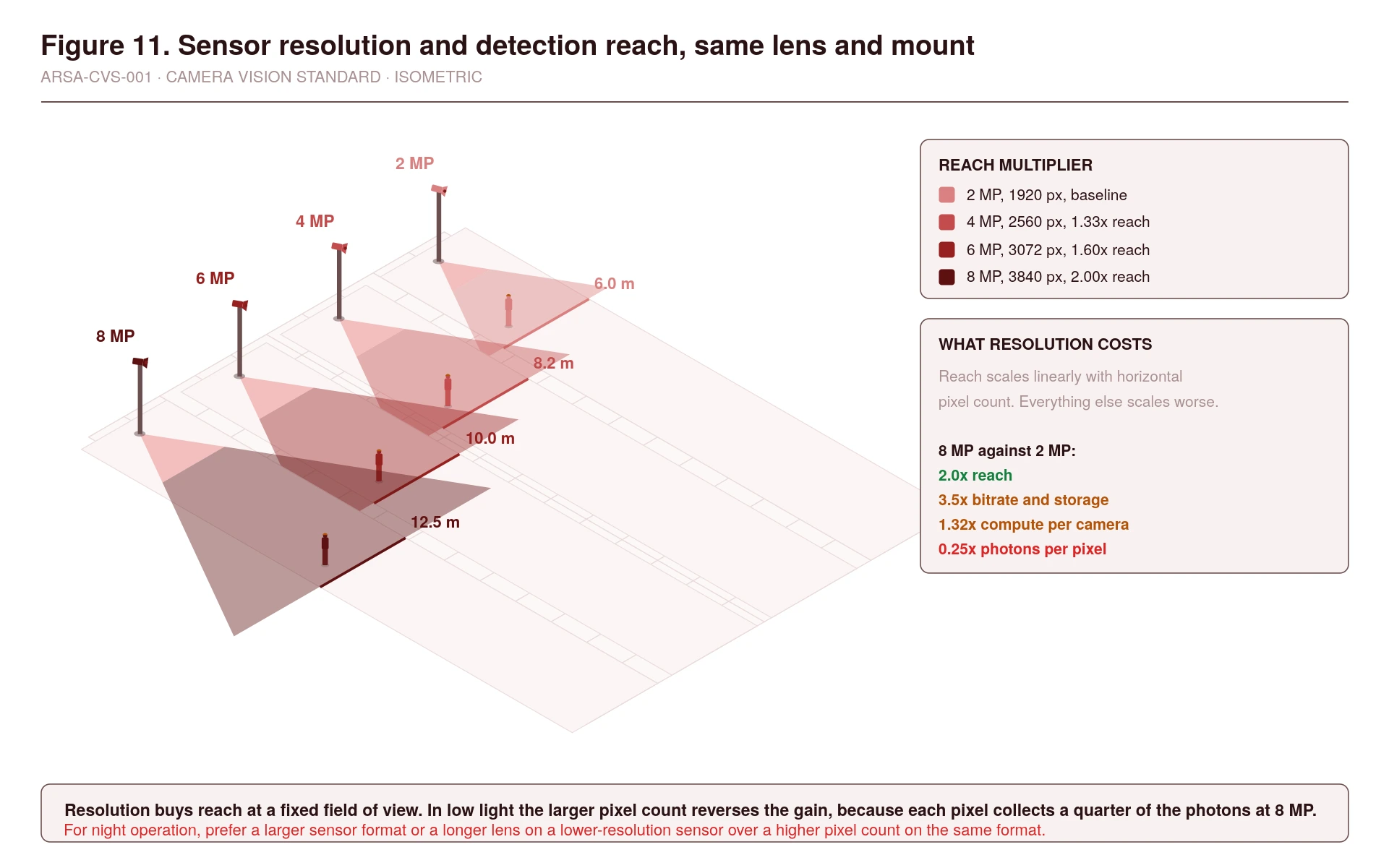
Resolution Buys Reach And Costs Light
Each step up in resolution divides the light collected by every pixel. An 8 MP camera performs worse than a 4 MP camera in a dimly lit area unless the sensor is physically larger. Where a scene must work at night, a longer lens on a 4 MP camera is usually the stronger option.
| Resolution | Reach vs 2 MP | Bitrate | Storage per camera per day | Light per pixel |
|---|---|---|---|---|
| 2 MP (1920×1080) | 1.00× | 2.48 Mbps | 26.7 GB | 1.00× |
| 4 MP (2560×1440) | 1.33× | 4.4 Mbps | 47.5 GB | 0.56× |
| 6 MP (3072×1728) | 1.60× | 6.33 Mbps | 68.3 GB | 0.39× |
| 8 MP (3840×2160) | 2.00× | 8.8 Mbps | 95.0 GB | 0.25× |
CAMERA ANGLE
Angle Matters as Much as Distance
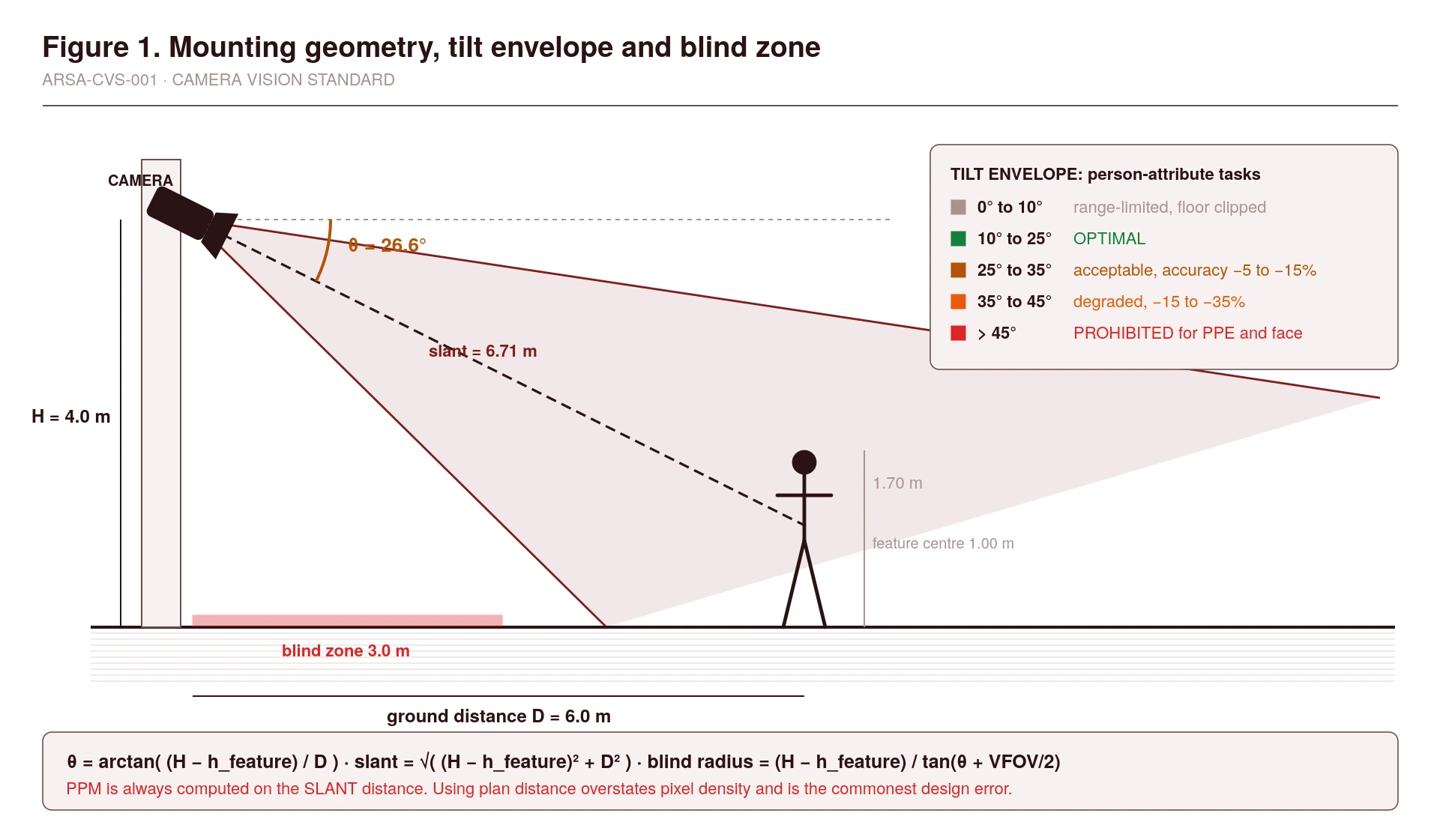
A camera looking steeply down sees the top of a helmet and very little else. The face, the vest front, and any harness strap are hidden by the wearer’s own body. This is the most frequent reason an otherwise adequate camera cannot be used for safety analytics.
A camera does not cover an area on a plan. It covers a wedge with a near edge, a far edge, and a width that grows with distance. The survey records that wedge for every camera.
| Tilt below horizontal | Status for person-attribute tasks |
|---|---|
| 0° to 10° | Range-limited, floor clipped |
| 10° to 25° | Optimal |
| 25° to 35° | Acceptable, accuracy −5 to −15% |
| 35° to 45° | Degraded, −15 to −35% |
| Above 45° | Prohibited for PPE and face |
Important: A camera mounted high for tamper protection must be set further back from the area it monitors. A 6 metre mount cannot perform helmet detection closer than about 7 metres from its own base.
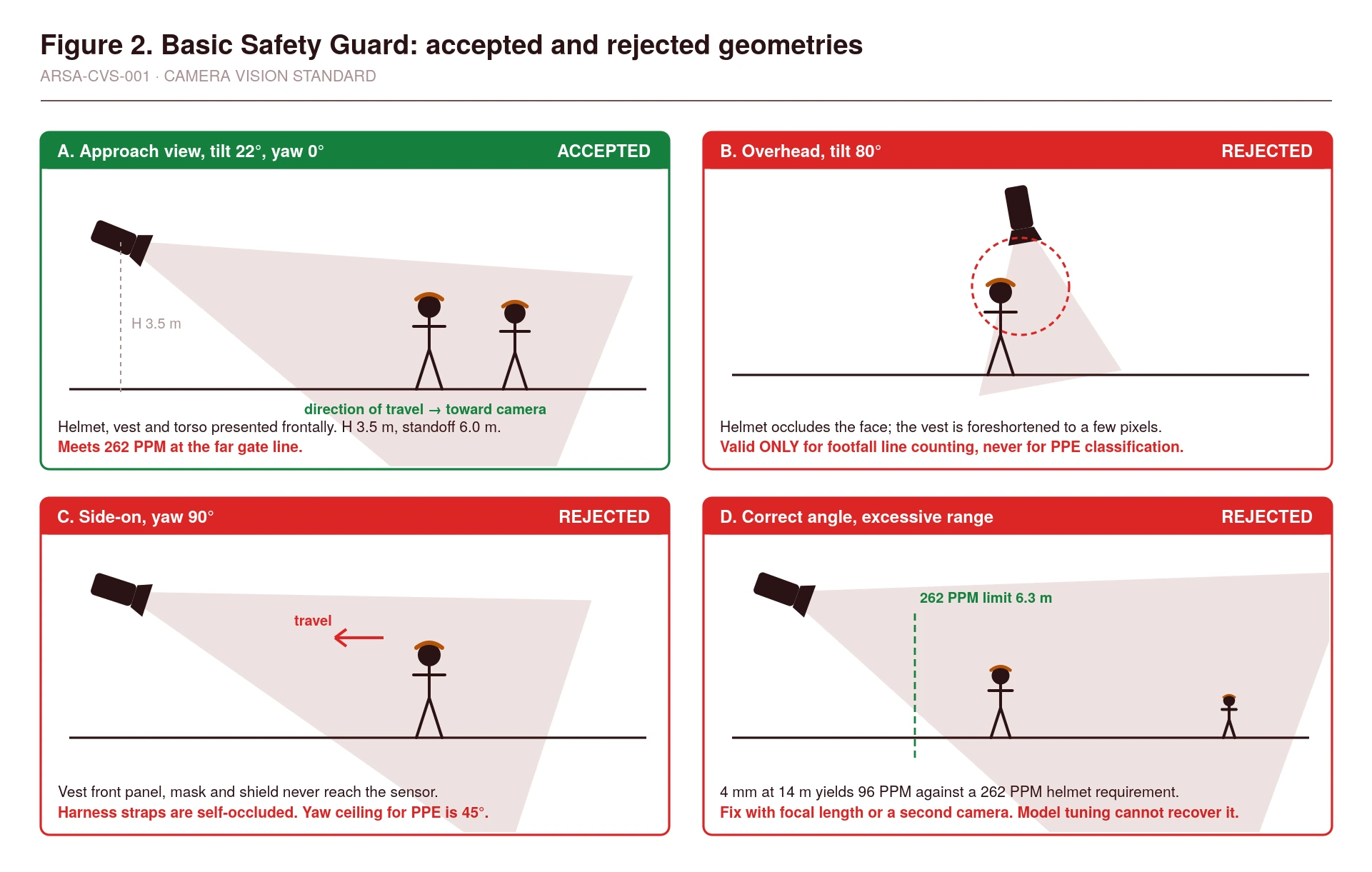
ACCEPTED AND REJECTED POSITIONS
Four Cases We See Most Often
The same camera, the same analytic, four mounting decisions. One is warrantable.
| Case | Verdict | Why |
|---|---|---|
| Approach view, tilt 22°, yaw 0° | Accepted | Helmet, vest, and torso presented frontally. 3.5 m mount, 6.0 m standoff. Meets 262 PPM at the far gate line. |
| Overhead, tilt 80° | Rejected | Helmet occludes the face; the vest is foreshortened to a few pixels. Valid only for footfall line counting, never for PPE classification. |
| Side-on, yaw 90° | Rejected | Vest front, mask, and shield never reach the sensor. Harness straps are self-occluded. Yaw ceiling for PPE is 45°. |
| Correct angle, excessive range | Rejected | 4 mm at 14 m yields 96 PPM against a 262 PPM requirement. Fix with focal length or a second camera. Model tuning cannot recover it. |
IT INFRASTRUCTURE
Camera Required Specification
The minimum column is the floor ARSA will contract accuracy against. Cameras below it can still be connected and will still produce output, with performance stated on a best-effort basis.
| Parameter | Minimum | Recommended |
|---|---|---|
| Sensor resolution | 2 MP (1920×1080) | 4 MP (2560×1440) |
| Sensor format | 1/2.9 or larger | 1/2.8 or larger |
| Low-light sensitivity, colour | ≤ 0.05 lux @F1.6 | ≤ 0.01 lux @F1.4 |
| Lens | Fixed, matched to task | Motorised varifocal |
| Codec | H.264 High Profile | H.265 |
| Frame rate, main stream | 15 fps | 25 fps |
| Bit rate control | CBR | CBR |
| WDR | Not required | ≥ 120 dB |
| Shutter control | Manual minimum shutter | Manual + priority mode |
| Illumination | IR 850 nm | IR 850 nm + white light option |
| Stream count | 2 concurrent | 3 concurrent |
| Protocol | RTSP / ONVIF Profile S | RTSP / ONVIF Profile S+G |
| Time sync | NTP | NTP |
| Ingress protection, outdoor | IP66 | IP66 / IK08 |
| Operating temperature | −10 to +50 °C | −20 to +60 °C |
| Mount rigidity | Wall / soffit | Pole with damping |
| Firmware | Vendor-current | Vendor-current, CVE-checked |
SETTINGS THAT DEGRADE ANALYTICS
Camera Settings We May Ask You to Change
Most cameras ship tuned for human viewing and recording efficiency. Several of those settings degrade analytics while making no visible difference on a monitor.
| Setting | Required value | Why |
|---|---|---|
| Smart codec (H.264+, H.265+, Zipstream) | Off on the analytic stream | Compresses the static background where small distant targets must be resolved |
| Bit rate mode | Constant | Variable bit rate starves the encoder exactly when activity increases |
| Minimum shutter | Set manually per analytic | Automatic exposure lengthens in low light and smears moving targets |
| On-camera motion detection and analytics | Off | Conflicts with ARSA processing and consumes camera resources |
| Privacy masks | Off on the analytic stream | Masks are burned into the image and permanently remove detections |
| Corridor / rotate mode | Off on the analytic stream | Rotated framing falls outside the models' training distribution |
| Time synchronisation | NTP, under one second drift | Required for cross-camera correlation and evidential export |
| Concurrent stream slots | At least two available | One is typically consumed by your existing recorder |
IT INFRASTRUCTURE
Network
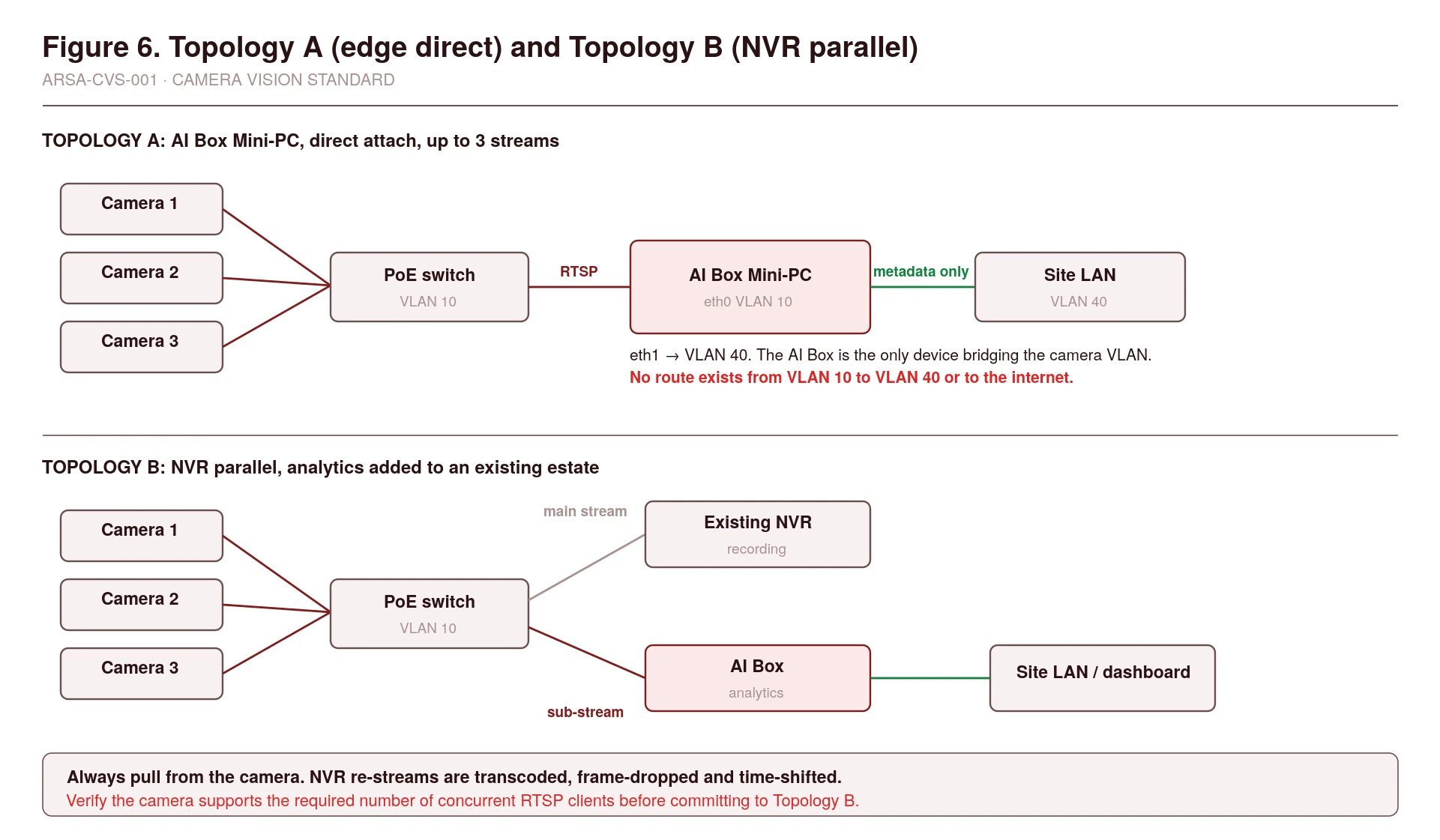
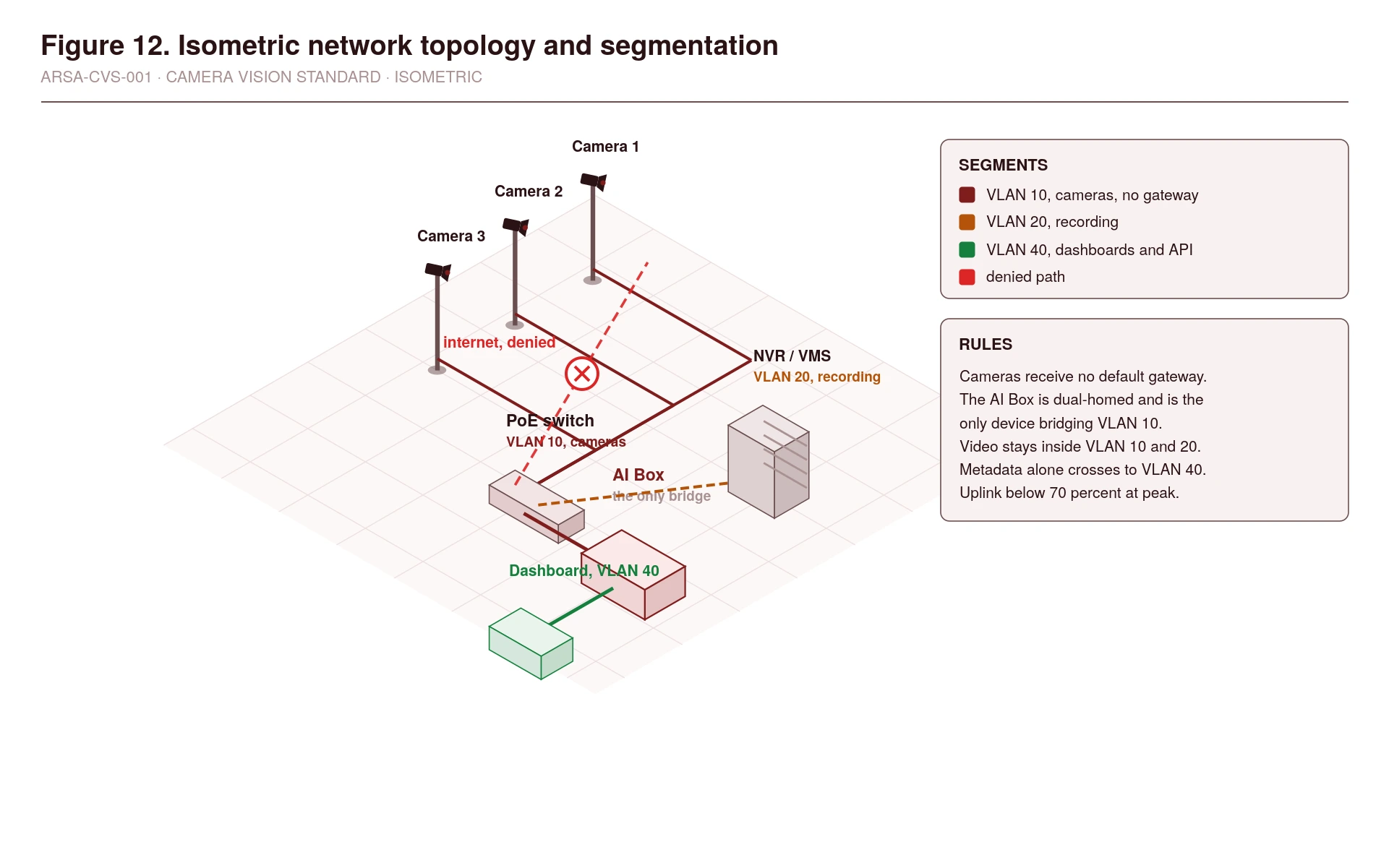
ARSA processes video on site. Video leaves your premises only where you explicitly configure it to. What crosses the network is analytic metadata: counts, events, and, where enabled, small cropped images.
- Cameras on an isolated VLAN with no internet route. The ARSA appliance is the only device bridging that VLAN.
- Access switch uplink below 70 percent utilisation at peak, including the duplicated stream where an existing recorder and the ARSA appliance both read the same camera.
- PoE budget with 25 percent headroom. Infrared and heater load peak together in the wet season.
- The ARSA appliance on a UPS with at least 15 minutes of hold-up, in a location under 35 °C with clear airflow.
- Network latency from camera to appliance under 20 ms, packet loss under 0.1 percent.
- Cabling Cat 6 or better, switching 1 Gbps or better.
Important: Always pull from the camera. NVR re-streams are transcoded, frame-dropped, and time-shifted. Verify the camera supports the required number of concurrent RTSP clients before committing to Topology B.
FAQ
Site Requirements Questions
Our cameras are 2 MP. Is that enough?
Often, yes, it depends on distance, not on the sensor alone. A 2 MP camera does restricted-zone intrusion to 23.6 m, vehicle counting to 24.9 m, and queue measurement to 16.8 m. It does helmet detection only to 6.3 m and 1:N face matching only to 3.1 m. Send us your camera schedule and mounting distances and the Design Review returns a pass or fail per position.
Should we buy 8 MP cameras to be safe?
Not automatically. Each step up in resolution divides the light collected per pixel, so an 8 MP camera performs worse than a 4 MP camera in a dim area unless the sensor is physically larger. An 8 MP camera also carries 3.5× the bitrate and storage of a 2 MP camera for 2× the reach. Where a scene must work at night, a longer lens on a 4 MP camera is usually the stronger choice.
Why does camera angle matter so much?
A camera looking steeply down sees the top of a helmet and almost nothing else, the face, the vest front, and any harness strap are hidden by the wearer’s own body. Above 45° below horizontal, PPE and face analytics are prohibited outright. Between 25° and 45° accuracy degrades measurably. This is the most common reason an otherwise adequate camera cannot be used.
Can we use the feeds from our existing NVR?
It is supported, but pull from the camera wherever possible. NVR re-streams are transcoded, frame-dropped, and time-shifted. If you must use the NVR path, confirm the camera supports the required number of concurrent RTSP clients first, one slot is typically already consumed by the recorder.
Will hi-vis vest detection work at night?
Not under infrared. Infrared produces a monochrome image and any colour-dependent analytic stops working. Night operation of vest detection or any colour-coded rule requires white light at the target plane.
What if a camera fails the review?
The review states the specific remediation and prices it separately: a different lens, a different position, a different camera, additional lighting, or an additional camera. You decide what to remediate. Zones that are not remediated are simply not covered by the accuracy commitment.
What does the accuracy figure in the proposal actually attach to?
Detection zones recorded as ACCEPTED in the Site Acceptance Record. If site conditions later change, a camera is moved, lighting is altered, racking obstructs a view, the affected zones revert to unaccepted status until re-surveyed.
Is the Design Review fee deducted from the project?
Yes, in full, if the project proceeds within 90 days.
Find Out Before You Commit
A Remote Camera Design Review returns a pass or fail against every requirement on this page, for up to 20 cameras. $1,500, deducted from the project if you proceed within 90 days.