
Warehouse And Logistics Video Analytics For Docks, Aisles And Yards
Keep people clear of forklifts, check PPE at the loading docks and count every truck through the yard gate, using the cameras already watching your depot. Detection runs on site, inside your network.
Core Applications
Warehouse Safety And Yard Use Cases On Existing CCTV
A distribution centre runs on tight cycles. Trucks queue at the gate, forklifts cross the same aisles as pickers, and a dock door turns over load after load in a shift. Most depots already record all of it, and nobody has time to watch. Video analytics reads the cameras you have, flags a person too close to a forklift or a missing vest at the dock during the shift, and turns the gate camera into a record of what came in and what left.
- Dock or gate camera
- AI Box at the depot
- Alert to the shift lead
Forklift And Pedestrian Zones
Draw the walkways, aisle ends and dock aprons where people and forklifts meet, and set a proximity rule for each. The system flags the moment a person enters the set radius around a forklift inside that zone.
PPE At The Loading Docks
Check helmets, high-visibility vests and safety boots wherever your site requires them: the dock apron, the yard and the cold room door. Violations are logged automatically and compiled into a daily compliance record for each dock.
Truck Counts At The Yard Gate
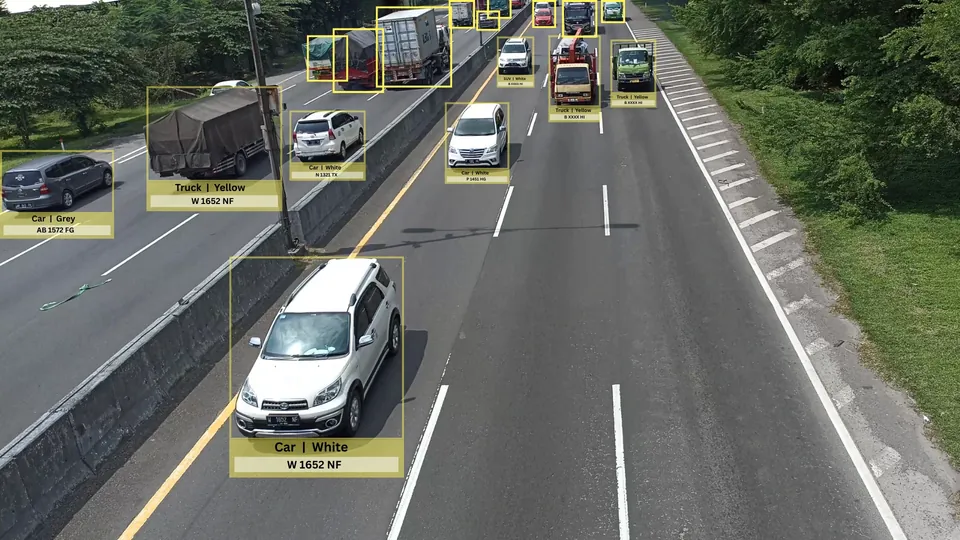
Count trucks, cars and motorcycles in and out by direction and class, spot vehicles standing at the gate, and read plates as an add-on where it is lawfully permitted.
Challenges
What A Warehouse And Yard Deployment Has To Handle
Racking And Sightlines
Tall racking, stacked pallets and open dock doors block views that looked clear at the survey. Each camera is checked against the zone it watches, and when racking moves, the affected zones are surveyed again.
Cold Rooms And Night Shifts
Infrared gives a monochrome image, so vest colour and any colour-coded rule need white light at the target. The AI Box sits outside the cold room, under 35 °C with clear airflow.
Many Depots, One Dashboard
A logistics network runs many sites with few IT staff. Each depot can run its own AI Box and keep working without an internet connection, or several depots can route their cameras to the software edition on your own servers and appear under one dashboard.
Camera Placement For Docks, Aisles And Yard Gates
Each analytic needs its subject large enough in the frame and seen from a usable angle. Our camera standard, ARSA-CVS-001, sets the figures every depot camera is checked against before a deployment:
- Cameras: 2 MP minimum, 4 MP recommended, at 15 fps or more.
- Forklift and pedestrian zones: 71 PPM (pixels per metre) at the target, tilt 15 to 40 degrees optimal and 55 at most, 10 lux.
- PPE at the docks: 262 PPM for helmets and 153 PPM for vests, tilt 10 to 25 degrees optimal, up to 35 for helmets and 40 for vests, 50 lux.
- Yard gate counting: 67 PPM at the vehicle, tilt 15 to 35 degrees optimal and up to 45, 10 lux.
- Licence plates: 325 PPM at the plate, tilt 10 to 25 degrees optimal and up to 30, on a camera framed tightly on one lane.
- Outdoor cameras: IP66 minimum, IP66 and IK08 recommended for yard poles and gate cabinets.
Maximum distance with a standard 60 degree lens
With a standard 60 degree lens, a 2 MP camera watches a zone up to 23.6 m away and counts vehicles up to 24.9 m, but reads plates only to 5.1 m, so the plate camera is planned on its own. If one of your cameras falls short, the free AI assessment report says which one and how to move it; the full figures are on the system requirements page.
FAQ
Warehouse And Logistics Video Analytics FAQ
Questions from operations, HSE and security leads at warehouses, distribution centres and truck yards.
Can it flag a pedestrian too close to a forklift?
Yes. Interaction rules can be configured to flag when a person enters a set radius around a forklift inside a zone you define, such as an aisle end, a crossing or a dock apron. Each event is logged with time, camera and zone.
Will it work in a cold store or on night shifts?
Yes, with the right light. PPE checks need 50 lux at the work zone and zone rules and vehicle counting need 10 lux. At night, vest detection needs white light, because infrared gives a monochrome image. The AI Box stays outside the cold room.
Can it count trucks and flag them standing at the gate?
Yes. Traffic Monitor counts trucks, cars and motorcycles by direction and class, reports the congestion state and flags stopped vehicles, so a queue at the gate shows up while it is still forming. It runs on an AI Box at the gate or as software on your own servers.
Can it read licence plates at the yard gate?
Yes, as an add-on to Traffic Monitor where plate reading is lawfully permitted. It needs 325 pixels per metre at the plate, up to 5.1 m on a 2 MP camera and 6.8 m on a 4 MP camera, and runs at one third of the unit's camera capacity.
Can we see several depots on one dashboard?
Yes. Each depot can run its own AI Box, or several sites can route their cameras to the software edition on your own servers and appear under one dashboard.
What happens when racking or the dock layout changes?
Zones are redrawn in the interface without retraining. If a camera moves, the lighting changes or racking blocks a view, the affected zones are surveyed again, and the support term covers model tuning for material changes.
How do I test it on my own warehouse cameras?
Send up to three one-minute clips through the free AI assessment, or choose the vehicle assessment for gate footage. An ARSA engineer returns an annotated clip, a report with the numbers per camera and a 30-minute call, within 3 business days.
Does the video leave the warehouse?
No. Detection runs on an AI Box inside your network or on your own servers, and works without an internet connection. Only the events go to your dashboard, webhook or email.
Test It On Your Own Docks And Gates
Send us up to three one-minute clips from your own dock, aisle or gate cameras and an ARSA engineer returns an annotated clip, a report with the numbers and a 30-minute call within 3 business days, free. Where footage cannot leave the site, a feasibility assessment measures our models against your lighting, racking and gate layout on site, and its fee is deducted from the project.
Every deployment follows the same steps: a site survey, a check of each camera against our placement standard, installation on an AI Box or your own servers, tuning on your footage and a handover. ARSA has built an automated industrial gate with UHF RFID for a warehouse operator in East Java and RFID terminals for Busana Apparel Group.
Related reading: forklift and pedestrian zones, PPE detection in cold storage, ANPR gate access for warehouses and ports and PPE monitoring in container yards.