
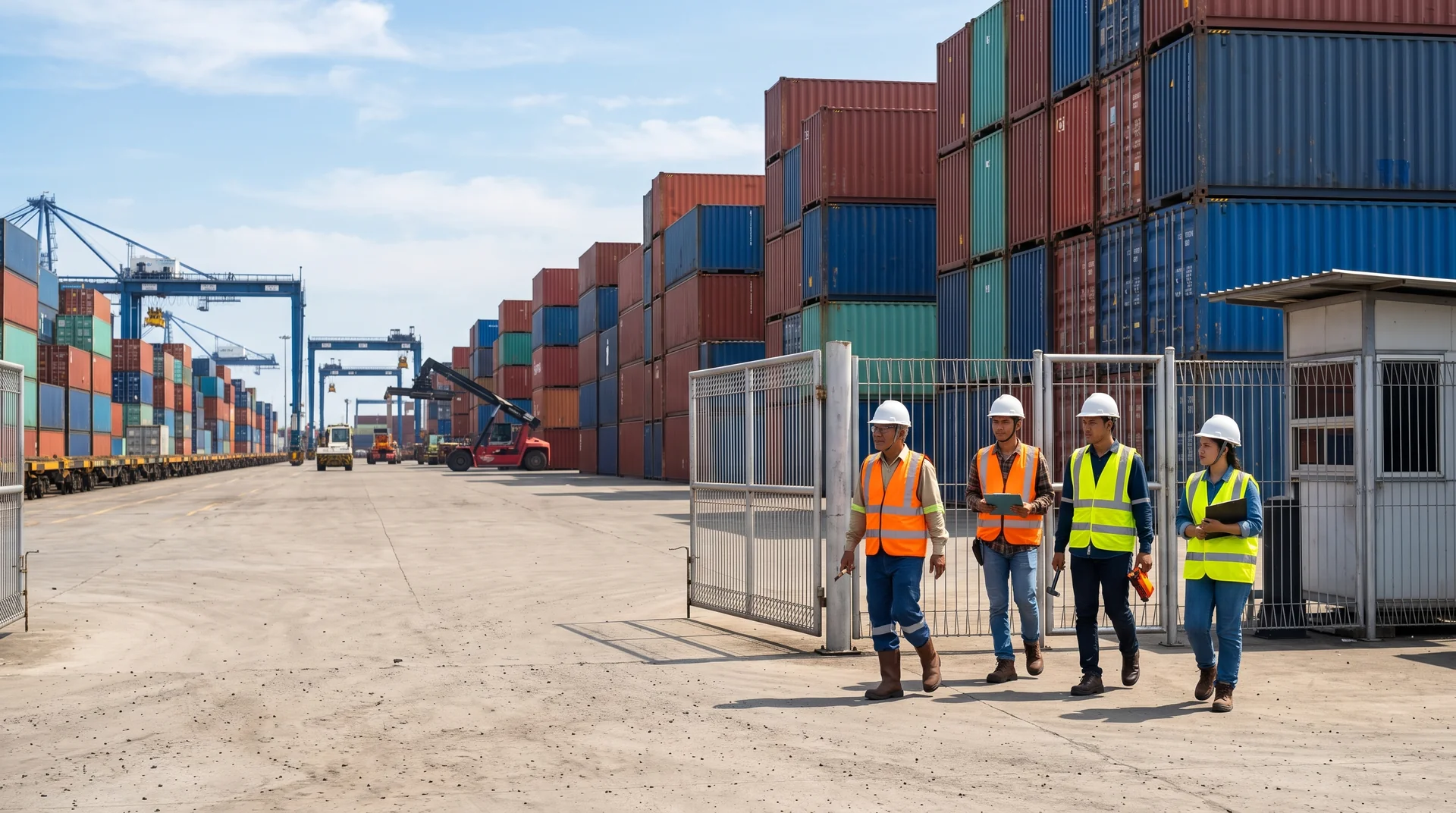

In a container terminal, people on foot work on the same open ground as machines that lift 40 tonnes and cannot see the ground beside their own wheels. That makes PPE compliance monitoring there a geometry problem before anything else: a camera can confirm a helmet only within a few metres of where it is mounted, and a yard is hundreds of metres across. This article covers where camera-based PPE detection works in a port, where it does not, and what it costs to find out before you buy.
THE SETTING
Why Ports Are Harder To Monitor Than Plants
Ports are harder to monitor because the hazards move, the ground is open, and the light goes from desert glare to floodlit night within one shift. A factory has fixed aisles and fixed machines. A terminal has quay cranes, straddle carriers, reach stackers and terminal tractors moving across ground that pedestrians also have to cross.
The regulators reflect this. In the United States, OSHA’s marine terminal standard says that each employee working in the immediate area of container handling equipment or in the terminal’s traffic lanes must wear a high visibility vest or equivalent (29 CFR 1917.71(e)), and head protection wherever falling objects are a risk (1917.93). In the UK, the HSE’s Safety in Docks Approved Code of Practice (L148) is published alongside lessons from incidents such as a tally clerk struck by a container handler where pedestrians and vehicles were not properly separated. In Singapore, PSA’s port user rules require helmets with chin straps fastened at the wharf and set vest specifications that reference ISO 20471 (PSA HSS circular). In Abu Dhabi, the OSHAD-SF framework requires employers to run a documented safety management system, with hazard identification, monitoring and audit as named elements. Australia’s model Code of Practice for Managing Risks in Stevedoring covers traffic management on the wharf and in the terminal.
None of these rules asks for cameras. They ask for PPE to be worn and for compliance to be monitored and recorded. Supervisors on foot cannot watch every crossing on every shift, and camera analytics can close part of that gap.
THE PHYSICS
How Far A Camera Can Actually See A Helmet
A 2 MP camera with a standard 60 degree lens can confirm a helmet out to 6.3 m and a vest out to 10.9 m. A 4 MP camera extends that to 8.4 m and 14.5 m. These limits come from ARSA’s published camera standard, ARSA-CVS-001, which requires 262 pixels per metre (PPM) at the target for helmets and 153 PPM for vests.
Pixel density falls with distance, so doubling the range halves it. A quay camera mounted high on a light mast to watch a 50 m apron sees people as moving shapes. That is enough to detect someone entering a zone, and too little to tell a hard hat from a cap. Restricted-zone intrusion needs only 71 PPM, which a 2 MP camera holds to 23.6 m and a 4 MP camera to 31.4 m.
Tilt matters as much as range. The best angle is 10 to 25 degrees below horizontal. The limit is 35 degrees for helmets and 40 for vests, and anything steeper than 45 degrees is prohibited for PPE because the wearer’s own body hides the equipment. Port security cameras are often mounted high and pointed steeply down to cover as much ground as possible, which makes them poor PPE cameras even when their resolution is fine. ARSA’s accepted reference position is a 3.5 m mount, a 6.0 m standoff and a 22 degree tilt. The lens and field of view visualizer shows what a given camera and lens will deliver before anyone climbs a pole.
| Analytic | Required PPM | 2 MP, 60 Degree Lens | 4 MP, 60 Degree Lens | Maximum Tilt | Minimum Light |
|---|---|---|---|---|---|
| Helmet Present Or Absent | 262 | 6.3 m | 8.4 m | 35 degrees | 50 lux |
| Hi-Vis Vest Present Or Absent | 153 | 10.9 m | 14.5 m | 40 degrees | 50 lux |
| Restricted-Zone Intrusion | 71 | 23.6 m | 31.4 m | 55 degrees | 10 lux |
| Vehicle Detection And Counting | 67 | 24.9 m | 33.3 m | 45 degrees | 10 lux |
A narrower lens roughly doubles each distance and halves the width covered. ARSA contracts accuracy only against cameras that meet the standard’s minimum of 2 MP and 15 fps, and it recommends 4 MP.
WHERE TO PUT THE CAMERAS
Watch The Points Where People Must Pass
In practice, a terminal should check PPE at the chokepoints people walk through and use wider zone detection everywhere else. Three kinds of location usually carry most of the value.
Gates And Pedestrian Crossings
Truck drivers climbing down at the gate, lashers walking to the quay and staff crossing traffic lanes all pass through fixed points. A camera at 3 to 4 m height, set 6 m back from the crossing line, sees each person from the front at a usable tilt and can confirm helmet and vest on every pass.
Quay Crane Landside Access
Lashing crews and checkers reach the area under the crane legs along defined walkways. A PPE camera on each access route, plus an intrusion zone covering the apron itself, answers two separate questions: whether the person who entered was wearing the right equipment, and whether anyone is standing where the spreader or a straddle carrier is about to be.
Stack Block And Reefer Row Entry
Reefer technicians and maintenance crews walk into the stacks. A PPE check at the block entrance and zone alerts inside the rows cover the stretch where a reach stacker driver has the poorest view of the ground.
ARSA’s material describes a configurable rule that flags a pedestrian entering a set radius around a forklift inside a zone. Whether that rule extends to the reach stackers, straddle carriers and terminal tractors on your yard should be settled in the design review, and should not be assumed.
CONDITIONS
Glare, Heat And Night Shifts
Outdoor terminal conditions affect three parts of a PPE deployment: the camera settings, where the compute sits, and how the yard is lit at night. ARSA publishes a requirement for each.
Sun on white and coloured container walls produces high contrast scenes, and a worker standing in shadow comes out underexposed. The standard recommends cameras with a wide dynamic range of 120 dB or more and a manually set minimum shutter so that moving people are not blurred. It also requires smart codecs to be switched off on the analytic stream, because they compress the static background where distant targets need to be resolved.
Outdoor camera housings should be IP66, and IK08 is recommended for cabinets. The AI Box appliance is specified for cabinet mounting at minus 10 to plus 50 degrees Celsius. The network requirements also ask for the appliance to sit below 35 degrees with clear airflow, on a UPS that lasts at least 15 minutes. In a Gulf summer, that puts it in the gatehouse or control room rather than in a sun-facing cabinet on the quay.
Night is the hardest constraint. Vest detection depends on colour, and infrared produces a monochrome image, so vest detection under infrared is unsupported. It needs at least 50 lux of white light at the target. Many terminals already floodlight their working areas, but the light at pedestrian crossings and stack entrances should be measured before any accuracy figure is accepted.
WHAT IT DOES AND DOES NOT DO
The Limits Worth Knowing Before Purchase
Basic Safety Guard detects whether a helmet, a high-visibility vest and safety boots are present or absent, and it raises alerts when someone enters a hazard zone. Each event is logged with timestamp, camera, zone and detection class, and can be exported in PDF or Excel reports. Alerts go to a dashboard, a siren relay, a webhook or an existing alerting system.
The system reports whether a helmet is present. It does not check PSA’s rule that the chin strap is fastened, or a requirement for a particular vest class under ISO 20471, because neither is on the published product’s detection list. Anything beyond the listed items goes through the custom add-on route. The system also does not replace physical separation of people and vehicles, which every regulator above treats as the primary control. A camera that falls short of the standard will still connect and produce output, but ARSA states its performance on a best-effort basis only. Accuracy commitments apply only to detection zones recorded as accepted in the Site Acceptance Record.
Detection runs on site. Video stays inside the terminal network, and only event data plus, where enabled, small cropped images travel across it. For operators handling footage under the UAE’s PDPL, Singapore’s PDPA or UK GDPR, this keeps the data inside the operator’s existing controls. The product can also use facial recognition for PPE evaluation, and whether to switch that on is a decision for the operator’s privacy assessment.
COST AND DELIVERY
What A Terminal Deployment Costs
A 20 camera deployment on one AI Box Server costs $10,900 for the appliance plus Safety Guard licences at $45 per camera per month, or $1,350 per camera for a perpetual licence. That comes to $900 a month on subscription, or $27,000 once for 20 perpetual licences, with optional maintenance at $243 per camera per year. Terminals that already run GPU servers can use the self-hosted software edition instead, at the same licence price.
Before any of that, ARSA offers paid site checks, listed on its services page. A Remote Camera Design Review costs $1,500 and takes one week. An On-Site Camera Survey costs $4,500 plus travel and covers up to 50 cameras. Either fee is deducted from the project fee if the project is contracted within 90 days. At a port, the review usually produces the real camera count, because existing security cameras rarely meet the tilt and PPM limits at the crossings.
ARSA delivers outside Indonesia. List prices are in USD, and invoicing is available in USD or EUR. Where visa conditions prevent ARSA engineers from travelling, a qualified local partner installs under ARSA supervision.
FAQ
Questions From Port Safety And IT Teams
Can Existing Port CCTV Cameras Be Used For PPE Detection?
Some can, but most security cameras on masts cannot. A camera works for helmet detection only if it delivers 262 PPM at the target and looks down at no more than 35 degrees. Gate and crossing cameras mounted at 3 to 4 m often qualify. High mast cameras covering the apron are usually suitable for zone intrusion only.
Is PPE Detection Software Available For Ports In The GCC?
Yes. ARSA sells Basic Safety Guard for deployment in the UAE and across the Gulf, either as an on-site appliance or as self-hosted software. Pricing is in USD, invoicing is in USD or EUR, and where visas prevent ARSA engineers from travelling, a local partner can install under ARSA supervision.
Does Vest Detection Work During Night Shifts On The Quay?
Only under at least 50 lux of white light at the target. Infrared images are monochrome and vest detection depends on colour, so it is unsupported under infrared. Measure the light at each crossing during a night shift before relying on it.
Can One System Cover A Whole Container Terminal?
One AI Box Server handles up to 25 cameras, and larger sites use the Server Pro or the self-hosted software. In practice the limit is camera placement: helmet detection needs a camera within 6.3 m on 2 MP or 8.4 m on 4 MP, so coverage is planned around crossings and access points.
Does Footage Leave The Terminal Network?
No. Detection runs on the appliance or on your own servers inside the network. The only data that leaves is the event data you choose to send out, such as alerts and reports.
GET STARTED
Check Your Crossings Before You Buy
Send ARSA the camera positions at your gates, crane access routes and stack entrances. A design review will tell you which cameras can confirm a helmet, which need a new lens or position, and what the changes cost. The cameras, detection classes and pricing are on the Basic Safety Guard product page.