
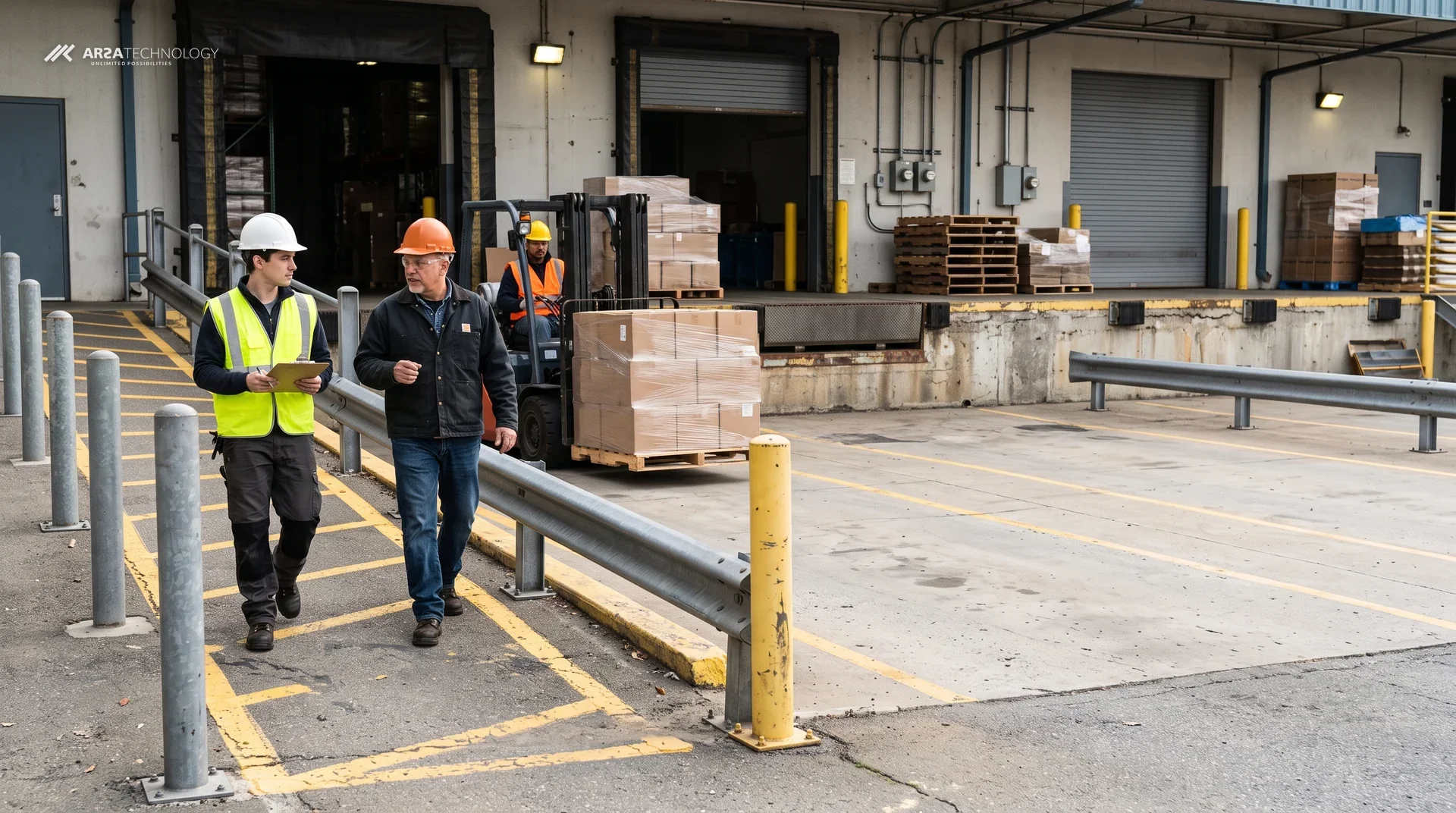
A distribution center usually runs forklifts and order pickers through the same aisles, crossings and dock doors, often within a metre or two of each other. Camera-based PPE compliance monitoring can show who is in which zone wearing what. It only works if each camera is placed for the distance at which a hi-vis vest can be resolved, and if forklift lanes and pedestrian walkways get separate rules. This article sets out both for warehouse operators in the US, UK, Australia, Singapore and the Gulf.
THE HAZARD
Why Forklift Aisles Need Their Own Monitoring Plan
Forklift and pedestrian collisions are among the most serious hazards in a warehouse, and every major regulator treats keeping people and trucks apart as the first control. Camera monitoring checks whether that separation, and the PPE that goes with it, holds up during a real shift.
In the United States, NIOSH estimated that forklift incidents kill nearly 100 workers and seriously injure about 20,000 more each year, and it named workers on foot struck by a forklift as one of the main fatal patterns (NIOSH Alert 2001-109). OSHA regulates the trucks themselves under 29 CFR 1910.178. In Great Britain, the HSE’s warehousing guidance asks for pedestrians and vehicles to be kept on separate routes where possible, for physical barriers where routes must run close together, and for risk assessments that account for shift changes, when foot traffic rises. Safe Work Australia’s traffic management guide for warehousing calls separating pedestrians from forklifts the most effective way to cut forklift injuries, and lists exclusion zones and forklift-only areas as the next options when full separation is impractical.
These documents all assume the separation is actually observed. A barrier stops nobody who steps around its end, and a hi-vis rule written into a site induction tells you nothing about the night shift. Cameras already watch most of these crossings. The question is whether they can produce evidence a safety manager can use.
ZONE RULES
Three Zone Types On One Camera
Basic Safety Guard lets you draw several zones in a single camera view and give each zone its own rule, so one aisle-end camera can treat the forklift lane, the walkway beside it and the crossing in front of it differently. Most warehouse views divide into three kinds of zone.
Forklift Lanes
A forklift lane is a hazard zone for anyone on foot. The rule here is entry detection: a person stepping into the lane triggers an alert whatever they are wearing, because a vest does not make it safe to walk where trucks run. ARSA’s manufacturing page also describes configurable interaction rules that flag a person inside a set radius of a forklift within a zone. Ask for that rule to be shown on your own footage before you rely on it.
Pedestrian Walkways
A walkway is where people are expected to be, so presence alone raises nothing. The rule is equipment. A person in the walkway without a hi-vis vest is logged as a violation with timestamp, camera, zone and detection class. Where the site also requires hard hats, for example under high racking, helmet detection is added to the same zone.
Crossings And Dock Thresholds
Marked crossings and dock door thresholds are where the two flows meet. They usually carry the strictest rule: vest required, entry logged, and where your procedures restrict times of use, time-based access rules applied. These are also the zones most worth wiring to a siren relay or a supervisor’s radio, because an alert at a crossing is only useful if somebody hears it within seconds.
CAMERA GEOMETRY
How Far A Hi-Vis Vest Reads In A Forklift Aisle
With a standard 60 degree lens, a 2 MP camera resolves a hi-vis vest out to about 10.9 m and a 4 MP camera out to about 14.5 m. Both figures come from the vest requirement of 153 pixels per metre (PPM) in ARSA’s camera standard, ARSA-CVS-001. Helmets need 262 PPM, which cuts the reach to 6.3 m on 2 MP and 8.4 m on 4 MP.
Warehouse aisles often run 40 m or more, so a single camera at the end of an aisle cannot judge vests along the whole length. A practical plan points cameras at the places where the rules change: aisle ends, cross-aisles, crossings and dock doors. It uses a narrower lens where a longer reach is needed, which roughly doubles the working distance and halves the width of the scene covered.
Mounting height is the other constraint. Warehouse cameras are often fixed high on racking uprights or roof steel so they cannot be tampered with, and a steep downward view hides the vest behind the wearer’s own shoulders and arms. ARSA-CVS-001 puts the optimal tilt at 10 to 25 degrees below horizontal, allows up to 40 degrees for vests and 35 for helmets, and prohibits anything steeper than 45 degrees for PPE. In the reference case the standard accepts, the camera sits 3.5 m up, 6.0 m back from the target line, at 22 degrees. As a rough geometric check, a camera mounted 8 m high and aimed at chest height needs to stand back at least about 8 m to stay within 40 degrees. At that distance the vest reach of a 2 MP sensor is already partly used up. ARSA’s lens and field of view visualizer lets you test a position before anyone climbs a ladder.
| Requirement | Hi-Vis Vest | Hard Hat |
|---|---|---|
| Pixel density at target | 153 PPM | 262 PPM |
| Reach, 2 MP, 60 degree lens | 10.9 m | 6.3 m |
| Reach, 4 MP, 60 degree lens | 14.5 m | 8.4 m |
| Optimal tilt below horizontal | 10 to 25 degrees | 10 to 25 degrees |
| Maximum tilt | 40 degrees | 35 degrees |
| Minimum light at target | 50 lux, white light | 50 lux |
| Camera minimum | 2 MP, 15 fps | 2 MP, 15 fps |
| Camera recommended | 4 MP | 4 MP |
Light matters as much as distance. A hi-vis vest is identified partly by its colour, and an infrared image is monochrome, so vest detection does not work under infrared. A warehouse that dims its lights or switches cameras to infrared on a quiet night shift loses vest detection in those zones until white light at 50 lux or more returns to the target plane.
LIMITS
What The System Does Not Do
The system detects people, equipment and zone entries in video and reports them. It does not slow or stop a forklift, it does not replace a barrier, and it holds no accuracy commitment for a camera that fails the site standard. Safety managers should plan around each of these limits.
It sits beside your engineering controls in the hierarchy. HSE and Safe Work Australia both rank physical separation above signage and procedures, and camera monitoring adds detection and evidence on top of those controls. Its value is the record: which crossings see the most breaches, on which shift, and whether a layout change reduced them. Events export as CSV or PDF for internal review, insurers or a regulator.
Accuracy attaches to zones recorded as ACCEPTED in the Site Acceptance Record. A camera below the standard still connects and still produces output, but on a best-effort basis. If racking is moved, a light is relocated or pallets block a view, the affected zones return to unaccepted status until they are surveyed again. In a warehouse that reslots every season, that review should be part of the change process.
Video stays on site. Detection runs on the appliance inside your network, and only event metadata, plus cropped images where you enable them, crosses the network. That helps under UK GDPR, Singapore’s PDPA and the UAE’s PDPL. The facial recognition option for PPE evaluation still involves biometric data, so take it through your own data protection assessment before you switch it on.
DEPLOYMENT
Sizing, Cost And Delivery Outside Indonesia
For a 12-camera warehouse safety deployment, ARSA’s pricing page lists the AI Box Server 12 at $19,900 as a one-time purchase, or $5,900 for the hardware plus $540 a month in Safety Guard licences on subscription. A three-camera pilot at one dock costs $5,190 on the Mini.
If you already run servers with a suitable GPU, the software edition is $45 per camera per month, with a four-camera minimum. List prices are in USD and invoicing is available in USD or EUR. Every product except the Self-Check Health Kiosk ships outside Indonesia. Where visa conditions prevent ARSA engineers from travelling, a qualified local partner installs under ARSA supervision.
Most warehouses should check their cameras before buying. A free footage assessment returns annotated video from one of your own recordings. The Remote Camera Design Review costs $1,500, takes one week, and gives a pass or fail for each position with priced remediation. The On-Site Camera Survey costs $4,500 plus travel and covers up to 50 cameras. Both fees are deducted from the project if you contract within 90 days. Details are on the services page.
FAQ
Questions From Warehouse Safety Teams
How Far Away Can A Camera Detect A Hi-Vis Vest In A Warehouse Aisle?
About 10.9 m on a 2 MP camera and 14.5 m on a 4 MP camera with a standard 60 degree lens. Those distances are where the image still carries 153 pixels per metre at the target, the minimum ARSA-CVS-001 sets for vests. A narrower lens roughly doubles the reach and covers a narrower slice of the aisle.
Can One Camera Apply Different Rules To A Forklift Lane And A Pedestrian Walkway?
Yes. Each camera view can hold several zones, each with its own rule. A typical setup alerts on any person entering the forklift lane, requires a vest in the walkway, and applies both conditions at the crossing between them.
Do Our Existing Warehouse Cameras Qualify?
Often they do, depending on mounting height and distance. Cameras need 2 MP and 15 fps at minimum, with 4 MP recommended, a tilt no steeper than 40 degrees for vests, and white light of at least 50 lux. High-mounted overview cameras are the usual failure, because their angle hides the vest. A Remote Camera Design Review reports which positions pass.
Will Vest Detection Work On The Night Shift?
Only under white light. Vest detection relies on colour, and infrared produces a monochrome image, so cameras that switch to infrared at night stop detecting vests in those zones. Keep at least 50 lux of white light at the target plane during night operations.
Can It Detect A Pedestrian Getting Too Close To A Moving Forklift?
ARSA describes interaction rules that flag a person entering a set radius around a forklift within a designated zone. Confirm how that behaves on your own aisles during the footage assessment or pilot. Zone entry and PPE detection are the core functions listed for Basic Safety Guard.
NEXT STEP
See It On Your Own Aisles
Basic Safety Guard runs on an AI Box in your control room, reads the IP cameras you already have, and turns forklift lanes, walkways and crossings into zones with their own rules and an exportable record. Review the specifications and pricing on the Basic Safety Guard page, or send a recording from one of your aisle cameras for a free assessment.