
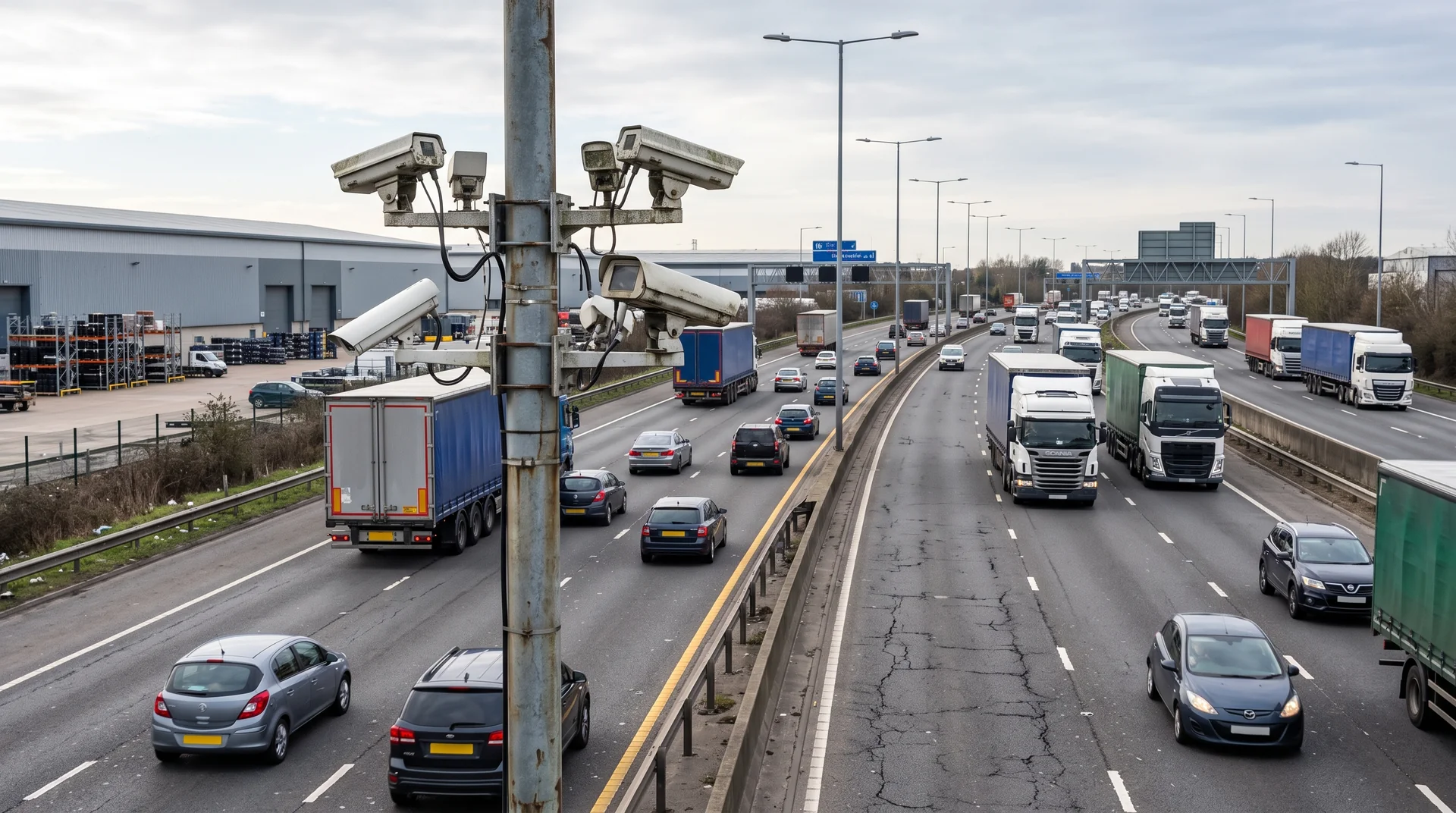

US state DOTs and their count contractors report vehicle classification against the FHWA 13-class scheme, which sorts vehicles by axles and trailer units. A camera running vision analytics classifies by appearance, so some of those classes come straight out of it and others only come out in groups. This article shows which are which, so a traffic count program can decide where camera counts belong before anyone buys anything.
THE STANDARD
What The FHWA 13-Class Scheme Asks For
The FHWA scheme sorts motor vehicles into 13 classes by the number of axles touching the road and the number of units. It runs from Class 1, motorcycles, to Class 13, multi-trailer trucks with seven or more axles. Appendix A of the 2022 Traffic Monitoring Guide defines the classes, and it tells agencies to count only the axles in the dropped position. Because of that rule, a truck with a raised lift axle can fall into a different class depending on whether it is loaded.
For federal reporting, the guide’s chapter on data reporting asks for classification counts of at least 48 hours with at least six vehicle groups: motorcycles, passenger cars, light trucks, buses, single-unit trucks and combination trucks. Those groups feed the truck percentages that the Highway Performance Monitoring System carries for each sample section. The six-group summary is the level a camera system needs to reach before it is useful for this work, so it is the level to test against.
CLASS BY CLASS
Which FHWA Classes A Camera Can Report
ARSA Traffic Monitor reports five classes: car, truck, bus, motorcycle and bicycle, with counts by direction. Motorcycles, cars and buses map directly onto FHWA classes. Trucks come out as one group, which covers FHWA Classes 5 through 13 together.
The table sets each FHWA class against what the system reports today. Where a row says “grouped”, the camera count can support a total but cannot split it the way an axle sensor would.
| FHWA Class | Description | Traffic Monitor Output | Fit |
|---|---|---|---|
| 1 | Motorcycles | Motorcycle | Direct |
| 2 | Passenger cars | Car | Direct |
| 3 | Four-tire single unit (pickups, vans) | Car | Merged with Class 2 |
| 4 | Buses | Bus | Direct |
| 5 to 7 | Single-unit trucks, two to four or more axles | Truck | Grouped |
| 8 to 13 | Combination trucks, single and multi-trailer | Truck | Grouped with 5 to 7 |
| None | Bicycles | Bicycle | Outside the FHWA scheme, reported separately |
There are two gaps here, and a procurement team should know both before anyone builds a business case. The published classes do not separate pickups and vans from cars, so Class 3 sits inside the car count. They also do not split single-unit trucks from combination trucks, so the HPMS truck split needs another source. If your program needs either split from cameras, ask ARSA before contract whether it can be scoped for your site. Do not assume it is there.
WHERE IT FITS
Where Camera Counts Belong In A Count Program
Camera classification is most useful at sites where you need volumes by direction with a broad class mix, and where putting a crew in live traffic is costly or unsafe. It does not replace the permanent axle-based stations that produce the full 13 classes.
Short-Duration Urban Counts
Road tubes on a busy arterial or a multilane urban street mean a crew working in live lanes and tubes that pull loose under heavy turning traffic. Where a camera already covers the approach, a 48-hour count by direction and class can run with nobody on the road, and it can run again next quarter without another deployment.
Intersections And Corridors
Counting lines are drawn per approach and per direction, and each class is counted separately. One server can hold many cameras across a corridor, so the same configuration gives repeatable counts over months. That suits planning studies, signal retiming and before-and-after work.
Continuous Count Stations
Permanent stations that report all 13 classes and truck weights need axle sensors in the pavement: loops with piezoelectric sensors, or weigh-in-motion. Keep them. A camera next to one adds congestion state, stopped vehicles and a visual record, but it does not count axles.
SITE REQUIREMENTS
Camera Geometry For Classification
Classification needs more detail on the vehicle than counting does: 107 pixels per metre at the counting line, against 67 for counting. Those figures come from ARSA’s engineering standard ARSA-CVS-001, published on the camera and site requirements page. Under that standard, a 2 MP camera with a 60 degree lens classifies out to about 15.6 m.
| Requirement | Counting | Classification |
|---|---|---|
| Pixel density at the line | 67 PPM | 107 PPM |
| Maximum distance, 2 MP, 60 degree lens | 24.9 m | 15.6 m |
| Maximum distance, 4 MP, 60 degree lens | 33.3 m | 20.8 m |
| Tilt below horizontal, optimal | 15 to 35 degrees | 10 to 25 degrees |
| Tilt below horizontal, maximum | 45 degrees | 40 degrees |
| Minimum light at the target | 10 lux | 20 lux |
| Camera minimum | 2 MP, 15 fps | 2 MP, 15 fps (4 MP recommended) |
| Outdoor cabinet | IP66, IK08 recommended | IP66, IK08 recommended |
At the 15.6 m classification limit, a 2 MP camera with a 60 degree lens covers a strip about 11 m wide, which is enough for three lanes. A wider cross section needs a higher resolution sensor, a longer lens or a second camera. A narrower lens roughly doubles the distance and halves the width covered.
Light is the other limit. Below 20 lux at the target, or in heavy rain, classification degrades before counting does, so a site can keep producing usable volumes on a night when its class split is unreliable. If your program counts across nights, check the street lighting at each counting line. The 50 lux minimum applies to the safety analytics. Traffic classification has its own 20 lux minimum, listed above.
DATA
Turning Camera Counts Into Submittable Data
Traffic Monitor stores counts by direction and class as a time series. It exports them as CSV, Excel or PDF, and pushes them to other systems through a REST API, webhooks or MQTT. Converting those counts into the record format your state uses for TMAS submission is a mapping step that your data team scripts once, or that you scope with ARSA during setup.
Settle three things before the first count. The first is the interval length: TMAS accepts several, and your program will have a standard one, so confirm that the export aggregates to it. The second is how the five camera classes map into your six reporting groups, with the Class 3 and truck splits marked as gaps or filled from another source. The third is validation. Count a sample period by hand from the recorded video and compare it with the system’s output before you accept a site. Accuracy commitments under ARSA-CVS-001 attach only to detection zones recorded as accepted in the Site Acceptance Record. If a camera is later moved or its lighting changes, that zone goes back to unaccepted until it is surveyed again.
DEPLOYMENT
Pole Cabinet Or Central Server
Approaches without video backhaul get an AI Box in the roadside cabinet, which counts on site and sends only the numbers upstream. Networks that already bring video back to a control centre run the self-hosted Traffic Monitor software on one server for every camera.
The AI Box Mini handles up to three cameras at $1,890, and the AI Box Server handles up to 25 at $10,900. The Traffic Monitor licence is $1,170 per camera perpetual, with optional maintenance of $211 a year, or $39 per camera per month on subscription. The software route has a four camera minimum. Perpetual licensing exists for public tenders that cannot accept a subscription, and published list prices make a rules-based comparison straightforward.
For buyers outside Indonesia: list prices are in USD, invoicing is available in USD or EUR, and appliances ship from Surabaya three to four weeks after order. Import duty and VAT are the buyer’s responsibility. Where visa conditions prevent ARSA engineers from travelling, a qualified local partner installs under ARSA supervision.
Frequently Asked Questions
Can AI Traffic Cameras Produce All 13 FHWA Vehicle Classes?
No. ARSA’s camera system reports five classes, and the FHWA scheme separates trucks by axle count and number of trailers, which a vision count of this kind does not resolve. Motorcycles, cars and buses map directly onto FHWA classes. Trucks are reported as one group covering Classes 5 through 13.
How Are Traffic Counts Calculated From Video?
An operator draws a counting line and a direction on each approach, and every vehicle that crosses the line is counted and assigned a class. The analysis runs on the appliance or server at the site. The counts are stored as a time series that can be summed into whatever reporting interval your program uses.
Can A Camera Count Vehicle Axles?
ARSA does not claim axle counting for Traffic Monitor. Axle-based classification comes from road tubes, loops with piezoelectric sensors, weigh-in-motion stations, or a person classifying vehicles from video. Where the full 13 classes are required, those sensors stay in the program and cameras cover the sites where volumes by direction and broad class are enough.
How Accurate Is Vehicle Classification At Night?
Classification holds up as long as there are at least 20 lux at the counting line and the camera meets 107 PPM there. Below that, and in heavy rain, classification degrades before basic counting, which needs only 10 lux. Wide dynamic range of 120 dB or better is recommended where headlight glare washes out the scene.
Do We Need New Cameras For Classification Counts?
Often you do not. Distance and angle decide whether a camera works, more than the sensor does. A 2 MP camera at 15 fps classifies out to 15.6 m at a tilt below 40 degrees. A Remote Camera Design Review costs $1,500, takes one week, returns a pass or fail for each position, and is deducted from the project fee if you contract within 90 days.
DEPLOY TRAFFIC MONITOR
Count And Classify From The Cameras You Already Run
Traffic Monitor counts by direction and class at the pole or on a central server, and the video stays on your network. To find out which of your approaches can support a 48-hour classification count, start with the Traffic Monitor page and ask for a design review of your camera positions.