
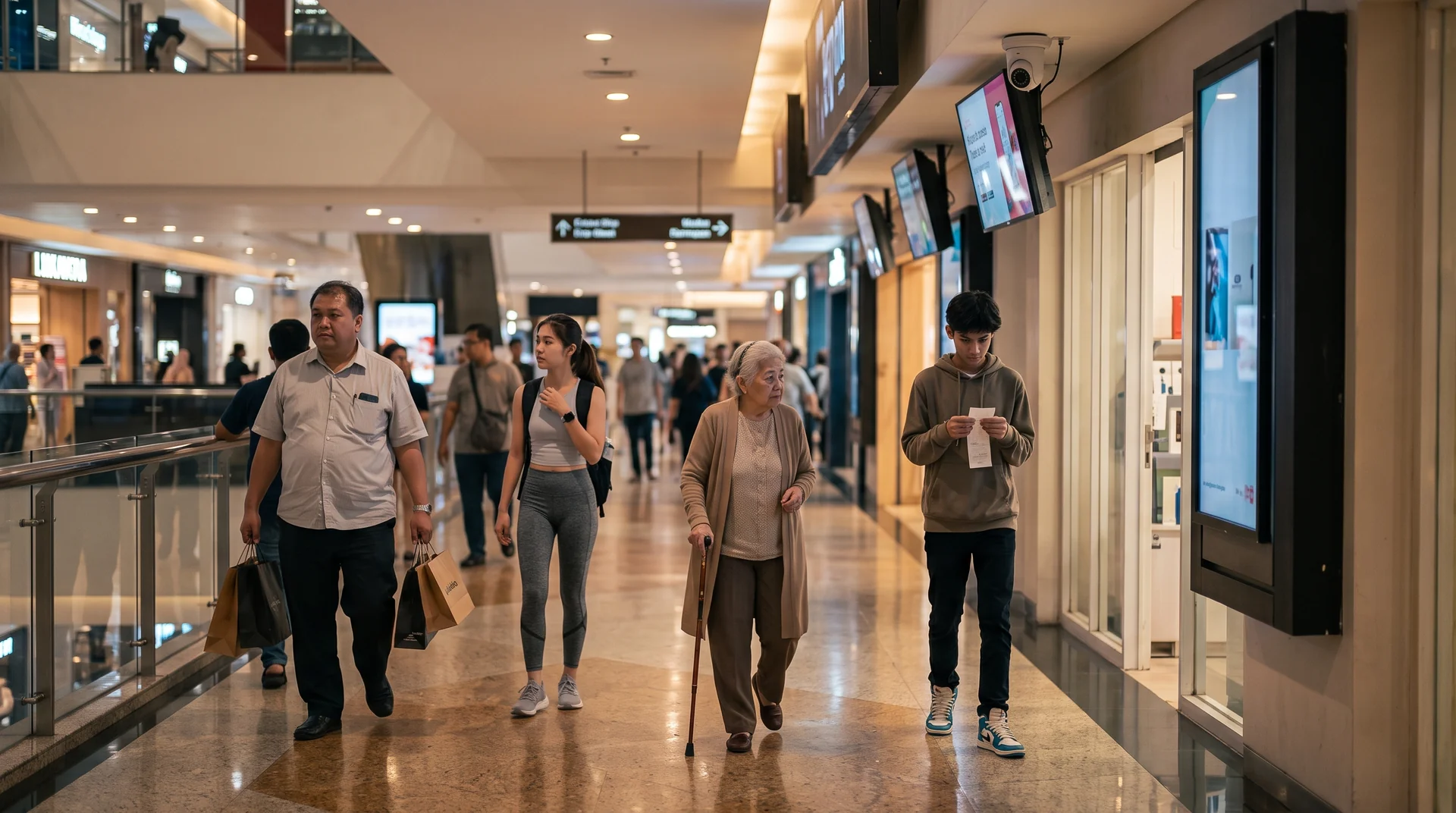

A camera on a videotron in Jakarta sees several thousand faces an hour. Indonesia’s Personal Data Protection Law, Undang-Undang No. 27 Tahun 2022, treats biometric data as specific personal data and carries an administrative fine of up to 2% of annual revenue under Pasal 57. The engineering question for a DOOH operator is how to produce a defensible impression count while the system holds no face image, no template, and no identity at any point.
THE PROBLEM
What A Camera On A Digital Billboard Actually Records
Most DOOH measurement pitches sell the revenue upside and stay quiet about what the sensor retains. The compliance exposure sits entirely in that gap: whether frames are written to disk, whether a face is converted into a comparable numeric template, and whether anything crosses the public internet.
An operator running 40 screens across malls and toll roads is a data controller the moment a camera captures an identifiable person, and the four common DOOH architectures place that controller in very different positions. A cloud measurement service uploads frames or crops to a vendor for processing, which means images of Indonesian pedestrians leave the operator’s network and frequently leave the country, triggering the cross-border transfer provisions in Pasal 56. A system that builds face templates to de-duplicate repeat viewers is processing biometric data in the plain sense of the law, because Pasal 4 defines biometric data as physical or physiological characteristics permitting unique identification, naming the face image explicitly. A system that counts presence on the device and writes only totals holds no personal data to protect after the frame is discarded.
THE LAW
How UU PDP Applies To Audience Counting In Public Space
UU PDP regulates data about an identified or identifiable individual. An aggregate count of viewers, with no stored image and no persistent identifier, has no individual to attach to, which is why anonymized counting sits outside the heaviest obligations rather than inside them.
The transition period ended on 17 October 2024, so every provision is now live for private operators. Indonesia has no dedicated implementing regulation for facial recognition technology yet, and that absence cuts against operators rather than for them: an architecture that avoids creating biometric data avoids the question the regulator has not answered. The European position runs parallel. GDPR Recital 26 removes anonymous information from scope, and detection without template generation is the reason camera-based counting survived in Europe while camera-based identification did not.
THE DISTINCTION
Three Operations People Call The Same Thing
Detection, estimation and recognition describe three different pipelines with three different legal profiles. Vendors blur them, and buyers sign for the wrong one.
Detection
The processor determines that a face-shaped region exists in the frame and where it points. The output is a bounding box and an orientation angle, held in memory for the duration of the frame. Nothing about the geometry of that face is written anywhere.
Estimation
The processor assigns a coarse attribute, such as an age band or a gender label, to the detection before discarding it. The output is a category increment on a counter. ARSA benchmarks this at plus or minus 5 years for age bands and above 95% for binary gender inside the 400 PPM zone, and the module runs with estimation switched off where an operator’s legal assessment prefers plain totals.
Recognition
The processor converts the face into a numeric template and compares it against stored templates to decide whether this is the same person as before. This is the operation that creates biometric data under Pasal 4, and the DOOH Audience Meter does not perform it.
THE ARCHITECTURE
Why Processing On Site Changes The Answer
The AI Box Mini mounts inside the media player enclosure behind the screen, needs 60 mm of depth clearance, and draws from the existing supply. Video is analysed where it is captured and never routed out of the display cabinet, so there is no upload path to disclose in a privacy notice and no cross-border transfer to justify.
What leaves the unit is a row of numbers: impressions, attention seconds, time window, screen ID. An impression is logged when a face is detected inside the measurement cone facing the display. Attention is logged when frontal orientation is sustained past the configured threshold, typically 1.0 to 1.5 seconds, so a passing glance increments the impression counter and leaves the attention counter alone. Those totals reach the ad server over REST, webhook or MQTT, as CSV or PDF for a buyer who wants the raw figures. A media buyer auditing the numbers gets counts with a timestamp, which is what proof of play requires anyway. The full site standard behind these figures is published at /system-requirements/.
THE NUMBERS
What The Camera Position Has To Deliver
Audience exposure counting requires 400 PPM at the far edge of the measurement zone, the highest pixel density in ARSA-CVS-001 apart from watchlist matching. Miss it and the count degrades quietly rather than failing loudly, which is the failure mode worth designing against.
| Requirement | Value |
|---|---|
| Pixel density at the far edge of the zone | 400 PPM |
| Working distance, 2 MP with a 60 degree lens | 4.2 m |
| Working distance, 4 MP | 5.5 m |
| Working distance, 8 MP | 8.3 m |
| Camera tilt below horizontal | Optimal 0 to 15 degrees, maximum 25 degrees |
| Minimum light at the face plane | 30 lux |
| WDR, camera facing outdoor light | 120 dB or better |
| Sensor floor | 2 MP, 4 MP recommended, 15 fps minimum |
| Mounting depth behind the display | 60 mm |
A 2 MP camera covering a 9 m forecourt measures the first 4.2 m of it and misses the rest. Doubling the distance halves pixel density, and no model tuning recovers information the sensor never captured. Plan the geometry with the lens and field of view visualiser before committing to a mounting point, or take the tilt limit as the binding constraint: a camera slung under a high billboard gantry at 40 degrees sees the tops of heads and counts almost nothing.
THE LIMITS
What The System Does Not Do
It does not identify anyone. It does not recognise a returning viewer, which means a person who walks past the same screen four times is four impressions and the estate-level reach figure is an estimate rather than a unique-person census.
It does not store images, so there is no footage to review when a buyer disputes a spike and no archive to hand over in an investigation. It does not measure people outside the cone, including anyone standing behind the camera or beyond the 400 PPM boundary. It does not read phones, MAC addresses or any signal outside the video stream. Most networks instrument 10% to 15% of screens across representative environments and extrapolate, so the estate number is modelled from a sample and should be described that way to buyers.
THE PAPERWORK
What Stays The Operator’s Responsibility
The module produces aggregate counts only. Notification and signage obligations in the space, and the legal assessment of the deployment, remain with the operator and vary by jurisdiction. ARSA supplies the architecture and the specification, and neither substitutes for counsel.
Practically, that means a notice at the site perimeter describing what the camera measures, an internal record of processing activities covering the deployment, and a written statement of the retention configuration, since the historical retention window is set by the operator against local storage. Landlords increasingly ask for that statement before granting a screen concession, which is the commercial reason to have it drafted before the survey rather than after.
Start With The Camera Positions
The DOOH Audience Meter licence is $750 perpetual per screen measured, or $25 per month, on an AI Box Mini at $1,890 for up to three cameras. Before any of that, the positions have to clear 400 PPM and 25 degrees, and the honest answer for a given gantry is arithmetic rather than opinion. A Remote Camera Design Review is $1,500 and returns a pass or fail per position with priced remediation in one week, deducted in full from the project fee if you contract within 90 days. An On-Site Camera Survey covering up to 50 screens is $4,500 plus travel.
See the full specification and deployment detail on the DOOH Audience Meter page, the appliance options at AI Box Series, or read how the revenue case is built in measuring digital billboard audience with AI analytics. To scope a review, contact us.
FAQ
Is Anonymous Audience Measurement Allowed Under UU PDP?
Measurement that creates no identified or identifiable individual falls outside the core obligations of UU PDP, because the law regulates data about an identified or identifiable person. The exposure comes from architecture rather than from the presence of a camera: a system that stores face images or builds comparable templates is processing biometric data under Pasal 4 and needs explicit consent, which is unobtainable from pedestrian traffic. A system that counts and discards has no such requirement. Confirm the conclusion with your own counsel against your specific deployment.
What Is Audience Measurement In DOOH?
Audience measurement is the count of people who had an opportunity to see a screen during a defined time window, together with how long they looked. In DOOH it replaces traffic estimates bought from a third party with a figure observed at the screen itself, which is what makes impressions comparable to the metrics online buyers already receive.
Does Face Detection Count As Biometric Data?
Face detection alone does not, because biometric data under Pasal 4 requires characteristics that permit unique identification of an individual. Detection determines that a face is present and which way it points, then discards the frame. Recognition converts the face into a stored template for comparison, and that conversion is where biometric processing begins.
Can Demographic Estimation Be Turned Off?
Yes. The module runs with age band and gender estimation disabled, reporting impressions and attention duration only. Operators facing a cautious landlord or a conservative internal legal position often deploy this way and lose nothing from the proof of play case, since impressions and attention carry the campaign reporting.
How Do Buyers Audit A Number They Cannot Trace To A Person?
Through the timestamped count series and the playout schedule. Impressions are attributed to the creative running in that window, exported as CSV or PDF or pulled through the query API, and the count sequence for a screen is auditable against footfall patterns and campaign timings. Traceability to an individual would defeat the design, so the audit runs on the aggregate series.
How Many Screens Need A Camera?
Most estates instrument 10% to 15% of screens, chosen to represent each environment type, and extrapolate from there. A national network of 200 screens across malls, transit and roadside typically starts with 20 to 30 instrumented positions, which also keeps the licence count and the number of camera positions requiring review proportionate.
Sources used for the regulatory statements: UU No. 27 Tahun 2022 full text (JDIH), Pasal 57 administrative sanctions, DLA Piper on the Indonesian transition deadline, Broadsign on DOOH and privacy.