
Automated Employee Health Screening for Workplace Compliance: An ROI Analysis for Public Sector Leaders
In today’s dynamic operational landscape, ensuring robust workplace compliance and employee well-being is paramount, especially within the public sector. Occupational health directors face increasing pressure to manage health protocols efficiently, reduce costs, and maintain a healthy, productive workforce. The challenge lies in achieving these objectives without overburdening staff or compromising data integrity. This is where automated employee health screening for workplace compliance emerges as a transformative solution, offering a clear path to enhanced operational efficiency and significant return on investment.
Traditional manual health screening processes are often resource-intensive, prone to human error, and create bottlenecks that hinder daily operations. For public sector entities, from government offices to transportation hubs and critical infrastructure, these inefficiencies can translate into substantial financial drains and potential compliance risks. ARSA Technology’s Self-Check Health Kiosk represents a paradigm shift, leveraging advanced AI and IoT to deliver precise, rapid, and compliant health assessments.
The Imperative for Automated Employee Health Screening for Workplace Compliance
Workplace compliance, particularly concerning health and safety, is non-negotiable. Regulations such as ISO 45001 emphasize the need for systematic approaches to occupational health and safety management. For public sector organizations, adhering to these standards is not just about avoiding penalties; it’s about safeguarding public trust, ensuring continuity of essential services, and protecting a valuable workforce. Manual screening, while well-intentioned, often falls short in scalability and consistency. Long queues for vital checks, inconsistent data recording, and the diversion of medical personnel from critical tasks all contribute to a system that is neither efficient nor truly compliant in a large-scale environment.
An automated approach, such as that offered by the ARSA Self-Check Health Kiosk, provides a standardized, objective, and rapid method for collecting essential health data. This not only streamlines the process but also generates consistent, auditable records crucial for demonstrating adherence to health and safety regulations.
The Financial Impact of Manual Health Checks
The costs associated with manual health screening extend far beyond direct labor. Consider the following:
- Staffing Overheads: Deploying nurses or administrative staff solely for routine vital checks is expensive. Each manual screening session can cost between $15-30, quickly accumulating for large workforces.
- Operational Delays: Bottlenecks at entry points or clinic intake desks lead to lost productivity. Employees waiting for screenings are not performing their primary duties, impacting overall operational flow.
- Data Inconsistencies & Errors: Manual data entry is susceptible to human error, leading to inaccurate records that can compromise compliance audits and hinder effective health trend analysis.
- Delayed Intervention: Without real-time, consistent data, early detection of potential health issues is often missed, leading to more severe conditions, increased absenteeism, and higher long-term healthcare costs.
These hidden costs erode budgets and undermine the very goal of workplace health programs. Public sector organizations, often operating with tight fiscal constraints, stand to gain significantly from solutions that offer clear cost efficiencies and measurable ROI.
Introducing the ARSA Self-Check Health Kiosk: A Comprehensive Solution
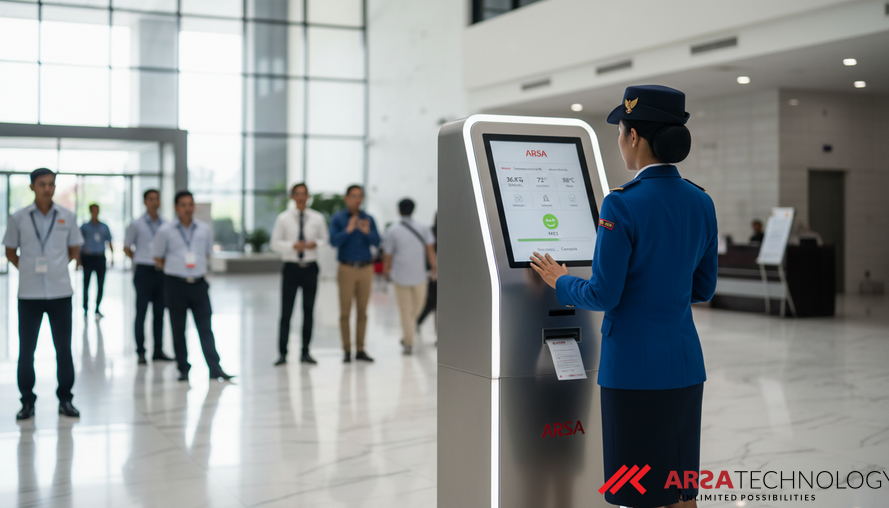
The ARSA Self-Check Health Kiosk is an AI & IoT-powered digital health station designed specifically to address the complexities of modern workplace health management. It offers a self-service, autonomous approach to vital sign measurement, capable of assessing multiple parameters in approximately 90 seconds, all without the need for medical personnel.
This innovative kiosk integrates medical-grade sensors to accurately measure critical parameters, including blood pressure monitoring, blood oxygen measurement (SpO2), and heart rate monitoring. Beyond these basic vitals, it also incorporates an advanced AI Romberg test kiosk for balance assessment, a crucial indicator for certain occupational safety roles. For secure and efficient identification, the kiosk supports face recognition identification or QR-based verification, with robust GDPR/HIPAA encryption ensuring data privacy and compliance with international data protection frameworks like the EU GDPR and Indonesia PDPA.
The Self-Check Health Kiosk overview highlights its ability to transform passive health data into actionable intelligence. All vital user data is recorded and displayed on a web-based health kiosk with dashboard and reporting, allowing occupational health directors to monitor trends, identify anomalies, and manage population health effectively. This centralized dashboard provides aggregated, de-identified analytics for comprehensive population health management, supporting proactive interventions and corporate wellness programs.
Key Features for Public Sector & Enterprise Compliance
For public sector and large enterprise environments, the ARSA Self-Check Health Kiosk offers features critical for compliance and operational excellence:
- Medical-Grade Accuracy: FDA/CE-certified sensors ensure reliable data, with ±3mmHg BP accuracy and ±0.2°C temperature precision. This adherence to international standards provides confidence in the screening results.
- Automated Pre-Shift Screening: The kiosk automates pre-shift health screening, ensuring employees are fit for duty before commencing work, which is vital for roles in critical infrastructure, logistics, or emergency services. This directly supports compliance with occupational safety standards.
- Early Detection of Employee Health Issues: By providing consistent, frequent health data, the system facilitates early detection of employee health issues, allowing for timely intervention and reducing the risk of more severe conditions. This proactive approach not only benefits employees but also significantly reduces long-term healthcare costs for the organization.
- Data Sovereignty and Security: With on-premise or hybrid cloud deployment options, organizations retain full control over their biometric and health data. AES-256 encryption, role-based access control, and audit logs with tamper detection ensure alignment with stringent security and compliance reviews, including those for sensitive government data.
- Scalability and Centralized Management: A single dashboard can manage hundreds or even thousands of kiosks across multiple sites. Centralized firmware updates and predictive maintenance minimize downtime, ensuring continuous operation.
- API Integration: The kiosk offers seamless REST API integration, allowing it to connect with existing HR systems, access control platforms, or other health management software. This flexibility ensures it fits into diverse IT ecosystems without requiring extensive overhauls.
For further insights into optimizing health management, consider reading about how to reduce occupational health costs with AI health kiosk technology.
Achieving ROI and Operational Efficiency
The financial justification for implementing an automated employee health screening for workplace compliance system is compelling. By replacing manual processes, organizations can achieve an ROI within 14-18 months, primarily through labor reallocation and increased patient throughput in clinical settings. The ability to replace 2-3 full-time equivalent (FTE) nurses per shift dedicated to routine vital checks frees up valuable medical staff to focus on critical care and more complex patient needs.
Beyond direct cost savings, the ARSA Health Kiosk contributes to:
- Reduced Absenteeism: Proactive health monitoring and early intervention lead to a healthier workforce, reducing sick days and improving overall productivity.
- Enhanced Compliance Posture: Automated, consistent data collection provides an undeniable audit trail, strengthening the organization’s position during compliance reviews (e.g., ISO 45001).
- Improved Employee Morale: Demonstrating a commitment to employee well-being through accessible, efficient health screening can boost morale and foster a positive workplace culture.
- Optimized Resource Allocation: By automating routine tasks, resources can be strategically reallocated to higher-value activities, aligning with the public sector’s mandate for efficient service delivery.
Another article, Streamlining Safety: Automated Employee Health Screening for Workplace Compliance, further details the operational benefits.
Future-Proofing Workplace Health with Data Sovereignty
In an era where data privacy is paramount, the ARSA Self-Check Health Kiosk offers robust data sovereignty options. For public sector entities, where sensitive employee data must often remain within national borders or specific secure networks, the on-premise deployment model is invaluable. This ensures that no biometric or health data leaves the organization’s infrastructure unless explicitly configured, aligning with strict data governance policies and international frameworks like GDPR, CCPA, and Indonesia PDPA. This commitment to data control fosters trust and mitigates risks associated with cloud-only solutions.
The kiosk’s capabilities extend beyond basic health checks. Its potential for integration with broader IoT ecosystems allows for a holistic approach to workplace safety and efficiency. While the focus here is on health, ARSA Technology offers a range of all ARSA products, including AI video analytics solutions like the ARSA DOOH Audience Meter (Software), demonstrating a versatile approach to intelligent operations. The underlying AI and IoT expertise ensures that the health kiosk is not just a standalone device but a component of a larger, intelligent infrastructure.
For organizations looking to further enhance their corporate wellness initiatives, exploring how an AI-powered self-service health screening kiosk can revolutionize employee health provides additional insights.
Conclusion
The adoption of automated employee health screening for workplace compliance is no longer a luxury but a strategic necessity for public sector organizations and enterprises committed to employee well-being, operational efficiency, and regulatory adherence. The ARSA Self-Check Health Kiosk provides a proven, profitable, and privacy-centric solution that addresses the core challenges of modern occupational health. By investing in this advanced AI and IoT technology, occupational health directors can significantly reduce costs, enhance compliance, and cultivate a healthier, more productive workforce.
Ready to transform your organization’s health screening protocols and achieve measurable ROI? Contact ARSA solutions team today to discuss a tailored deployment plan.
—
FAQ Section
1. How does a digital health kiosk for hospital visitor screening enhance safety?
A digital health kiosk for hospital visitor screening automates vital checks like temperature, blood pressure, and SpO2 upon entry, quickly identifying individuals who may pose a health risk. This reduces the burden on staff, minimizes human error, and provides instant, consistent data for better access control and infection prevention.
2. What are the benefits of a self-service blood pressure kiosk for clinics?
A self-service blood pressure kiosk for clinics significantly reduces patient wait times and frees up nursing staff from routine measurements, allowing them to focus on critical patient care. It provides accurate, consistent readings, integrates data directly into digital health records, and improves overall clinic efficiency and patient flow.
3. Can an AI Romberg test kiosk for balance assessment integrate with existing systems?
Yes, an AI Romberg test kiosk for balance assessment, like the ARSA Self-Check Health Kiosk, is designed with REST API integration. This allows seamless connection with existing HR platforms, occupational health systems, or other data management tools for comprehensive employee health record keeping and analysis.
4. What kind of reporting does a health kiosk with dashboard and reporting offer?
A health kiosk with dashboard and reporting provides real-time operational and safety metrics, historical analytics, and business insights. It offers aggregated, de-identified data for population health management, allowing occupational health directors to track trends, identify anomalies, and generate compliance reports efficiently.
—
Stop Guessing, Start Optimizing.
Discover how ARSA Technology drives profit through intelligent systems.