
Beyond Incidents: How to Measure Safety Performance Beyond Lagging Indicators with AI
For EHS directors in the construction industry, the traditional approach to safety measurement, heavily reliant on lagging indicators, is no longer sufficient. While metrics like Total Recordable Incident Rate (TRIR) and Lost Time Injury Frequency Rate (LTIFR) are crucial for compliance and benchmarking, they inherently tell you about failures after they’ve occurred. In 2026, the critical question for safety leaders is how to measure safety performance beyond lagging indicators to proactively prevent harm and foster a truly safe work environment.
Construction remains a high-risk industry, accounting for over 30% of all workplace fatalities globally, according to the International Labour Organization (ILO). This stark reality underscores the urgent need for a shift from reactive reporting to predictive prevention. Relying solely on past incidents means you’re always looking in the rearview mirror, missing opportunities to intervene before an accident happens. This article will guide you through building a balanced safety scorecard for EHS teams, focusing on the power of leading indicators, and how advanced AI solutions like the ARSA Basic Safety Guard (AI Box) can revolutionize your safety strategy.
Why Lagging Indicators Alone Don’t Prevent Incidents
Lagging indicators, by their very nature, are reactive. They quantify the outcomes of safety failures—injuries, fatalities, property damage. While essential for understanding historical performance and demonstrating compliance, they offer little insight into the underlying conditions that lead to incidents. A construction site might report zero injuries for a quarter, yet still harbor numerous unaddressed hazards, inconsistent PPE usage, or inadequate training. This creates a false sense of security, leaving EHS teams vulnerable to unforeseen events.
The problem with this rearview-mirror safety approach is that it only confirms that your controls have already failed. To genuinely reduce workplace injury rates and enhance overall safety, EHS professionals must adopt a proactive strategy that identifies and mitigates risks before they escalate. Research from the Campbell Institute at the National Safety Council highlights this, showing that organizations with established leading indicator programs experienced an average 77% reduction in incidence rates over a three-to-twelve-year period. This isn’t just an incremental improvement; it’s a transformative shift in how safety outcomes are shaped.
Examples of Leading Indicators for Workplace Safety in Construction
Leading indicators are forward-looking metrics that reveal the effectiveness of your safety programs and predict future performance. They focus on the actions and conditions that prevent incidents. For construction, these can include:
- Near-Miss Reporting Rate: A high volume of near-miss reports indicates a strong safety culture where workers feel comfortable identifying potential hazards without fear of blame. This is a powerful predictor of future incidents.
- Safety Training Completion Rate: Tracking the percentage of workers with up-to-date, role-specific certifications (e.g., fall protection, confined space entry, equipment operation) ensures competency readiness.
- Toolbox Talk Frequency and Quality: Regular, engaging toolbox talks tailored to daily site-specific hazards are vital for consistent risk communication.
- Hazard Identification & Close-Out Time: This measures the speed and efficiency with which identified hazards are resolved. A site that quickly closes out corrective actions demonstrates a robust safety culture.
- Behavioral Safety Observation Rate: Formal observations by supervisors and safety officers help identify at-risk behaviors (e.g., improper lifting, missing PPE) before they lead to injuries.
- PPE Compliance Rate: The percentage of workers observed correctly using required Personal Protective Equipment (PPE) is a visible metric reflecting safety discipline and the effectiveness of first-line defenses. As of 2025, OSHA mandates the proper fitting of all PPE for individual workers, emphasizing the importance of this indicator.
- Safety Audit Completion Rate: Ensures that planned audits are conducted on schedule, preventing blind spots where risks might go undetected.
- Permit-to-Work Compliance: For high-risk activities, adherence to permit systems ensures necessary precautions are in place, significantly reducing the likelihood of serious incidents.
These examples of leading indicators for workplace safety provide EHS teams with a real-time pulse on site safety health, enabling proactive management rather than reactive damage control.
Leveraging AI for Proactive Safety Monitoring
Manually tracking safety observations and corrective action closure across a dynamic construction site can be overwhelming. This is where AI-powered video analytics becomes a game-changer. ARSA Technology, with its 7+ years of experience and partnerships with NVIDIA and Intel, offers solutions specifically designed for demanding industrial environments.
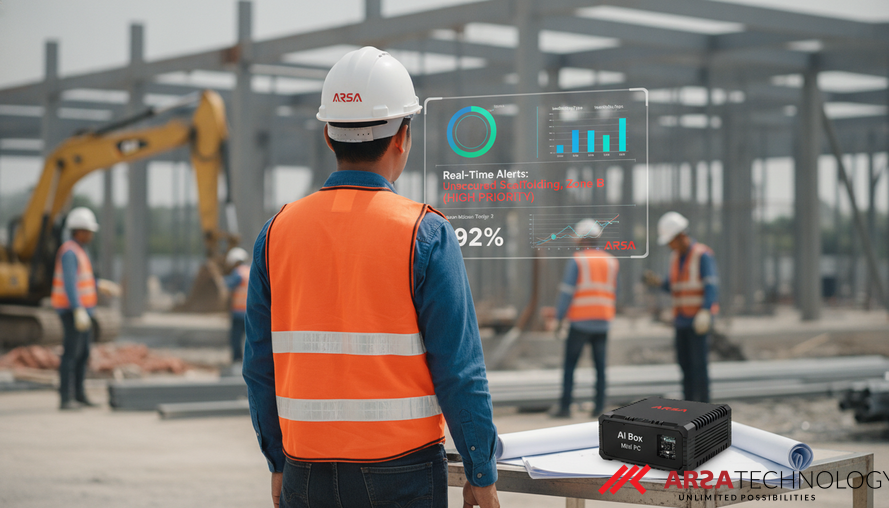
The ARSA Basic Safety Guard (AI Box) is an edge computing solution that transforms existing CCTV cameras into intelligent safety sensors. It provides real-time monitoring and alerts for critical safety parameters without relying on cloud connectivity, ensuring data privacy and low latency. This plug-and-play system can be set up in as little as 5 minutes, integrating seamlessly with your current ONVIF and RTSP compatible cameras.
Key functions of the ARSA Basic Safety Guard include:
- PPE detection: Automatically identifies if workers are wearing required PPE such as hard hats, safety vests, and masks.
- Restricted area monitoring: Detects unauthorized intrusions into hazardous zones.
- Real-time alerts: Instantly notifies EHS teams of safety violations or incidents.
- Safety compliance reporting: Automates data collection for OSHA, EU-OSHA, and ISO 45001 reporting, significantly reducing manual effort.
By deploying an AI Box Series, EHS directors can gain unprecedented visibility into site conditions. For instance, the Mini PC model can process up to 3 camera streams, ideal for distributed deployments, while the Server model handles up to 30 cameras for centralized monitoring. This edge AI capability ensures that video streams are analyzed on-device and do not leave your network unless explicitly configured, providing full control over data.
Building a Balanced Safety Scorecard for EHS Teams
A truly effective safety program integrates both leading and lagging indicators into a comprehensive scorecard. This balanced approach provides a holistic view of safety performance, allowing EHS teams to understand past outcomes while actively shaping future results.
Here’s how to approach it:
1. Define Your Metrics: Select a mix of leading and lagging indicators relevant to your construction operations. Focus on metrics that are actionable and measurable.
2. Set Clear Targets: Establish realistic but ambitious targets for both types of indicators. For example, aim for a 10% increase in near-miss reports or a 95% PPE compliance rate.
3. Implement Data Collection: Utilize technology like the ARSA Basic Safety Guard for automated data capture on leading indicators like PPE compliance and restricted area monitoring. For other metrics, ensure robust manual reporting systems are in place. For more complex data integration, consider ARSA Custom Web Application services.
4. Regular Review and Analysis: Conduct weekly or monthly reviews of your safety scorecard. Analyze trends, identify areas of concern, and celebrate successes. This consistent review is vital for tracking safety observations and corrective action closure.
5. Feedback Loop and Continuous Improvement: Use the insights from your scorecard to refine safety procedures, update training, and implement new controls. This iterative process is key to continuous improvement.
The 2026 ABC Health and Safety Performance Report (HSPR) highlights that contractors deploying AI in safety programs report 28% reductions in TRIR and 34% reductions in DART. This demonstrates the tangible business outcomes and ROI of integrating advanced technology into your safety management system. Automating safety inspections and monitoring with AI not only helps lower workers’ compensation insurance premiums but also significantly contributes to a safer, more productive workforce. For further insights into enhancing workplace safety with AI, read our blog post on How to Automate PPE Compliance Monitoring with AI for Enhanced Workplace Safety.
Conclusion
The imperative to move beyond traditional, reactive safety metrics is clear. For EHS directors, understanding how to measure safety performance beyond lagging indicators is not just about compliance; it’s about creating a culture of proactive safety that protects workers and enhances operational efficiency. By embracing leading indicators and leveraging innovative AI solutions like the ARSA Basic Safety Guard, construction companies can transform their safety programs from merely reporting incidents to actively preventing them. This strategic shift leads to reduced injury rates, streamlined reporting, and a stronger, more resilient workforce.
Ready to transform your construction site safety? Contact ARSA Technology’s solutions team today to learn how our AI products can help you build a safer, more efficient future. For a quick start on deploying on-premise AI safety analytics, refer to our guide on Deploying On-premise AI Safety Analytics with Full Data Sovereignty in 5 Minutes. You can also explore What Is PPE Detection? How AI Video Analytics Software Delivers Smart Safety Monitoring for more details.
FAQ
What are the key differences between leading and lagging safety indicators?
Lagging indicators measure outcomes that have already occurred, such as injury rates or fatalities, providing a historical view of safety performance. Leading indicators, conversely, are proactive measures that predict future safety outcomes by tracking activities and conditions designed to prevent incidents, like PPE compliance rates or near-miss reports.
Why is it crucial for construction EHS teams to focus on leading indicators in 2026?
In 2026, with increasing regulatory scrutiny and the high-risk nature of construction, focusing on leading indicators is crucial because why lagging indicators alone don’t prevent incidents. Leading indicators enable EHS teams to identify and address potential hazards before they result in injuries, fostering a proactive safety culture and significantly reducing accident rates.
How can AI technology assist in tracking safety observations and corrective action closure?
AI technology, such as ARSA’s Basic Safety Guard (AI Box), can automate the monitoring of safety observations like PPE compliance and restricted area intrusions. It provides real-time alerts for violations, automates data collection for reporting, and helps streamline the process of tracking safety observations and corrective action closure, making it easier to identify trends and ensure timely resolution of hazards.
What are the business benefits of building a balanced safety scorecard for EHS teams?
Building a balanced safety scorecard for EHS teams offers numerous business benefits, including a significant reduction in workplace injury rates, automation of compliance reporting (e.g., OSHA, EU-OSHA, ISO 45001), lower workers’ compensation insurance premiums, and the elimination of manual safety inspections. This leads to improved operational efficiency, enhanced worker morale, and a stronger safety culture.
Stop Guessing, Start Optimizing.
Discover how ARSA Technology drives profit through intelligent systems.