
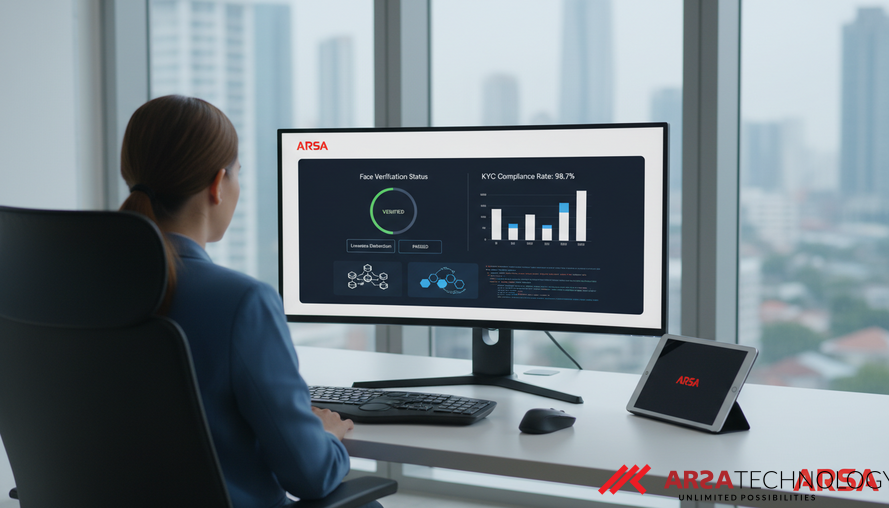

Cloud API vs. On-Premise SDK: Which 1:N face recognition against database Approach Fits Your Stack?
In the rapidly evolving landscape of Web3, crypto exchanges, and decentralized finance (DeFi), robust identity verification is no longer a luxury—it’s a critical necessity. Compliance engineers face the challenge of implementing secure, scalable, and user-friendly Know Your Customer (KYC) processes. A key decision in this journey is choosing between a cloud-based face recognition API for crypto exchange and Web3 KYC or an on-premise SDK. This guide will help you navigate these options, focusing on the ARSA Face Recognition & Liveness API, to determine which deployment model best aligns with your operational and compliance requirements.
The demand for sophisticated identity solutions in the crypto space is driven by stringent regulatory frameworks like PSD2, eIDAS, and FinCEN, all aimed at combating fraud and money laundering. As platforms expand, the need for efficient onboarding and continuous security becomes paramount. ARSA Technology offers both cloud API and on-premise SDK solutions, each designed to deliver enterprise-grade face recognition and liveness detection with 99.67% accuracy.
Understanding Your Core Needs: Cloud API vs. On-Premise SDK
The choice between a cloud API and an on-premise SDK for face recognition hinges on several factors, including data sovereignty, infrastructure control, deployment speed, and ongoing maintenance. Both approaches offer powerful capabilities for 1:N face recognition against database, 1:1 face verification, and advanced liveness detection, but they cater to different operational philosophies.
The Agility of a Cloud-Based Face Recognition API for Crypto Exchange and Web3 KYC
For many crypto exchanges and Web3 platforms, speed to market and minimal infrastructure overhead are paramount. This is where a cloud-based solution like the ARSA Face Recognition & Liveness API shines. It provides a complete identity layer, not just a simple comparison endpoint, allowing you to launch face login in days, not months.
With a cloud API, you leverage ARSA’s managed infrastructure, meaning you don’t need to worry about server provisioning, maintenance, or scaling. This significantly reduces your IT burden and allows your team to focus on core product development. The setup is remarkably fast, enabling your first API call in under 5 minutes. This plug-and-play nature is ideal for rapid SaaS prototyping and agile development cycles.
Key features of the ARSA Face Recognition & Liveness API include:
- 1:N Face Recognition Against Database: Identify users against a secure face database, crucial for access control and fraud prevention.
- 1:1 Face Verification: Confirm a user’s identity by comparing two faces, perfect for login and step-up authentication.
- Face Detection with Bounding Boxes: Accurately locate faces within images and videos.
- Passive Liveness Detection: Detects presentation attacks without requiring user interaction.
- Active Liveness with Head Movement Challenges: Engages users in simple actions to prevent sophisticated spoofing attempts, compliant with ISO 30107-3.
- Age Estimation, Gender Classification, and Expression Detection: Provides additional demographic and behavioral insights (neutral, happy, sad, surprise, anger).
- Face Database Management: Easily enroll, update, and remove identities, organizing data by application or tenant.
- Per-Account Isolated Databases: Ensures robust data privacy and tenant separation, a critical aspect for multi-client platforms.
The ARSA Face Recognition API supports JPEG/PNG image formats and MP4/WebM video for active liveness, offering flexibility in integration. Developers can quickly get started with cURL, Python, and JavaScript code examples provided in the Face Recognition API documentation. To further enhance accuracy, the system supports multiple images per face ID.
From a business perspective, the cloud API offers compelling outcomes. You pay only for what you use, with transparent Face API pricing plans ranging from a Basic free 30-day trial (100 calls/month, 100 face IDs, no credit card) to enterprise-grade Mega plans ($1,290/mo for 500,000 calls and 500,000 face IDs). All features are included on every plan, ensuring no hidden limitations, and billing is handled via PayPal monthly subscriptions. A developer dashboard with usage analytics provides clear oversight of your consumption. This model helps crypto exchanges and Web3 platforms meet stringent KYC and AML obligations under frameworks like PSD2, eIDAS, and FinCEN, while preventing presentation attacks and synthetic identity fraud. For more insights on maximizing ROI, consider reading our article on Maximizing ROI with a Robust Face Recognition API for Crypto Exchange and Web3 KYC.
When On-Premise SDK is the Preferred Choice for KYC Face Recognition for Crypto Exchange
While cloud APIs offer unparalleled agility, certain organizations, particularly those operating in highly regulated sectors or dealing with extremely sensitive data, may require the ultimate level of control. This is where an on-premise SDK becomes indispensable. The ARSA Face Recognition & Liveness SDK provides the same advanced AI capabilities as the cloud API but is deployed entirely within your own infrastructure.
For environments demanding air-gapped systems, zero data exposure, or strict adherence to local data sovereignty laws (beyond international standards like GDPR), the SDK offers full control over data, security, and operations. No biometric data leaves your infrastructure, and you define all retention and access policies, aligning perfectly with internal security and compliance reviews. This is often the case for critical infrastructure operators or government entities.
The SDK includes a built-in web dashboard for system operation and maintenance, API call logs for diagnostics, an internal sandbox for safe endpoint testing, and comprehensive documentation for managing API keys and configuring system behavior. While requiring more initial setup and ongoing IT management, the on-premise SDK provides an unmatched level of data control and customization for organizations with the necessary infrastructure.
For a deeper dive into the on-premise vs. cloud decision, especially in a European context, our article Choosing the Best Face Recognition API for KYC and Digital Onboarding in Europe: Cloud vs. On-Premise offers valuable perspectives.
Securing Web3 Onboarding with Face Liveness API for Crypto Onboarding
Regardless of your deployment choice, the core of secure crypto onboarding lies in robust liveness detection. Spoofing attacks, where fraudsters use photos, videos, or even 3D masks to bypass identity checks, are a persistent threat. A reliable face liveness API for crypto onboarding is essential to prevent these presentation attacks and synthetic identity fraud.
ARSA’s solutions incorporate both passive and active liveness detection. Passive liveness works seamlessly in the background, analyzing subtle cues to determine if a live person is present. Active liveness, with its challenge-response mechanism (e.g., head movements), adds an extra layer of security, making it extremely difficult for fraudsters to impersonate legitimate users. This dual approach ensures high accuracy and resilience against evolving fraud techniques, crucial for any face verification API for Web3 wallet.
The Role of Face API for DeFi Compliance
Decentralized Finance (DeFi) platforms, while aiming for decentralization, are increasingly facing pressure to integrate compliance measures. A robust face API for DeFi compliance allows these platforms to verify user identities without compromising the core principles of privacy and user control. By integrating a secure face recognition solution, DeFi protocols can demonstrate a commitment to regulatory standards, attracting institutional investors and fostering broader adoption. The ability to perform KYC checks, even in a pseudonymized environment, adds a layer of trust and accountability that is vital for the long-term sustainability of the DeFi ecosystem. Our blog post, Powering Web3 Onboarding: The Essential Face Recognition API for Crypto Exchange KYC, further elaborates on this critical need.
Why ARSA Technology is Your Partner in Web3 Identity
ARSA Technology brings over seven years of deep engineering expertise to the table, delivering production-ready AI and IoT systems for security, operations, and decision intelligence. Our commitment to accuracy, scalability, privacy, and operational reliability is evident in every product. Whether you choose the agile Face Recognition & Liveness overview API or the comprehensive on-premise SDK, you benefit from a solution engineered to meet the highest standards.
Our solutions are trusted by enterprises and public institutions, reflecting our proven capability in deploying mission-critical systems. We understand the unique challenges of the crypto and Web3 space, from the need for rapid onboarding to the imperative of stringent compliance. Our flexible deployment models ensure that you retain full control over your data, privacy, and performance.
Conclusion
Choosing the right identity verification solution for your crypto exchange or Web3 platform is a strategic decision that impacts security, compliance, and user experience. While an on-premise SDK offers ultimate data control for highly regulated environments, the ARSA Face Recognition & Liveness API provides unparalleled agility, scalability, and ease of integration for most platforms. With its comprehensive features, robust liveness detection, and flexible pricing, it empowers compliance engineers to effectively manage KYC face recognition for crypto exchange and secure Web3 onboarding.
Ready to enhance your platform’s security and streamline your KYC processes? Contact ARSA solutions team today to discuss your specific needs or create a free Face API account to experience the power of ARSA’s face recognition technology.
FAQ
What is the primary benefit of using a cloud-based face recognition API for crypto exchange and Web3 KYC?
The primary benefit is rapid deployment and minimal infrastructure management. A cloud API allows you to integrate advanced face recognition and liveness detection capabilities into your platform quickly, often within minutes, without needing to provision or maintain your own servers. This reduces IT overhead and accelerates time to market for secure Web3 onboarding.
How does ARSA’s face liveness API for crypto onboarding prevent fraud?
ARSA’s face liveness API employs both passive and active liveness detection. Passive liveness analyzes subtle cues to verify a live person without user interaction, while active liveness uses challenge-response mechanisms (like head movements) to detect sophisticated spoofing attempts, such as photos, videos, or 3D masks, ensuring robust anti-spoofing protection.
Can ARSA’s face verification API for Web3 wallet be scaled to handle high user volumes?
Yes, the ARSA Face Recognition & Liveness API is designed for scalability. Its cloud-based infrastructure can handle varying user volumes, with pricing tiers (from Basic to Mega) that accommodate up to 500,000 API calls per month and support large face databases, making it suitable for growing Web3 wallets and crypto exchanges.
What compliance standards does ARSA’s face API for DeFi compliance help meet?
ARSA’s face API helps DeFi platforms meet critical regulatory obligations under international frameworks such as PSD2, eIDAS, and FinCEN. By providing secure identity verification and liveness detection, it assists in combating money laundering, preventing fraud, and building trust within the decentralized finance ecosystem.
Stop Guessing, Start Optimizing.
Discover how ARSA Technology drives profit through intelligent systems.