
Cloud API vs On-Premise SDK: Which PPE Detection Approach Fits Your Stack for AI Restricted Area Monitoring in Oil and Gas Facilities?
For EHS Directors in the demanding oil and gas and mining sectors, ensuring worker safety and operational integrity within hazardous zones is paramount. The strategic decision to implement advanced safety technology, particularly for AI restricted area monitoring for oil and gas facilities, often boils down to a critical choice: a cloud-based API or an on-premise SDK. Both offer distinct advantages, but understanding which deployment model aligns best with your organization’s infrastructure, security protocols, and compliance needs is key to maximizing ROI and achieving robust safety outcomes.
Traditional manual surveillance in these environments is prone to gaps, making continuous monitoring of vast, complex sites challenging. Vision AI systems are transforming this by providing automated detection of unauthorized personnel and safety violations, minimizing risks associated with human error and limited visibility. As noted by AppsTek Corp, AI for industrial safety solutions enable real-time alerts with contextual data, significantly reducing manual monitoring efforts and improving incident response times in critical areas like drilling sites and heavy equipment zones.
The Rise of AI in Industrial Safety: A 2026 Perspective
The global industrial landscape, especially in oil and gas and mining, is rapidly adopting AI-driven solutions to enhance safety and operational efficiency. By 2026, energy companies face increasing challenges in securing remote and high-risk areas. AI systems, integrating computer vision and advanced sensors, continuously monitor surroundings, detecting everything from PPE violations to ground instability, and triggering alerts if workers enter restricted areas or approach heavy machinery too closely. This shift from reactive safety responses to proactive and predictive approaches is a significant cultural change, driven by the capabilities of artificial intelligence.
Cloud API: Agility and Rapid Deployment
Cloud-based AI APIs offer a compelling option for organizations seeking quick integration and minimal infrastructure overhead.
- Fast Setup: Typically, a cloud API can be integrated into existing applications or systems with relatively little development effort, often within minutes for initial calls.
- Managed Infrastructure: The vendor manages all the underlying hardware and software, reducing the burden on your internal IT teams.
- Scalability: Cloud services are designed for elastic scalability, easily handling fluctuating workloads without requiring you to provision additional compute resources.
- Accessibility: Data and insights can be accessed from anywhere with an internet connection, facilitating remote monitoring and distributed teams.
However, for industries like oil and gas and mining, cloud solutions introduce considerations around data sovereignty, latency, and continuous connectivity. Transmitting sensitive video streams and operational data to external cloud servers can raise privacy concerns and may not meet strict regulatory requirements for data residency. Furthermore, remote or air-gapped facilities may lack the reliable internet access necessary for consistent cloud API performance.
On-Premise SDK: Control, Security, and Compliance
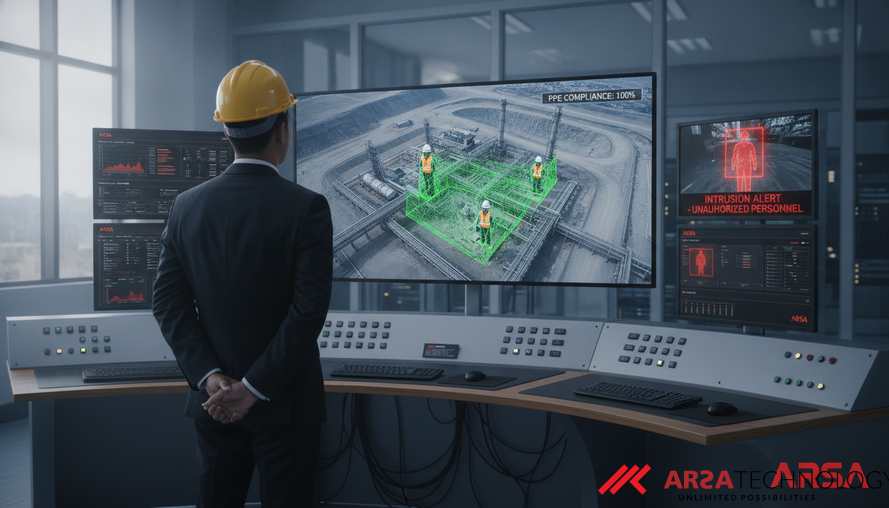
For organizations where data ownership, security, and offline operation are non-negotiable, an on-premise SDK (Software Development Kit) provides the ultimate control. ARSA Technology’s AI Video Analytics Software, particularly the ARSA Basic Safety Guard module, exemplifies this approach. This solution is deployed directly on your existing servers or edge infrastructure, offering a robust AI restricted area monitoring for oil and gas facilities capability.
- Full Data Ownership: All video streams, inference results, and metadata remain entirely within your infrastructure. This is crucial for meeting stringent data privacy regulations (e.g., GDPR, local data protection acts) and internal security policies.
- No Cloud Dependency: The system operates without an internet connection for core functions, making it ideal for remote sites or environments requiring air-gapped systems. This ensures uninterrupted safety zone monitoring without internet.
- Low Latency: Processing occurs at the edge or on local servers, minimizing the time between detection and alert, which is critical for real-time safety interventions.
- Customization and Integration: An SDK provides greater flexibility for custom integrations with existing SCADA systems, proprietary dashboards, and alerting mechanisms via a Custom Web Application or REST API.
- Enhanced Security: With no external data transfer, the risk of data breaches or unauthorized access via third-party cloud services is eliminated. This is vital for an intrusion detection system for hazardous zones.
In mining, for instance, environments are characterized by dust, noise, and poor lighting, which significantly limit visibility and worker awareness. Traditional alarms can go unnoticed due to noise protection. AI-powered systems deployed on-premise can bridge this gap by identifying personnel even in low-visibility conditions and providing clear, localized alerts to operators, thereby reducing fatal collisions between vehicles and workers, a leading cause of mining accidents worldwide (Blaxtair).
ARSA Basic Safety Guard (Software): Your On-Premise Advantage
ARSA Technology’s ARSA Basic Safety Guard (Software) is engineered specifically for organizations demanding maximum control and reliability. As an on-premise AI solution, it transforms existing CCTV streams into real-time operational intelligence without cloud dependency or vendor lock-in. This software-only platform is hardware-agnostic, supporting deployment on NVIDIA Jetson and x86 inference hardware, and is horizontally scalable by design.
Key functionalities include:
- PPE Detection: Real-time monitoring for compliance with mandatory PPE (helmets, vests, masks), generating immediate alerts for violations.
- Restricted Area Monitoring: Defining virtual geofences within your facility to detect unauthorized entry into hazardous zones, triggering automated restricted zone alerts edge computing.
- Safety Violation Alerts: Instant notifications for unsafe behaviors or conditions.
- Compliance Reporting: Automated generation of audit-ready reports and event logs, simplifying adherence to standards like ISO 45001 and OSHA.
- Centralized Safety Monitoring: Analyze multiple camera streams from a central location, providing comprehensive AI perimeter protection for mining sites and oil and gas facilities.
This approach offers significant business outcomes, including reduced accidents, improved compliance audit readiness, and the ability to integrate seamlessly with existing IT and SCADA infrastructure. For EHS Directors, this means a robust, secure, and fully controllable safety monitoring system that delivers measurable ROI, often with visible returns within the first months of deployment. To learn more about how ARSA’s solutions can enhance your safety protocols, consider reading “The EHS Director’s Guide to AI Restricted Area Monitoring for Oil and Gas Facilities” and “What to Evaluate When Choosing a PPE Detection Provider for AI Restricted Area Monitoring in Oil and Gas Facilities” from our blog.
Making the Right Choice for Your Operations
The decision between a Cloud API and an On-Premise SDK for AI restricted area monitoring for oil and gas facilities hinges on your specific operational context. If rapid prototyping, minimal IT involvement, and broad accessibility are priorities, a cloud API might be suitable. However, for mission-critical environments with strict data sovereignty, security, and offline operation requirements, an on-premise SDK like ARSA Basic Safety Guard (Software) offers unparalleled advantages.
ARSA Technology, with over 7 years of experience and partnerships with industry leaders like NVIDIA and Intel, specializes in delivering production-ready AI solutions that work in the real world. Our on-premise and edge computing offerings ensure that your critical safety data remains secure and under your control, supporting your compliance needs and enhancing operational safety without compromise.
FAQ
What are the primary benefits of an on-premise SDK for AI restricted area monitoring for oil and gas facilities?
An on-premise SDK offers full data ownership, operates without cloud dependency, provides low-latency processing, allows for deep customization and integration with existing systems, and enhances security by keeping all data within your infrastructure. This is crucial for sensitive environments and regulatory compliance.
How does ARSA Basic Safety Guard (Software) enhance safety zone monitoring without internet?
ARSA Basic Safety Guard (Software) is designed for fully on-premise deployment, meaning all AI processing and data analytics occur locally on your servers or edge devices. This eliminates the need for an internet connection for core operations, ensuring continuous safety zone monitoring without internet even in remote or air-gapped facilities.
Can ARSA’s AI solutions provide effective intrusion detection system for hazardous zones in mining sites?
Yes, ARSA’s AI Video Analytics Software, including the Basic Safety Guard module, is highly effective as an intrusion detection system for hazardous zones. It can define virtual boundaries and trigger immediate automated restricted zone alerts edge computing upon detecting unauthorized entry, ensuring robust AI perimeter protection for mining sites and other industrial facilities.
What kind of compliance reporting does ARSA Basic Safety Guard offer?
ARSA Basic Safety Guard provides automated generation of detailed safety reports and event logs from real-time video analytics data. These reports can include PPE compliance rates, restricted area breach incidents, and other safety violations, aiding EHS Directors in demonstrating adherence to internal policies and external regulatory frameworks.
Ready to secure your critical operations with proven AI technology? Explore all ARSA products or contact our solutions team today to discuss how ARSA Basic Safety Guard (Software) can be tailored to your specific needs.
Stop Guessing, Start Optimizing.
Discover how ARSA Technology drives profit through intelligent systems.